 Sign up with Google
 Sign in with Zoho

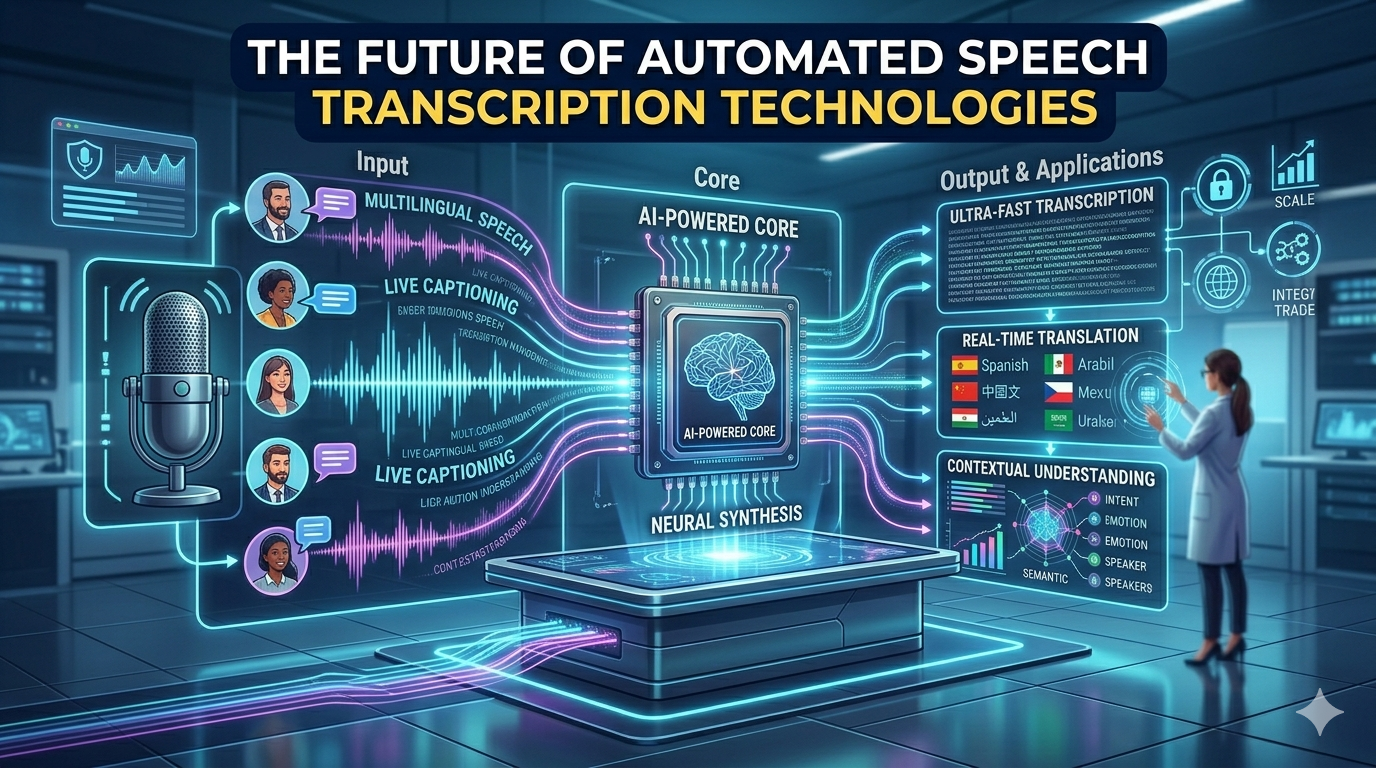
As artificial intelligence continues to evolve, automated speech transcription technologies are becoming more sophisticated, scalable, and industry-specific. From customer support interactions and healthcare documentation to multilingual AI systems and media production, transcription technologies are transforming the way organizations process and utilize spoken data. Businesses increasingly rely on accurate speech-to-text systems to improve operational efficiency, train AI models, and unlock actionable insights from audio content.
At Annotera, we recognize that the future of automated speech transcription lies in the combination of advanced AI, high-quality training data, and human-in-the-loop validation. As a trusted data annotation company, we help enterprises build reliable AI-driven transcription systems through scalable annotation and speech data services.
The Growing Importance of Automated Speech Transcription
Speech transcription technology converts spoken language into written text using automatic speech recognition (ASR) systems powered by machine learning and natural language processing (NLP). With the rapid increase in digital audio content, transcription tools are now essential for organizations handling large volumes of conversations, interviews, meetings, podcasts, and multilingual voice interactions.
The demand for automated transcription has accelerated due to:
- Expansion of voice-enabled technologies
- Increased adoption of virtual assistants
- Growth of remote communication platforms
- Rising demand for accessible digital content
- AI training requirements for speech-based applications
AI and Deep Learning Will Drive Future Advancements
The future of speech transcription technologies is closely tied to advancements in deep learning models. Traditional rule-based systems struggled with accents, overlapping speech, and noisy audio environments. Today’s AI-powered systems use neural networks and transformer architectures to understand language patterns more effectively.
Future transcription systems will offer:
Context-Aware Transcription
Next-generation models will better understand sentence context, intent, and speaker relationships. Instead of simply converting words into text, AI systems will interpret meaning more accurately.
For example, future systems will distinguish between similar-sounding words based on context, significantly reducing transcription errors.
Real-Time Multilingual Processing
Businesses increasingly operate across global markets. Future transcription systems will support seamless multilingual transcription and live translation with higher precision.
AI models trained on region-specific datasets will improve recognition for dialects, accents, and mixed-language conversations.
Improved Noise Reduction
Background noise remains one of the biggest challenges in automated transcription. Emerging AI models will use advanced audio separation and enhancement technologies to isolate speech more effectively in noisy environments such as call centers, hospitals, or public spaces.
This progress depends heavily on high-quality labeled audio datasets provided by experienced audio annotation company providers like Annotera.
Human-in-the-Loop Systems Will Remain Essential
Despite rapid automation, fully autonomous transcription systems still face challenges involving technical jargon, emotional tone, overlapping conversations, and regional speech variations.
The future will increasingly rely on hybrid human-in-the-loop workflows where AI performs initial transcription and human reviewers validate, correct, and optimize outputs.
Human reviewers help:
- Correct contextual errors
- Improve speaker diarization
- Validate timestamps
- Handle industry-specific terminology
- Improve model retraining datasets
This approach ensures higher transcription quality while continuously improving AI model performance over time.
Organizations seeking scalable AI development often partner with providers specializing in data annotation outsourcing to access skilled linguistic experts and annotation teams without building in-house infrastructure.
Edge AI and On-Device Transcription Will Increase
Privacy concerns and latency issues are driving the development of edge AI transcription systems that operate directly on user devices instead of cloud servers.
Future devices such as smartphones, wearable devices, and automotive systems will process speech locally, enabling:
- Faster response times
- Enhanced privacy protection
- Reduced internet dependency
- Lower operational costs
This trend will be especially important in industries handling sensitive information such as healthcare, banking, and government services.
However, edge AI models require optimized training datasets and lightweight architectures to maintain performance without excessive computational demands.
Emotion and Intent Recognition Will Become More Advanced
Future transcription technologies will go beyond simple text conversion by analyzing vocal tone, emotion, and intent.
AI systems will increasingly detect:
- Customer frustration
- Emotional stress
- Satisfaction levels
- Urgency indicators
- Behavioral patterns
This advancement will significantly improve applications in customer support, mental health monitoring, virtual assistants, and conversational AI systems.
Training these models requires accurately labeled emotional speech datasets, making professional annotation services even more important for AI development.
As an experienced data annotation company, Annotera supports the development of advanced conversational AI through scalable audio labeling and speech annotation workflows.
Data Quality Will Define AI Performance
The future success of automated transcription technologies depends less on algorithms alone and more on the quality of training data.
Poor-quality audio datasets can lead to:
- Biased transcription outputs
- Accent recognition failures
- Inaccurate multilingual processing
- Reduced model reliability
To address these challenges, AI developers increasingly rely on expert annotation providers for:
- Audio segmentation
- Speech labeling
- Speaker identification
- Timestamp annotation
- Accent and dialect tagging
- Noise classification
High-quality training data enables AI systems to generalize effectively across real-world scenarios.
This growing demand is driving increased adoption of data annotation outsourcing and specialized speech dataset preparation services worldwide.
The Role of Ethical AI in Speech Transcription
As transcription technologies become more widespread, ethical AI practices will become increasingly important. Organizations must ensure that speech AI systems are fair, unbiased, and privacy compliant.
Future regulations may require:
- Transparent AI training processes
- Consent-based audio collection
- Bias testing across demographics
- Secure handling of sensitive recordings
Responsible AI development requires diverse datasets representing different languages, accents, age groups, and communication styles.
Professional annotation providers can help organizations build inclusive datasets that reduce algorithmic bias and improve overall transcription fairness.
Conclusion
Automated speech transcription technologies are entering a new era driven by AI innovation, multilingual capabilities, real-time processing, and advanced contextual understanding. As businesses continue adopting voice-driven applications, the need for accurate, scalable, and industry-specific transcription systems will only increase.
However, the future of speech transcription depends heavily on the availability of high-quality annotated audio datasets and expert human validation. AI models can only perform effectively when trained on diverse, accurately labeled data.
At Annotera, we help organizations build reliable speech AI systems through expert annotation services, scalable workforce support, and customized data solutions. As a trusted audio annotation company and provider of audio annotation outsourcing services, Annotera enables businesses to develop future-ready automated transcription technologies with higher accuracy, efficiency, and scalability.