 Sign up with Google
 Sign in with Zoho
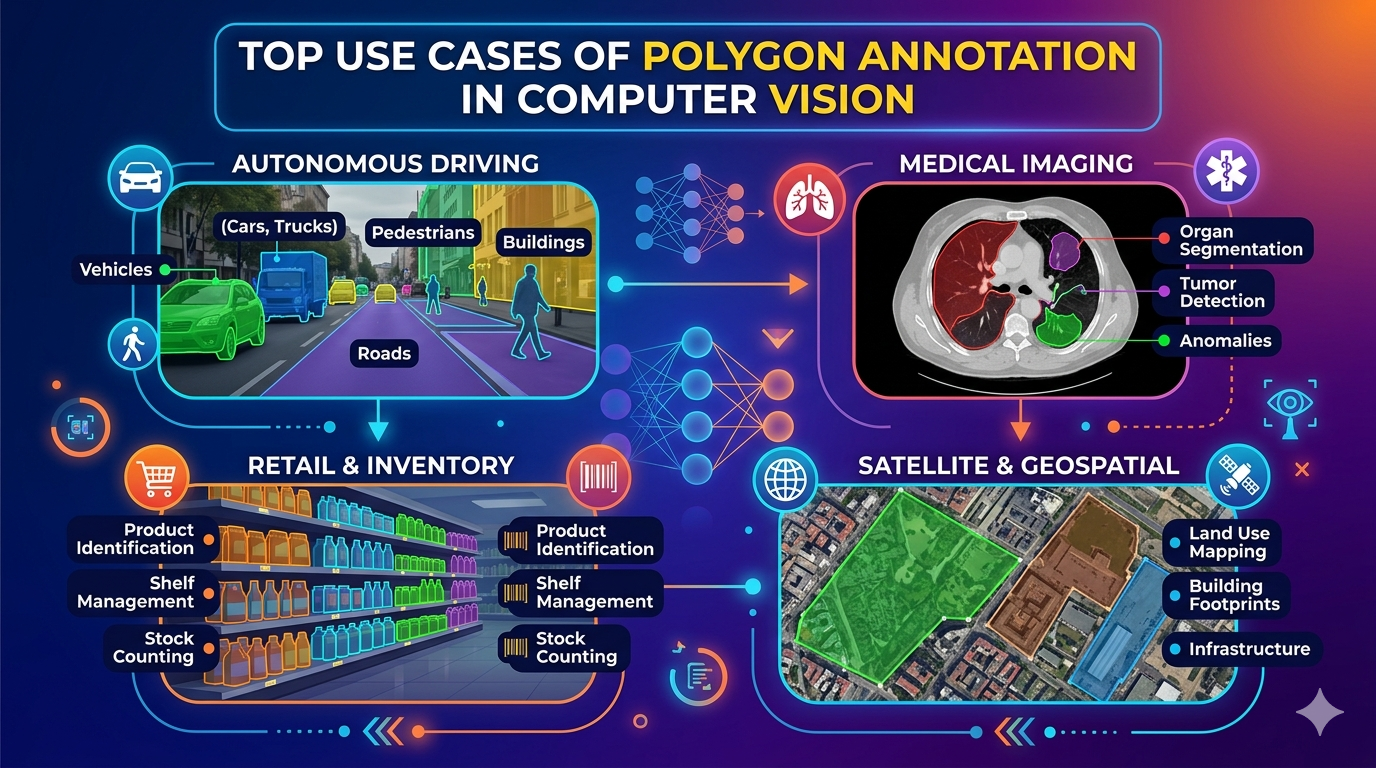
In the rapidly evolving world of artificial intelligence, data quality directly shapes model performance. Among the many labeling techniques used in computer vision, polygon annotation has emerged as one of the most precise and versatile methods. Unlike simple bounding boxes, polygon annotation traces the exact contours of an object using multiple connected points, making it ideal for complex and irregular shapes.
For AI teams building advanced vision models, choosing the right annotation method can significantly impact accuracy, efficiency, and deployment success. As a trusted data annotation company and image annotation company, Annotera helps businesses leverage high-precision polygon labeling to train reliable computer vision systems across industries.
This article explores the top use cases of polygon annotation in computer vision and why organizations increasingly prefer data annotation outsourcing and image annotation outsourcing for these demanding projects.
What Is Polygon Annotation?
Polygon annotation is a labeling method where annotators create a closed shape around an object by placing multiple points along its boundary. This approach captures the exact edges of objects far more accurately than rectangular boxes.
It is widely used in segmentation tasks where pixel-level precision is required, especially for irregular objects such as roads, organs, crops, buildings, and machinery. This precision is especially important in models built for semantic and instance segmentation.
Why Polygon Annotation Matters in Computer Vision
Modern computer vision models depend on highly detailed training datasets. Polygon annotation improves model learning by minimizing background noise and preserving object shape information. This leads to better segmentation accuracy, stronger edge detection, and more reliable classification outcomes.
For businesses deploying AI in production, this level of accuracy often becomes a competitive advantage.
1. Autonomous Vehicles and Traffic Scene Understanding
One of the most important use cases of polygon annotation is in autonomous driving systems.
Self-driving vehicles must detect and interpret complex environments that include:
- pedestrians
- vehicles
- cyclists
- traffic signs
- road lanes
- sidewalks
- obstacles
Since many of these objects have irregular shapes and may overlap, polygon annotation enables precise segmentation that helps the AI distinguish between adjacent objects.
For example, separating a pedestrian from a bicycle or accurately outlining lane boundaries requires more than a bounding box. Polygon labeling provides the exact shape information needed for safer navigation systems.
2. Medical Imaging and Diagnostics
Healthcare is another domain where polygon annotation plays a critical role.
Medical AI applications require highly accurate segmentation of structures such as:
- tumors
- organs
- blood vessels
- lesions
- bones
- tissue regions
In MRI scans, CT images, and X-rays, even small boundary inaccuracies can affect diagnosis quality. Polygon annotation allows precise outlining of anatomical structures, enabling AI models to support radiologists and clinicians with higher confidence.
This is one of the most demanding use cases where organizations often rely on a specialized image annotation outsourcing partner like Annotera for consistent, clinically accurate labeling workflows.
3. Agriculture and Precision Farming
Computer vision is transforming agriculture through drone imagery and satellite-based crop monitoring.
Polygon annotation is extensively used to identify and segment:
- crop boundaries
- diseased leaves
- fruit clusters
- irrigation zones
Because plants and crop sections rarely follow regular geometric shapes, polygon labeling helps models detect subtle visual differences with much greater precision.
AI systems trained with polygon-labeled agricultural data can support yield prediction, disease detection, and resource optimization, making this a high-value use case for agritech companies.
4. Satellite and Geospatial Image Analysis
Remote sensing applications rely heavily on polygon annotation.
In satellite and aerial imagery, AI models often need to segment:
- buildings
- roads
- land parcels
- water bodies
- forests
- infrastructure assets
These objects usually have complex and non-uniform boundaries that simple boxes cannot accurately represent.
Polygon annotation helps geospatial AI models deliver more precise land classification and urban planning insights. This is particularly useful for smart city development, disaster management, and environmental monitoring.
5. Retail and E-commerce Product Recognition
Retail automation systems increasingly use computer vision for product recognition and inventory management.
Polygon annotation is useful for:
- shelf item segmentation
- product boundary detection
- overlapping object recognition
- automated checkout systems
In crowded retail environments, products often overlap or appear in irregular arrangements. Polygon labeling helps AI models distinguish one product from another with better edge awareness.
For e-commerce, this also improves visual search and recommendation engines by enabling more accurate product isolation.
6. Manufacturing and Quality Inspection
Industrial AI systems use polygon annotation for defect detection and visual inspection.
Common use cases include:
- surface crack detection
- component segmentation
- defect localization
- machine part recognition
Manufacturing defects often appear as highly irregular shapes, making polygon annotation the preferred method for accurate training data.
As a professional data annotation company, Annotera supports manufacturers with scalable data annotation outsourcing solutions to accelerate defect detection workflows and improve production quality.
7. Robotics and Warehouse Automation
Warehouse robots and industrial automation systems rely on computer vision to identify objects in real time.
Polygon annotation helps in labeling:
- packages
- pallets
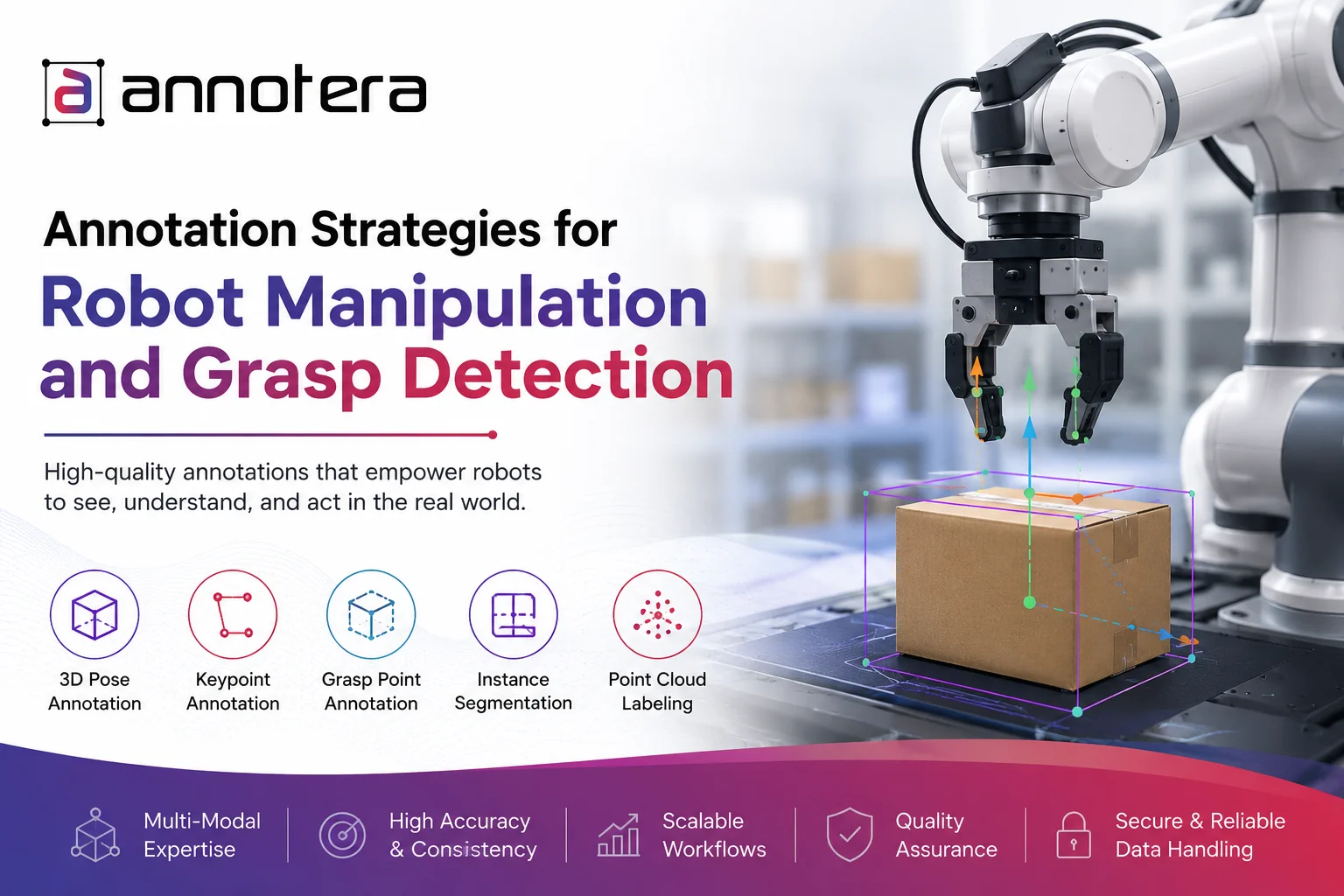
- robotic grasp points
- conveyor belt objects
- irregular warehouse items
Precise object boundaries improve robotic pick-and-place accuracy, reducing operational errors and increasing automation efficiency.
Why Businesses Choose Annotation Outsourcing
Polygon annotation requires significant time, skill, and quality control. Compared to bounding boxes, it is more labor-intensive but offers far better accuracy. Some industry sources estimate it can take several times longer than box annotation, especially for high-complexity scenes.
This is why many organizations choose image annotation outsourcing.
By partnering with Annotera, businesses gain:
- expert annotators
- scalable teams
- faster turnaround times
- rigorous QA workflows
- domain-specific expertise
- cost-efficient production
Whether you need healthcare datasets, automotive segmentation, or satellite image labeling, outsourcing ensures consistent quality at scale.
Final Thoughts
Polygon annotation remains one of the most valuable techniques in computer vision, particularly for AI models that require high-precision segmentation.
From autonomous vehicles and healthcare to agriculture and manufacturing, its use cases continue to expand as AI systems become more advanced.
At Annotera, we specialize in delivering reliable, scalable, and high-quality annotation services tailored to complex AI workflows. As a trusted data annotation company and image annotation company, we help businesses accelerate AI development through expert data annotation outsourcing and image annotation outsourcing services.
When precision matters, polygon annotation is not just an option—it is a necessity.