Sign up with Google
 Sign in with Zoho


In today’s AI-driven world, video data has become one of the most valuable sources of information for training intelligent systems. From autonomous vehicles and smart surveillance to sports analytics and healthcare monitoring, video-based machine learning models rely heavily on accurately labeled data. While object detection and frame-by-frame labeling are widely discussed, one critical aspect often determines the true performance of video AI systems: temporal annotation.
At Annotera, we understand that building reliable AI models requires more than static image labeling. As a trusted data annotation company and video annotation company, we help businesses unlock the full value of video datasets through precise and scalable temporal annotation solutions. In this complete guide, we explain what temporal annotation is, why it matters, key techniques involved, industry use cases, and best practices for implementation.
What Is Temporal Annotation?
Temporal annotation refers to the process of labeling events, actions, objects, or behaviors across a sequence of video frames over time. Unlike single-frame annotation, temporal annotation focuses on how visual elements evolve from one frame to another.
For example, in a traffic surveillance video, a car moving from the left lane to the right lane is not simply an object in one frame. Instead, the system must understand its movement path, duration, speed changes, and interaction with other vehicles over time. Temporal annotation captures these time-based relationships.
This type of annotation is essential for training AI systems that need to recognize:
- Motion patterns
- Human activities
- Event sequences
- Object trajectories
- Behavioral changes
In simple terms, temporal annotation answers not only what is happening, but also when and for how long it is happening.
Why Temporal Annotation Matters in Video AI
Video data is inherently dynamic. A single frame can provide limited context, but the sequence of frames reveals the complete story. Therefore, temporal annotation enables AI models to understand continuity and context.
For instance, consider a security camera feed. A still frame may show a person standing near a door, but only temporal analysis reveals whether the person is entering, leaving, loitering, or behaving suspiciously.
This makes temporal annotation indispensable for applications such as:
- Action recognition – identifying activities like running, jumping, or falling
- Event detection – spotting incidents such as collisions or unauthorized access
- Object tracking – following the same object across multiple frames
- Behavior prediction – anticipating future movements or actions
A professional video annotation outsourcing partner can ensure these time-sensitive labels are consistent, accurate, and scalable for enterprise AI workflows.
Core Components of Temporal Annotation
Temporal annotation includes several interconnected techniques that work together to create a meaningful timeline of video events.
1. Frame Sequencing
This involves linking annotations across consecutive frames. Rather than treating each frame independently, annotators establish continuity between frames so that the same object or action can be tracked over time.
For example, a pedestrian crossing the road is assigned the same identity from start to finish.
2. Start and End Time Labeling
One of the most important aspects is defining when an event begins and ends.
For example:
- Start: person begins to fall
- End: person reaches the ground
This is particularly useful in action recognition datasets.
3. Object Tracking
Tracking assigns persistent IDs to moving objects throughout the video sequence. This allows AI systems to understand movement paths and interactions.
Examples include:
- tracking vehicles in traffic footage
- following players in sports videos
- monitoring patients in healthcare environments
4. Event Segmentation
Temporal segmentation divides a video into meaningful time intervals.
For example, a retail surveillance video may be segmented into:
- customer enters store
- browsing shelves
- checkout process
- customer exits
This helps machine learning systems classify complete workflows.
Common Techniques Used in Temporal Annotation
Different projects require different temporal annotation methods. Some of the most widely used techniques include:
Bounding Box Tracking
This method tracks an object using bounding boxes across multiple frames.
For example, a moving car is enclosed within a rectangular box that updates position frame by frame.
This technique is highly effective for:
- traffic monitoring
- sports analytics
- surveillance systems
Polygon and Segmentation Tracking
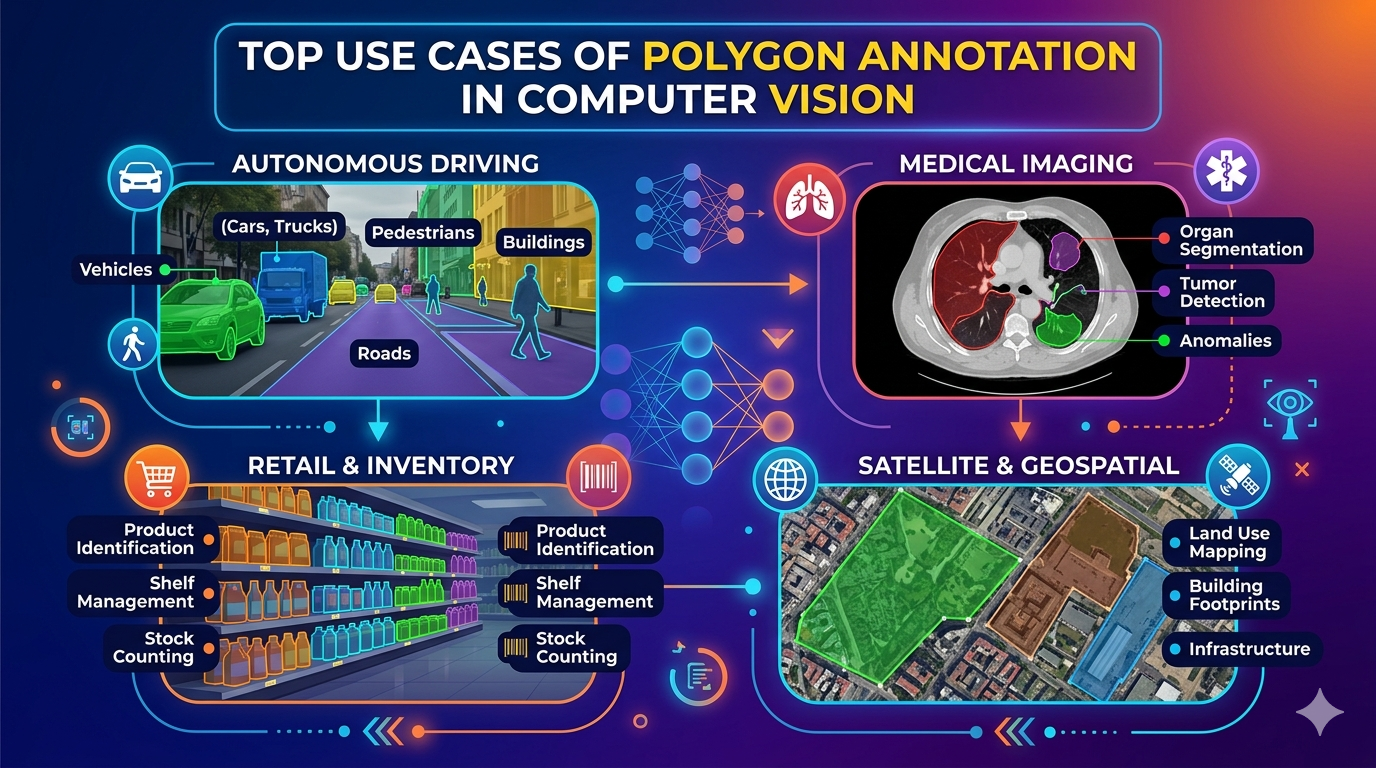
When precise shape boundaries are required, polygons or segmentation masks are used instead of simple boxes.
This is especially useful in medical and autonomous driving applications where pixel-level precision matters.
Keypoint Tracking
For human pose estimation and motion analysis, keypoints such as joints and landmarks are tracked over time.
Examples include:
- elbow movement
- knee position
- facial landmarks
This technique supports gesture recognition and biomechanics analysis.
Timestamp-Based Event Labels
Some workflows focus on labeling specific events with exact timestamps.
For example:
- 00:12 – person enters frame
- 00:19 – object dropped
- 00:25 – person exits
This is widely used in video intelligence systems.
Industry Applications of Temporal Annotation
Temporal annotation has become a foundational element across multiple industries.
Autonomous Vehicles
Self-driving systems depend on temporal annotation to understand how pedestrians, vehicles, cyclists, and traffic signals move over time.
A reliable video annotation company ensures accurate tracking of lane changes, turns, and collision risks.
Security and Surveillance
Temporal labeling helps AI identify suspicious activity, intrusion detection, crowd movement, and unusual behavioral patterns.
For example, AI can distinguish between normal walking and loitering based on time-based annotations.
Healthcare and Medical AI
Hospitals and health-tech companies use temporal annotation for:
- surgery video analysis
- patient activity monitoring
- fall detection systems
- rehabilitation tracking
This is where expert data annotation outsourcing services become highly valuable due to the complexity and sensitivity of medical datasets.
Sports Analytics
Temporal annotation is used to track players, ball movement, and tactical sequences across the entire match timeline.
This enables performance analysis and strategy optimization.
Retail Intelligence
Retail brands use temporal annotation to analyze customer behavior, dwell time, queue management, and product interaction patterns.
Challenges in Temporal Annotation
Although highly valuable, temporal annotation is more complex than static image labeling.
High Volume of Frames
Even short videos contain thousands of frames, making manual annotation time-intensive.
Consistency Across Frames
Maintaining the same object identity across multiple frames requires careful validation.
Occlusion and Motion Blur
Objects may disappear temporarily or become blurred during movement, increasing annotation difficulty.
Multi-Object Environments
Crowded scenes with multiple moving objects require advanced tracking precision.
This is why many organizations prefer video annotation outsourcing to experienced providers like Annotera.
Best Practices for Accurate Temporal Annotation
To achieve high-quality datasets, businesses should follow proven annotation standards.
Define Clear Guidelines
Every project should include detailed instructions for:
- start and end event definitions
- tracking continuity rules
- occlusion handling
- labeling hierarchy
Use Quality Assurance Workflows
Multi-layer QA ensures consistency and minimizes errors.
At Annotera, every annotation pipeline includes expert review and validation checkpoints.
Combine Automation with Human Expertise
AI-assisted pre-labeling tools can accelerate workflows, while human annotators ensure accuracy.
This hybrid approach improves both speed and quality.
Choose Domain-Specific Expertise
Different industries require specialized knowledge. For example, healthcare videos need medically informed annotation standards.
Partnering with an experienced data annotation company ensures project-specific expertise.
Why Choose Annotera for Temporal Annotation?
At Annotera, we specialize in high-precision video labeling services tailored for advanced AI systems. As a trusted data annotation company and video annotation company, we deliver scalable temporal annotation solutions for enterprises across industries.
Our services include:
- frame-by-frame tracking
- event timestamp labeling
- action segmentation
- keypoint motion tracking
- custom workflow design
- enterprise-grade QA
Whether you need data annotation outsourcing for surveillance AI or video annotation outsourcing for autonomous systems, our expert teams ensure accuracy, consistency, and fast turnaround.
Final Thoughts
Temporal annotation is the backbone of intelligent video AI systems. By capturing how events and objects evolve over time, it transforms raw video footage into actionable training data.
As industries increasingly rely on video intelligence, the demand for accurate and scalable temporal labeling will continue to grow. Choosing the right annotation partner can significantly impact model performance and deployment success.
At Annotera, we help organizations turn complex video datasets into high-quality AI-ready assets through expert temporal annotation services.