 Sign up with Google
 Sign in with Zoho

Artificial Intelligence (AI) systems have rapidly evolved from simple rule-based software to advanced technologies capable of understanding speech, analyzing conversations, and detecting sound patterns in real time. Applications such as virtual assistants, voice search, automated transcription, and intelligent call analytics all rely heavily on high-quality audio data. However, raw audio recordings alone are not enough for AI models to learn effectively. They must first be transformed into structured datasets through a process known as audio annotation.
Audio annotation plays a critical role in preparing sound data so machine learning models can understand and interpret it accurately. For organizations building speech-enabled products, investing in reliable annotation services is essential for developing high-performance AI systems. As a trusted data annotation company, Annotera helps organizations transform raw audio datasets into high-quality training data that powers modern AI solutions.
This article explores what audio annotation is, how it works, and why it is crucial for AI training.
Understanding Audio Annotation
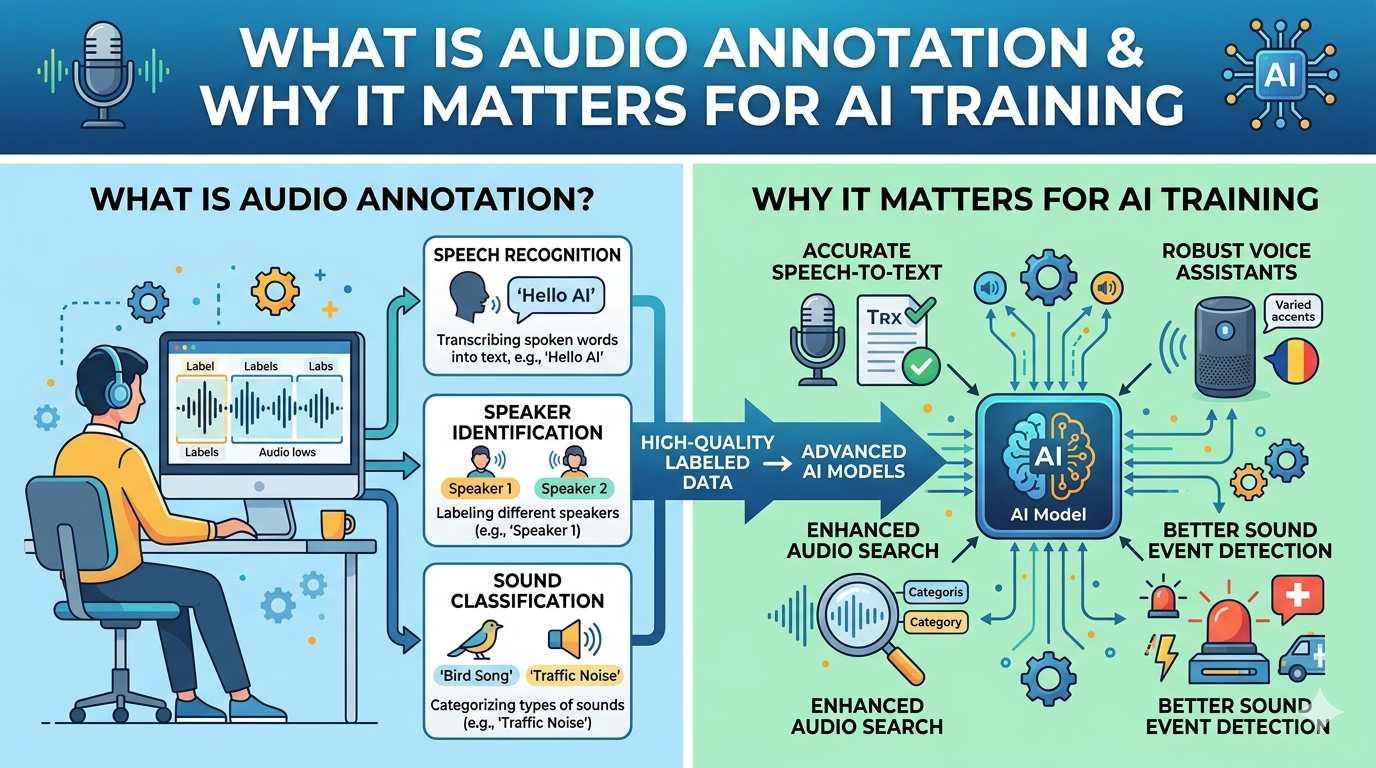
Audio annotation is the process of labeling or tagging audio files with relevant metadata so machine learning algorithms can interpret them. These labels may include speech transcriptions, timestamps, speaker identification, emotion tags, background noise classification, and more.
In simple terms, annotation converts unstructured sound recordings into structured datasets that AI models can analyze. Machines cannot inherently understand audio signals because they only perceive them as digital waveforms. By adding contextual labels and metadata, annotators provide the information needed for algorithms to identify patterns and learn from the data.
For example, in a recorded conversation, annotation may include:
- The exact transcription of spoken words
- Identification of each speaker
- Time markers for when speech starts and ends
- Emotional tone (happy, angry, neutral)
- Background sounds such as traffic or music
These annotations help AI systems learn how to interpret speech, recognize different voices, and understand the context of conversations.
Why Audio Annotation Matters for AI Training
Audio annotation is fundamental to the development of speech-based AI technologies. Without annotated data, machine learning models would not be able to understand spoken language or differentiate between various sound patterns.
1. Enabling Speech Recognition Systems
One of the most common uses of audio annotation is training Automatic Speech Recognition (ASR) systems. These systems convert spoken words into text and power applications like voice typing, call transcription, and digital assistants.
Annotated datasets containing accurate transcriptions and timestamps allow models to learn how speech corresponds to written language. This training process enables AI systems to recognize spoken commands and respond appropriately.
For instance, when users say “Set an alarm for 7 AM,” a trained AI model can recognize the command and execute the requested task.
2. Improving Natural Language Understanding
Speech recognition alone is not enough for modern conversational AI. Systems must also understand intent, context, and emotion. Audio annotation provides the additional metadata needed for advanced natural language processing (NLP).
By labeling intent, sentiment, and conversational context, AI models can analyze spoken language more effectively. This capability is essential for chatbots, virtual assistants, and voice-based customer service tools.
3. Supporting Multimodal AI Systems
Modern AI models often analyze multiple types of data simultaneously, including text, images, videos, and audio. Annotated audio data plays a key role in these multimodal systems by providing contextual information that complements visual or textual inputs.
For example:
- Autonomous vehicles analyze audio signals like sirens or horns.
- Video analytics systems combine video annotation with audio cues.
- Smart devices use voice commands to control connected systems.
Organizations frequently partner with a video annotation company alongside audio specialists to ensure consistent labeling across multimodal datasets.
4. Enhancing AI Accuracy and Performance
The performance of an AI model largely depends on the quality of its training data. Poorly labeled audio datasets can lead to inaccurate predictions, misunderstood commands, and unreliable voice recognition.
High-quality annotation improves:
- Speech recognition accuracy
- Voice command interpretation
- Sound classification models
- Sentiment analysis systems
In machine learning, this concept is often summarized as “garbage in, garbage out.” If the training data is inaccurate, the model’s predictions will also be unreliable.
Partnering with a specialized data annotation outsourcing provider ensures that datasets are labeled consistently and accurately.
Types of Audio Annotation
Audio annotation encompasses several specialized tasks depending on the AI application. The most common types include:
Speech-to-Text Transcription
This is the most widely used form of audio annotation. Annotators convert spoken language into written text while preserving punctuation, pauses, and speaker transitions.
It is widely used for:
- Voice assistants
- Automated subtitles
- Meeting transcription tools
Speaker Identification (Diarization)
Speaker diarization identifies and labels each speaker in an audio recording. This allows AI systems to distinguish between multiple voices in a conversation.
This technique is particularly important in:
- Call center analytics
- Podcast transcription
- Meeting recordings
Emotion and Sentiment Annotation
Emotion detection labels the emotional tone of speech, such as happiness, anger, or frustration. These annotations are essential for sentiment analysis models used in customer service and social media monitoring.
Sound Event Detection
Not all audio data contains speech. Many applications require identification of environmental sounds such as alarms, vehicle noise, or footsteps.
Annotating these sounds helps train AI systems used in:
- Security monitoring
- Smart cities
- Industrial automation
Challenges in Audio Annotation
While audio annotation is critical for AI development, it also presents several challenges.
Data Complexity
Audio files often contain multiple speakers, overlapping speech, and background noise. Annotators must carefully identify and label each element with precise timestamps.
Time-Intensive Process
Unlike image annotation, which involves labeling static visuals, audio annotation requires listening to entire recordings. This makes the process more time-consuming and resource-intensive.
Consistency and Quality Control
Maintaining consistent labeling standards across large datasets requires strict guidelines and multi-level review processes. Quality assurance frameworks ensure annotations remain accurate and reliable.
Many organizations address these challenges by leveraging data annotation outsourcing services to scale their projects efficiently.
The Role of Annotera in Audio Annotation
As AI adoption continues to grow, organizations need reliable partners capable of delivering high-quality training datasets at scale. Annotera provides specialized annotation services designed to support AI development across multiple industries.
As an experienced data annotation company, Annotera offers:
- High-accuracy audio annotation services
- Speech transcription and labeling
- Speaker diarization and sound event detection
- Multilingual audio dataset preparation
- Quality assurance and validation processes
In addition to audio services, Annotera also operates as a leading video annotation company, enabling organizations to build comprehensive multimodal training datasets.
Through flexible video annotation outsourcing and audio labeling services, Annotera helps AI teams accelerate model development while maintaining data accuracy and consistency.
The Future of Audio Annotation in AI
Voice technology is becoming an integral part of everyday digital interactions. From smart assistants and automated call centers to voice-controlled vehicles and accessibility tools, audio-driven AI is rapidly expanding.
As these technologies evolve, the demand for high-quality annotated datasets will continue to grow. Advanced AI systems will require more nuanced labeling, including emotional tone detection, multilingual speech recognition, and multimodal audio-video analysis.
Organizations that invest in accurate annotation processes today will be better positioned to build smarter and more reliable AI systems tomorrow.
Conclusion
Audio annotation is a foundational process in AI development, transforming raw sound recordings into structured datasets that machines can understand. By adding labels such as transcriptions, speaker identification, timestamps, and emotion tags, annotators enable machine learning models to interpret speech and sound accurately.
From speech recognition systems to conversational AI and environmental sound detection, audio annotation plays a critical role in powering modern intelligent technologies.
For organizations building AI-driven products, partnering with an experienced data annotation company like Annotera ensures access to high-quality training data. Through expert annotation workflows and scalable data annotation outsourcing services, Annotera supports businesses in developing robust AI models that deliver reliable real-world performance.