Sign up with Google
 Sign in with Zoho

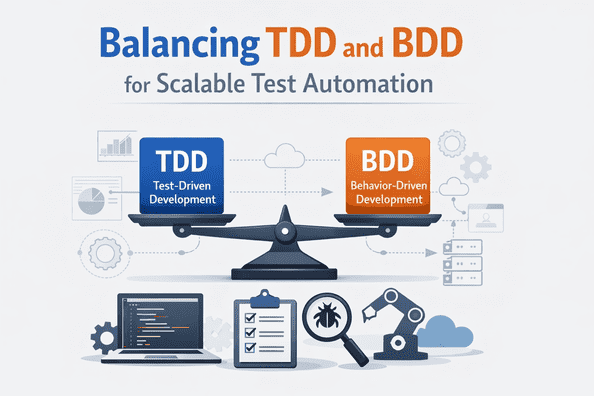
Choosing the right testing approach can significantly impact how teams build, test, and deliver software. Among the most widely discussed methodologies, TDD vs BDD is a common debate—especially for teams aiming to improve code quality and collaboration.
While both approaches promote early testing and better design, they serve different purposes and suit different team dynamics. Instead of asking which one is better, the real question is: which approach fits your team’s needs?
In this guide, we’ll break down TDD vs BDD and provide a practical decision framework to help teams choose the right approach based on their goals, workflows, and project requirements.
Understanding TDD vs BDD
Before diving into the decision framework, it’s important to understand what each approach represents.
What is TDD?
Test-Driven Development (TDD) is a development approach where tests are written before the actual code.
TDD Workflow
- Write a failing test
- Write code to pass the test
- Refactor the code
TDD focuses on:
- Code correctness
- Clean design
- Developer productivity
What is BDD?
Behavior-Driven Development (BDD) builds on TDD but focuses on application behavior from a user perspective.
BDD Workflow
- Define behavior using natural language (Given-When-Then)
- Collaborate across teams
- Implement and validate behavior
BDD emphasizes:
- Collaboration between stakeholders
- Clear communication
- User-centric testing
Key Differences Between TDD vs BDD
Understanding the differences helps teams make informed decisions.
Focus
- TDD: Code-level correctness
- BDD: User behavior and requirements
Language
- TDD: Technical (unit tests, assertions)
- BDD: Business-readable (scenarios, features)
Audience
- TDD: Developers
- BDD: Developers, QA, and business stakeholders
Scope
- TDD: Unit-level testing
- BDD: Functional and acceptance-level testing
Both approaches complement each other but are used in different contexts.
Why Teams Struggle with TDD vs BDD
Many teams face confusion when deciding between TDD vs BDD.
Common challenges include:
- Lack of understanding of both approaches
- Misalignment between technical and business teams
- Overcomplicating implementation
- Choosing tools before defining strategy
Without a clear framework, teams often adopt the wrong approach or fail to implement either effectively.
A Practical Decision Framework for TDD vs BDD
Let’s break down how teams can decide between TDD vs BDD based on real-world factors.
1. Define Your Primary Goal
Start by identifying what you want to achieve.
Choose TDD if:
- You want cleaner, well-structured code
- Your focus is on logic and implementation
- You need fast feedback during development
Choose BDD if:
- You want better collaboration across teams
- You need clear alignment with business requirements
- You want to validate user behavior
Your goal determines your starting point.
2. Consider Your Team Structure
Team composition plays a major role in deciding TDD vs BDD.
Developer-Centric Teams
If your team consists mostly of developers:
- TDD is easier to adopt
- Faster implementation
- Less overhead
Cross-Functional Teams
If your team includes QA, product managers, and stakeholders:
- BDD improves communication
- Shared understanding of requirements
- Better collaboration
Choose the approach that aligns with your team dynamics.
3. Evaluate Project Complexity
Different projects require different approaches.
Simple or Backend-Focused Applications
- TDD works well for logic-heavy systems
- Easier to manage and scale
Complex, User-Focused Applications
- BDD helps define user behavior clearly
- Better for feature-rich systems
Project complexity influences how much collaboration and clarity you need.
4. Assess Communication Needs
Communication is a key factor in TDD vs BDD.
Low Communication Overhead
- TDD is sufficient
- Developers can work independently
High Collaboration Requirements
- BDD is more effective
- Ensures everyone is aligned
If miscommunication is a recurring issue, BDD can help solve it.
5. Determine Testing Scope
Think about what level of testing you need.
Code-Level Validation
- TDD is ideal
- Focuses on unit tests
Behavior-Level Validation
- BDD is better
- Focuses on scenarios and user flows
Matching the scope with the approach ensures better results.
6. Consider Tooling and Learning Curve
Both approaches require tools and learning effort.
TDD
- Easier to start
- Uses standard testing frameworks
- Lower learning curve
BDD
- Requires understanding of behavior-driven tools
- Involves writing scenarios
- Slightly higher complexity
Choose based on your team’s readiness and experience.
7. Think Long-Term Scalability
Your decision should support long-term growth.
TDD for Scalability
- Helps maintain clean codebase
- Easier to refactor
BDD for Scalability
- Improves documentation
- Maintains clarity in large teams
Both approaches scale differently depending on your priorities.
Can Teams Use TDD and BDD Together?
Yes—and in many cases, they should.
Instead of choosing between TDD vs BDD, teams can combine both:
- Use TDD for unit-level testing and code quality
- Use BDD for defining user behavior and acceptance criteria
This hybrid approach provides:
- Strong technical foundation
- Clear business alignment
It allows teams to get the best of both worlds.
Real-World Example
Consider a team building an e-commerce platform.
Using TDD
- Developers write unit tests for pricing logic
- Ensure calculations are accurate
Using BDD
- Define user scenarios like “User adds item to cart”
- Validate checkout flow
Together, they ensure both code correctness and user experience.
Common Mistakes to Avoid
When implementing TDD vs BDD, teams often make mistakes:
- Treating them as mutually exclusive
- Overcomplicating test scenarios
- Ignoring collaboration in BDD
- Skipping refactoring in TDD
Avoiding these pitfalls leads to more effective implementation.
Best Practices for Teams
To successfully adopt TDD vs BDD:
- Start small and scale gradually
- Align approach with team goals
- Focus on clarity and maintainability
- Encourage collaboration
- Continuously improve processes
These practices ensure long-term success.
Role of Modern Tools
Modern tools make it easier to implement both approaches.
They help:
- Automate test execution
- Improve test coverage
- Integrate with CI/CD pipelines
For example, tools like Keploy can automatically generate test cases from real API interactions, helping teams validate behavior and functionality more efficiently while supporting both TDD and BDD workflows.
Conclusion
The debate around TDD vs BDD is not about choosing a winner—it’s about choosing what works best for your team. Each approach has its strengths, and the right choice depends on your goals, team structure, and project requirements.
By using a clear decision framework, teams can adopt the right approach—or even combine both—to improve code quality, enhance collaboration, and deliver better software.
In the end, success lies not in the methodology itself, but in how effectively it is applied.