Sign up with Google
 Sign in with Zoho

Something nobody warned me about when I moved from a team doing monthly releases to one shipping forty times a day: the testing knowledge I'd built up over years became partially wrong almost immediately.
Not outdated. Wrong. Built on assumptions that stopped being true.
It took an embarrassingly long time to figure out which assumptions those were.
The obvious stuff stops being the problem
Slow deployment cycles produce failures that are almost considerate about announcing themselves. Endpoint down. UI broken. Service won't start. You see it, you fix it, done.
What I started running into instead was weirder. An API returning the right structure on most requests and a subtly different one on others, not consistently enough to pin down. A workflow that broke six hours after a deployment, long after anyone was paying attention. Two services that both deployed correctly on their own but behaved differently when they updated within thirty minutes of each other.
That last one took us two days to debug. Two days, for something that was effectively a timing issue between independent deployments. No single component was broken. The interaction between them was.
Classic black box testing wasn't designed for this. Neither was classic anything, really. The whole mental model of "deploy, verify, done" falls apart when there's no discrete "done."
You can't manually verify forty deployments a day. You just can't.
I tried. For about three weeks after joining that team I kept a manual verification checklist. I genuinely believed I could keep it up.
What actually happened was the checklist became something I ran when I had time, then something I skimmed, then a document that existed and that nobody looked at. The deployments didn't slow down. My capacity did. Under enough pressure, manual steps don't get streamlined. They get skipped.
And honestly, I don't think this is a discipline problem or a culture problem. It's just math. If verifying a deployment takes twenty minutes and deployments happen every fifteen minutes, you're already behind before you start.
The only thing that actually worked was treating behavioral verification as something that ran automatically inside the pipeline, not something humans did at the end of it. Every deployment triggers the tests. Results come back before the next deployment goes out. The feedback loop stays intact without anyone having to maintain it through willpower.
Internal coverage gives you false confidence at scale
Here's the thing that actually frustrated me most in that period. We had solid internal test coverage. Unit tests, integration tests. The engineers were good, the tests were real.
We still had behavioral regressions in production on a regular basis.
What I eventually worked out was that internal tests verify components. They don't verify that components still interact correctly from the outside after independent changes. In a distributed system where services are deploying on different schedules, that gap is where most of the actual breakage lives.
A service could pass all its own tests perfectly and still break something downstream because its API response changed in a small way that nobody internally noticed or cared about. The field was still there. The type changed from int to string. Downstream service falls over. Internal tests: all green.
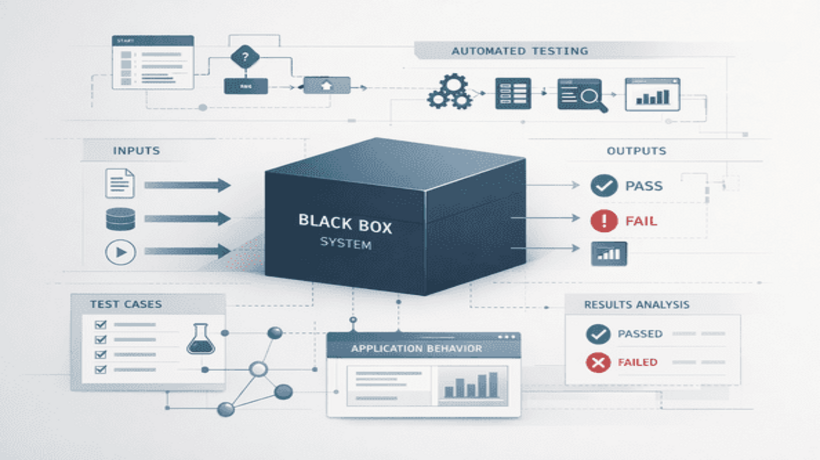
Black box testing from the outside catches this because it doesn't care about internal logic. It only asks whether the observable behavior is still what it was. That's the right question.
Your test environment is lying to you more than you think
Mocked dependencies. Curated test payloads. Manually set up data. These are all photographs of a system from some point in the past.
In a slow deployment cycle, those photographs stay accurate long enough. In a fast one, you're validating behavior against a snapshot that might be weeks out of actual sync with production. Real payloads have evolved. A dependency updated. Traffic patterns shifted. Edge cases appeared that didn't exist when you wrote the mocks.
I started noticing this when we'd get a production failure, go back to run the reproduction case against the test environment, and it wouldn't reproduce. Not because the fix had worked. Because the test environment wasn't matching production conditions closely enough to even show the bug.
That's a specific kind of terrible. Your safety net has holes and the holes are invisible.
Moving toward production-like test conditions helped more than almost anything else we did. Not full production testing. Just closer to it. Real payload shapes. Real dependency behavior rather than idealized stubs. More maintenance, yes. But the failures we were catching shifted from "things nobody would ever hit" to "things that actually happened last week."
API contracts become the most important thing to protect
In a distributed system, the API is where everything meets. And small changes to API behavior have a way of breaking things far away from the change itself.
I watched a date format change in one service's response take down a data pipeline that three different teams owned pieces of. The team that made the change didn't know the pipeline existed. The pipeline teams didn't know the format had changed. Everyone's internal tests were green.
At high deployment frequency, API regression testing isn't one part of the testing strategy. It basically is the strategy. You're not checking whether the code does what it intends. You're checking whether the contracts that other things depend on have held.
Error responses specifically. Test those. Everyone tests success paths. Error response formats change constantly during refactors and almost nobody has regression coverage for them. I've seen this cause production incidents more times than I should be willing to admit.
Speed matters in a way that's easy to get wrong
There's a version of this problem where you build a comprehensive behavioral test suite, feel good about the coverage, and then quietly watch it stop being used because it takes too long.
Ninety-minute test suites don't get run on every deployment. They get run when someone remembers, or when something already broke. At that point the coverage is real but the feedback loop is broken, which is most of what you actually needed.
Ten minutes is roughly the ceiling before engineers start making decisions without waiting for results. That's the constraint I design around now. Critical paths, the workflows that would cause a support incident if broken, run on every deployment. Everything else runs on a slower schedule.
It's not complete coverage. It's enough confidence to keep shipping. For most teams in most situations, that's actually the right tradeoff, even if it feels uncomfortable to say out loud.
What I'd tell someone walking into this for the first time
The mental model shift is the hard part. Black box testing in a high-deployment environment isn't a faster version of what you were doing before. It's a different activity.
You're not verifying that a release is good before it goes out. You're continuously confirming that a system that's always changing is still behaving coherently from the outside. Workflows completing. APIs returning what they're supposed to. Services that were fine yesterday still fine after three other services updated around them.
Get that running automatically. Keep it fast. Stay close to production conditions. Test error paths not just happy ones.
And accept that you will still miss things. The goal isn't a perfect safety net. It's catching enough, fast enough, that you find out before your users do.