Sign up with Google
 Sign in with Zoho
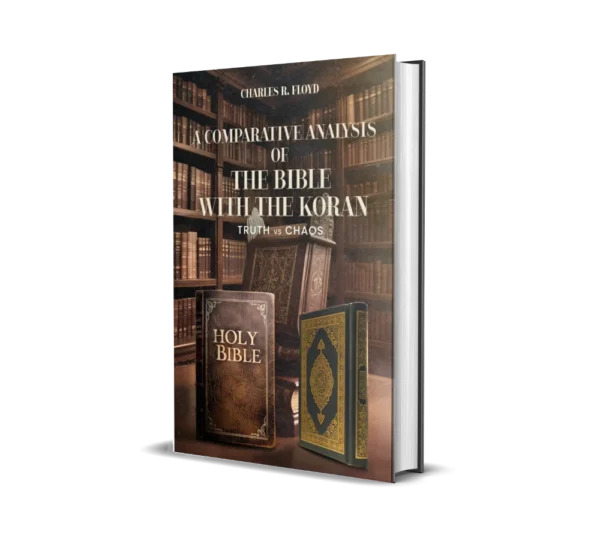
Truth vs. Chaos, he positioned it as a rigorous, faith-informed examination of two of the world's most influential scriptures. Floyd, a self-described born-again Christian who began studying Islam after 9/11, promises readers an honest comparison. But the book delivers something far more narrow: a one-sided verdict dressed in the language of scholarship. And the uncomfortable truth is that most reviewers aren't saying so loudly enough.
This article breaks down the most significant methodological, theological, and structural problems embedded throughout Floyd's work that matter to readers, whether Christian, Muslim, or simply intellectually curious.
"Floyd does not approach two texts with equal weight. He approaches one text as absolute truth and uses it as a weapon against the other."
1. The Bias Is Baked In From Page One
Floyd states in Part I: "When a disparity occurs, something must not be true; and as the conclusion is made, either God or Allah must be lying. My conclusion as a Christian is that, should a disparity exist, then Alla must be wrong." That sentence appears in chapter one. Not the conclusion chapter one.
This is not a comparative analysis. This is confirmation bias dressed in academic clothing. A genuine scholarly comparison between any two religious texts demands that the analyst apply the same epistemological standard to both sources. Floyd openly admits he does not. He begins with the outcome and works backward, selectively citing scriptural passages to support a conclusion he reached before the research began.
Readers who pick up this book expecting a fair-minded dialogue between Christianity and Islam will find a prosecutorial brief instead. That is not inherently wrong. Writers are entitled to their convictions, but Floyd markets the work as a comparative analysis, and that framing misleads.
2. The Factual Errors Floyd Criticizes Are Often Present in His Own Text
Floyd dedicates considerable space in Part I to pointing out what he calls factual errors in the Koran. He highlights the story of the soldiers at the river, where the Koran attributes the episode to Saul, while the Bible attributes it to Gideon, and frames this as a glaring Koranic inaccuracy.
What he does not address is the well-documented history of oral transmission in both traditions. Floyd himself acknowledges in the introduction that the Koran began as an oral tradition and was compiled in written form during the Caliphate of Umar (644–656 AD). But he uses that historical reality selectively: as evidence against the Koran's reliability, while making no equivalent acknowledgment about the centuries of oral tradition that precede the written Old Testament.
By Part III, Floyd is analyzing Jihad passages with equal imbalance, cherry-picking the most violent Koranic verses without applying the same standard to Old Testament passages about warfare, genocide, and divine-mandated violence that Biblical scholars spend considerable energy contextualizing.
"Applying one standard of textual scrutiny to one book and a different standard to the other is not analysis. It is advocacy."
3. The Treatment of Women Passages Lacks Historical Context Selectively
Part IV examines discriminatory passages in the Koran, particularly those involving women. Floyd correctly identifies that the Koran, in its historical context, treated women as property in certain passages. He points to the roughly 400-year gap between Jesus's teachings, which Floyd notes introduced a more egalitarian framing, and Muhammad's writings.
This is a legitimate point. But Floyd does not apply it with intellectual honesty. He does not return to Leviticus 18, which he briefly cites in Part I, and interrogates the discriminatory weight of those passages through the same critical lens. He does not examine the historical treatment of women in ancient Israel or in the early Christian church, where women were largely barred from leadership.
A reader who has spent any time studying religious history finds this omission jarring. Floyd uses historical context as a defense when it serves the Bible and as a prosecutorial tool when it applies to the Koran. That asymmetry hollows out the credibility of his analysis.
4. The Denial of the Crucifixion: A Theological Difference Framed as Moral Failure
The most emotionally charged section of Floyd's book involves the Koran's denial of Christ's crucifixion (Sura 4:156-157). Floyd calls this perhaps the most important disparity of all, and from a Christian theological standpoint, the conviction is understandable.
But Floyd frames the Koranic position not as a theological disagreement between two traditions but as an act of moral and intellectual deception. He writes that questioning the crucifixion is 'at least ignorant and at best apathetic.' He demands that readers accept the Christian account as historical fact and dismisses Islamic theology as falsehood.
What this reveals is the fundamental flaw in the book's premise. Floyd is not comparing two religious texts. He is using one religious text to disprove the other, a method that no credible interfaith scholar, historian of religion, or theologian would recognize as analysis. Billions of Muslims hold the Koranic account with the same sincerity and conviction that Floyd holds the Biblical account. His book offers them no engagement, only dismissal.
"The book offers Muslim readers no engagement only dismissal. That is not scholarship. That is a sermon."
5. The Works Doctrine Section Misrepresents Islamic Theology
Part II focuses on what Floyd calls the 'works doctrine, ' the Islamic belief that good deeds and righteous living determine one's standing before God. Floyd contrasts this repeatedly with Christian grace theology, framing Islam as a religion of exhausting moral accounting versus Christianity's gift of unearned salvation.
The problem here is not Floyd's Christian conviction. The problem is that he presents a flattened, entry-level understanding of Islamic soteriology and offers it as a comprehensive critique. Islamic scholars have debated the relationship between works, faith, and divine mercy for centuries. The Koran itself, as even Floyd's own excerpts show, repeatedly describes God as 'forgiving and merciful.'
Floyd does not engage with that theological complexity. He presents a caricature and then refutes it. That approach may satisfy readers who already share his conclusions, but it does nothing to educate those who don't.
6. What the Book Gets Right And Why That Makes the Flaws Worse
It would be dishonest to say the book has no merit. Floyd identifies genuine textual disparities between the Bible and the Koran, the different accounts of Moses at the rock, the discrepancies around Mary and Zachariah, and the varied color of the heifer in the sin offering. For readers with no prior knowledge of either text, these side-by-side comparisons are informative.
The bibliography in Part VII is also a positive signal. Floyd cites scholars like Nabeel Qureshi and references historical sources. He is not entirely uninformed.
But that is precisely what makes the methodological failures so frustrating. When a writer demonstrates enough research to do better, the choice not to do better feels deliberate. And deliberate bias, presented as scholarship, is a different kind of problem than simple ignorance.
The Bottom Line
Charles R. Floyd's book is not without an audience. Evangelical Christians who want scriptural ammunition for interfaith debate will find it useful. Those who want to understand the Koran or why 1.8 billion people follow it will find very little here.
Floyd's core argument is that the Bible is true and that wherever the Koran differs, it is wrong. That is a theological position, not a comparative analysis. The title of the book promises one thing; the contents deliver another.
For any reader who has sat across from someone of a different faith and genuinely tried to understand their worldview, this book will feel like a missed opportunity. Floyd had access to both texts. He chose only to listen to one.
"Truth vs. Chaos" Floyd’s subtitle tells you everything about where he started and nothing about where the evidence actually leads."