 Sign up with Google
 Sign in with Zoho

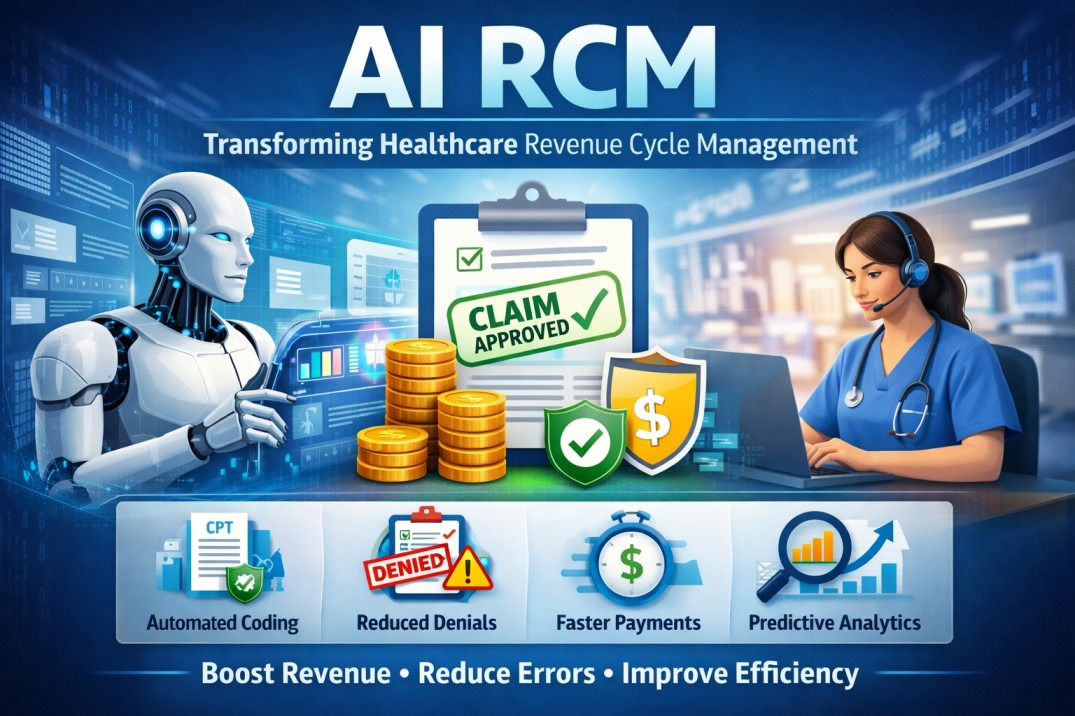
Healthcare organizations today are under constant pressure to improve financial performance while maintaining high-quality patient care. One of the most critical yet complex areas is Revenue Cycle Management (RCM). From patient registration to final payment collection, the process involves multiple steps, stakeholders, and systems.
Traditional RCM processes are often slow, error-prone, and heavily dependent on manual work. This is where AI RCM (Artificial Intelligence in Revenue Cycle Management) is creating a major shift.
AI is not just a trend in healthcare finance. It is becoming a necessity.
What is AI RCM?
AI RCM refers to the use of artificial intelligence technologies such as machine learning, natural language processing (NLP), and automation to optimize and manage the entire revenue cycle.
It enhances every stage of RCM, including:
- Patient eligibility verification
- Medical coding
- Claims submission
- Denial management
- Payment posting
- Accounts receivable follow-ups
Instead of relying on manual processes, AI analyzes large volumes of data, identifies patterns, and automates repetitive tasks with high accuracy.
Why Traditional RCM is Failing
Before understanding the benefits of AI, it’s important to recognize the limitations of traditional RCM systems.
1. High Error Rates
Manual data entry and coding mistakes often lead to claim denials.
2. Slow Processes
Billing cycles take longer due to manual verification and follow-ups.
3. Lack of Visibility
Healthcare providers struggle to get real-time insights into financial performance.
4. Increasing Denials
Payers are becoming stricter, and denial rates are rising.
5. Staff Burnout
Administrative staff spend hours on repetitive and low-value tasks.
These issues directly impact revenue, cash flow, and operational efficiency.
How AI RCM Solves These Problems
AI introduces intelligence, automation, and predictive capabilities into RCM workflows.
1. Automated Medical Coding
AI-powered systems can analyze clinical documentation and assign accurate medical codes. This reduces human errors and ensures compliance.
2. Smart Claims Processing
AI checks claims before submission to identify errors or missing information. This significantly reduces rejection rates.
3. Predictive Denial Management
AI predicts which claims are likely to be denied and suggests corrective actions before submission.
4. Real-Time Eligibility Verification
AI verifies insurance details instantly, reducing delays and administrative burden.
5. Intelligent AR Follow-Ups
AI prioritizes accounts receivable based on payment probability, helping teams focus on high-value claims.
Key Benefits of AI RCM
1. Faster Payments
AI reduces claim errors and speeds up processing, leading to quicker reimbursements.
2. Reduced Denials
With predictive analytics and pre-submission checks, denial rates drop significantly.
3. Cost Efficiency
Automation reduces the need for large billing teams and minimizes operational costs.
4. Improved Accuracy
AI eliminates human errors in coding, billing, and documentation.
5. Better Decision-Making
Real-time dashboards and analytics provide insights into revenue trends and bottlenecks.
6. Scalability
AI systems can handle large volumes of data without increasing staff.
AI RCM in Action: Real-World Use Cases
1. Automated Prior Authorization
AI streamlines prior authorization processes by extracting required data and submitting requests automatically.
2. Denial Pattern Analysis
AI identifies recurring denial patterns and helps fix root causes.
3. Patient Payment Prediction
AI predicts which patients are likely to delay payments and suggests proactive engagement strategies.
4. Charge Capture Optimization
AI ensures that all billable services are captured accurately, preventing revenue leakage.
Challenges of Implementing AI RCM
While AI RCM offers significant advantages, implementation comes with challenges.
1. Integration with Existing Systems
Healthcare organizations often use legacy systems that are difficult to integrate with AI tools.
2. Data Quality Issues
AI systems depend on clean and structured data. Poor data quality can impact performance.
3. Initial Investment
Although AI reduces costs in the long run, the initial setup can be expensive.
4. Change Management
Staff may resist adopting new technologies due to lack of training or fear of job displacement.
How to Successfully Implement AI RCM
To maximize the benefits of AI, healthcare providers should follow a strategic approach:
1. Start with High-Impact Areas
Focus on processes like denial management or coding where AI can deliver immediate results.
2. Ensure Data Readiness
Clean and standardize data before implementing AI solutions.
3. Choose the Right Partner
Work with AI RCM providers that offer both technology and domain expertise.
4. Train Your Team
Provide proper training to ensure smooth adoption.
5. Monitor and Optimize
Continuously track performance and refine AI models.
The Role of Human Expertise in AI RCM
AI does not replace humans. Instead, it enhances their capabilities.
The most effective AI RCM systems follow a “human-in-the-loop” approach, where:
- AI handles repetitive tasks
- Humans oversee complex decision-making
- Experts ensure compliance and accuracy
This combination delivers the best results in terms of efficiency and reliability.
Future of AI in Revenue Cycle Management
The future of AI RCM looks promising as technology continues to evolve.
1. Hyper-Automation
End-to-end automation of the revenue cycle with minimal human intervention.
2. Advanced Predictive Analytics
More accurate forecasting of revenue trends and risks.
3. Personalized Patient Billing
AI-driven patient engagement for better payment experiences.
4. Integration with EHR Systems
Seamless integration with electronic health records for real-time data flow.
5. Voice and NLP Advancements
Improved clinical documentation through AI-powered speech-to-text systems.
Why Healthcare Organizations Must Adopt AI RCM Now
Delaying AI adoption can put healthcare providers at a competitive disadvantage.
Organizations that continue using traditional RCM methods may face:
- Higher denial rates
- Slower cash flow
- Increased operational costs
- Reduced patient satisfaction
On the other hand, adopting AI RCM enables:
- Faster revenue cycles
- Improved financial stability
- Enhanced operational efficiency
Conclusion
AI RCM is transforming the way healthcare organizations manage their revenue cycles. By automating repetitive tasks, improving accuracy, and providing actionable insights, AI helps providers maximize revenue while reducing administrative burden.
The shift toward AI-powered RCM is no longer optional—it is essential for staying competitive in today’s healthcare landscape.
Healthcare providers that embrace AI today will be better positioned to deliver efficient, patient-centered care while maintaining strong financial performance.