Sign up with Google
 Sign in with Zoho

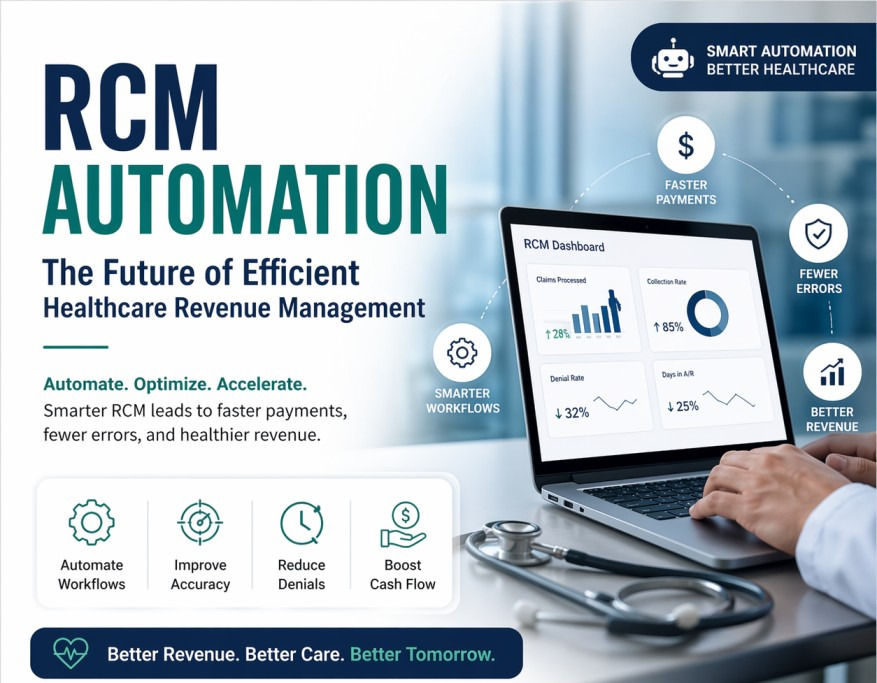
Healthcare organizations today face increasing pressure to improve financial performance while maintaining high-quality patient care. Rising administrative costs, frequent claim denials, and complex payer rules make revenue cycle management (RCM) more challenging than ever. This is where RCM automation steps in as a game-changing solution.
By leveraging advanced technologies like artificial intelligence (AI), machine learning, and robotic process automation (RPA), RCM automation helps healthcare providers streamline billing workflows, reduce errors, and accelerate reimbursements. It’s no longer a luxury—it’s becoming a necessity for modern healthcare practices.
What is RCM Automation?
RCM automation refers to the use of technology to manage and optimize the entire revenue cycle—from patient registration and insurance verification to coding, billing, and payment collection.
Instead of relying on manual processes, automated systems handle repetitive tasks such as:
- Eligibility verification
- Charge capture
- Medical coding assistance
- Claims submission
- Denial management
- Payment posting
The goal is simple: increase efficiency, reduce human error, and maximize revenue collection.
Why Traditional RCM is No Longer Enough
Manual RCM processes are time-consuming and prone to errors. Even small mistakes in coding or documentation can lead to claim denials, delayed payments, or compliance risks.
Some common challenges in traditional RCM include:
- High claim denial rates
- Slow reimbursement cycles
- Billing errors and inconsistencies
- Administrative burden on staff
- Lack of real-time insights
These issues directly impact a healthcare provider’s financial health. RCM automation addresses these pain points by introducing speed, accuracy, and intelligence into the workflow.
Key Benefits of RCM Automation
1. Faster Claims Processing
Automation significantly reduces the time required to submit and process claims. Clean claims are generated quickly, leading to faster reimbursements and improved cash flow.
2. Reduced Claim Denials
AI-powered tools can identify errors before claims are submitted. By catching issues early, practices can drastically reduce denial rates and rework.
3. Improved Accuracy
Automation minimizes human errors in coding, billing, and data entry. This ensures compliance with payer requirements and reduces costly mistakes.
4. Enhanced Staff Productivity
Administrative staff often spend hours on repetitive tasks. Automation frees up their time, allowing them to focus on higher-value activities like patient engagement and financial planning.
5. Better Financial Visibility
Automated RCM systems provide real-time dashboards and analytics. This helps providers track key performance indicators (KPIs), identify bottlenecks, and make data-driven decisions.
How AI is Transforming RCM Automation
Artificial intelligence is taking RCM automation to the next level. Unlike traditional systems, AI can learn from data and continuously improve performance.
Here’s how AI enhances RCM:
- Predictive Analytics: Forecasts claim denials and suggests corrective actions
- Smart Coding: Assists in accurate medical coding based on clinical documentation
- Automated Denial Management: Identifies patterns in denied claims and recommends solutions
- Natural Language Processing (NLP): Extracts relevant information from clinical notes
This intelligent automation ensures that revenue cycles are not just faster, but also smarter.
Key Areas Where RCM Automation Makes an Impact
Patient Registration & Eligibility Verification
Automated systems verify insurance eligibility in real-time, reducing front-end errors that often lead to claim denials.
Medical Coding
AI-assisted coding tools help ensure accurate code assignment, improving compliance and reimbursement rates.
Claims Management
Automation ensures clean claim submission, tracks claim status, and flags potential issues before they escalate.
Denial Management
Automated workflows analyze denial reasons and prioritize claims for faster resolution.
Payment Posting
Payments are automatically matched and posted, reducing manual effort and improving accuracy.
Challenges in Implementing RCM Automation
While RCM automation offers significant benefits, implementation can come with challenges:
- Initial Investment: Technology adoption may require upfront costs
- Integration Issues: Compatibility with existing EHR systems can be complex
- Staff Training: Teams need to adapt to new workflows and tools
- Data Security Concerns: Ensuring compliance with healthcare regulations is critical
However, these challenges are temporary and often outweighed by long-term gains in efficiency and revenue.
Best Practices for Successful RCM Automation
To maximize the benefits of automation, healthcare organizations should follow these best practices:
Start with a Clear Strategy
Identify pain points in your current revenue cycle and prioritize areas for automation.
Choose the Right Technology
Select solutions that integrate seamlessly with your existing systems and offer scalability.
Focus on Data Quality
Accurate data is the foundation of effective automation. Ensure proper documentation and validation processes.
Train Your Team
Provide adequate training to staff to ensure smooth adoption and optimal use of automated tools.
Monitor Performance
Continuously track KPIs such as denial rates, collection time, and revenue growth to measure success.
The Future of RCM Automation
The future of RCM automation is driven by innovation. As AI and machine learning continue to evolve, we can expect even more advanced capabilities, such as:
- Fully autonomous revenue cycles
- Real-time payer communication
- Advanced predictive analytics
- Personalized patient billing experiences
Healthcare providers who adopt automation early will gain a competitive advantage, both financially and operationally.
Conclusion
RCM automation is revolutionizing the way healthcare organizations manage their revenue cycles. By reducing errors, accelerating payments, and improving efficiency, it enables providers to focus more on patient care and less on administrative burdens.
In an industry where margins are tight and regulations are complex, automation offers a clear path to sustainable growth. Whether you run a small practice or a large healthcare organization, investing in RCM automation is no longer optional—it’s essential for long-term success.