Sign up with Google
 Sign in with Zoho
Generative AI is everywhere right now. In boardrooms, in strategy decks, and in almost every digital transformation conversation.
Yet for all the excitement, one question continues to slow leaders down: where exactly should we use it to create real business value?
Because not every use case is worth pursuing. Some drive measurable growth. Others quietly drain time, budget, and momentum. The difference is rarely the technology. It is the clarity behind where and how it is applied.
The right use cases turn generative AI solutions into faster decisions and scalable productivity gains. The rest is just noise.
How to Choose the Right Generative AI Use Cases for Maximum Business Impact?
The “wait and see” phase for GenAI is over, but a clear execution gap still remains. Studies show that 78% of organizations now use AI in at least one business function, yet only a small fraction have scaled it across the enterprise.
For leaders, the challenge is no longer adoption but choosing use cases that turn hype into real value.
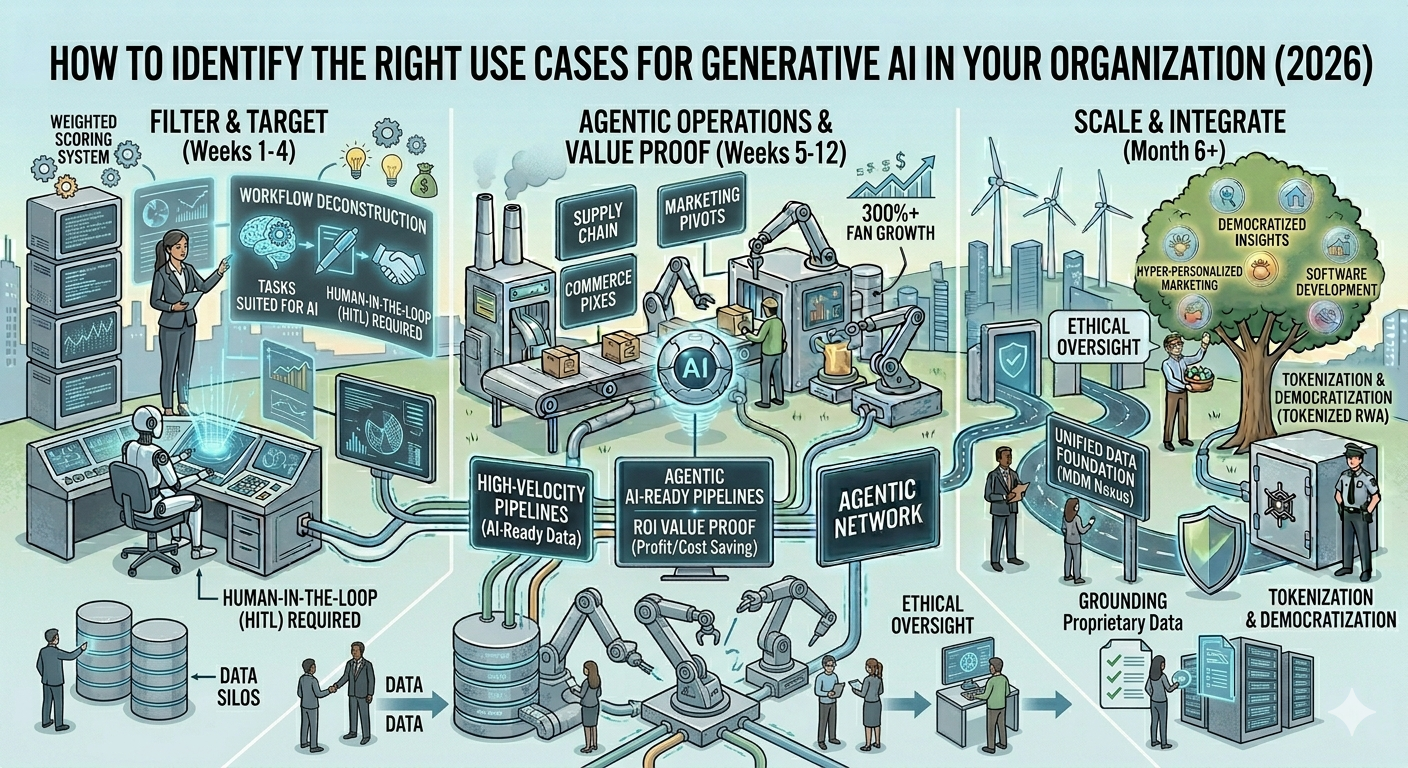
Here’s a quick way to identify where GenAI can actually move the needle in your organization:
Prioritize Use Cases Tied to Revenue or Cost
Don't use GenAI just for the sake of adoption. Focus on areas that have a strong potential for revenue growth:
- Customer Service and Experience: Intelligent chatbots together with automated follow-ups and hyper-personalization.
- Content & Marketing: Personalized email campaigns together with automated marketing text that operates at high capacity.
- Sales Enablement: Next-best-action recommendations together with call summary extraction to support its operations.
Look for Customer Experience Gaps
If your audience is struggling with slow response times or generic interactions, that is a prime candidate for generative AI solutions.
For instance, GenAI eliminates drop-offs in digital e-commerce by providing context-aware support that responds to queries without requiring human involvement. Additionally, it replaces highly customized interactions with generic marketing outreach.
Focus on High-Volume Work
Whether it’s processing legal documents, triaging customer support tickets, or generating thousands of product descriptions, high-volume tasks are the prime candidates for genAI solutions.
In these scenarios, even incremental improvements in speed lead to massive cumulative gains in enterprise productivity. What takes hours manually can often be reduced to minutes, at scale.
The best starting points are “data router” roles, where teams spend significant time summarizing reports, extracting key information, or categorizing content. Automating these tasks does more than save time. It allows talented people to concentrate on high-value, strategic tasks.
GenAI works best where there is both volume and repetition; this makes these use cases the fastest path to visible impact:
- Operations & Back Office: Large-scale compliance checks, document classification, and invoice processing.
- Legal & Compliance: Policy summarization across massive document collections, contract evaluation, and clause extraction.
- Customer Support: This includes knowledge base updates for high-volume queries, response drafting, and ticket triage.
Start Where Implementation Is Fast, and Risk Is Low
Not every use case needs to be complex or novel at first. Make sure to start with internal workflows, such as content drafting or employee support. They are easy to test, show quick results, and help you scale GenAI later.
Here are some good starting points:
- Internal knowledge assistants for employees
- Automated report or email drafting
- Meeting summaries and action item extraction
- Basic customer query handling with AI support
Industry-Specific Use Cases Where Generative AI Is Delivering Measurable ROI
Generative AI creates the most impact when applied to industry-specific workflows and challenges. Organizations that pair GenAI with the expertise of a data and analytics services company are better positioned to scale these use cases effectively. Here’s a quick view:
Here’s how this plays out across industries:
How to Build a Practical Framework for Evaluating GenAI Use Cases?
If you already have a list of potential use cases, the next challenge is deciding which to prioritize. This is why you need a framework that balances feasibility with strategic value.
This is a quick 3-step framework for assessing generative AI solutions:
Step 1: The Strategic Value Audit
Determine if the use case moves a primary business lever.
Does it:
- Drive Revenue: Enable hyper-personalization that increases conversion?
- Reduce Cost: Automate high-volume content production or document processing?
- Mitigate Risk: Improve compliance accuracy or fraud detection?
Step 2: The Data Readiness Check
A use case is only as strong as its data, which makes effective data management essential.
- Accessibility: Is the data accessible through APIs, or is it segregated?
- Quality: Is the information clear, identified, and impartial?
- Security: Is it possible to use the data in an LLM framework without going against privacy laws?
Step 3: Impact Mapping vs. Complexity
Plot your ideas on a matrix.
- Quick Wins: Low Complexity and High Impact (e.g., automated email writing, internal knowledge bots).
- Strategic Bets: High Complexity and High Impact (e.g., AI-driven drug research, autonomous customer support agents).
- De-prioritize: Low impact and High Complexity.
Make Generative AI Work Where It Matters Most
The most successful leaders are trading the AI "hype" for high-impact use cases tied to real ROI and solid data. This change turns AI from a collection of disparate trials into a targeted source of economic value.
This is where the right strategic partner becomes critical. As a premier data and analytics services company, Straive helps enterprises move from "pilot purgatory" to structured, scalable generative AI solutions.
With this foundation in place, organizations are better positioned to apply GenAI with clarity and purpose. The right use cases will not just support your strategy; they will shape it.