 Sign up with Google
 Sign in with Zoho

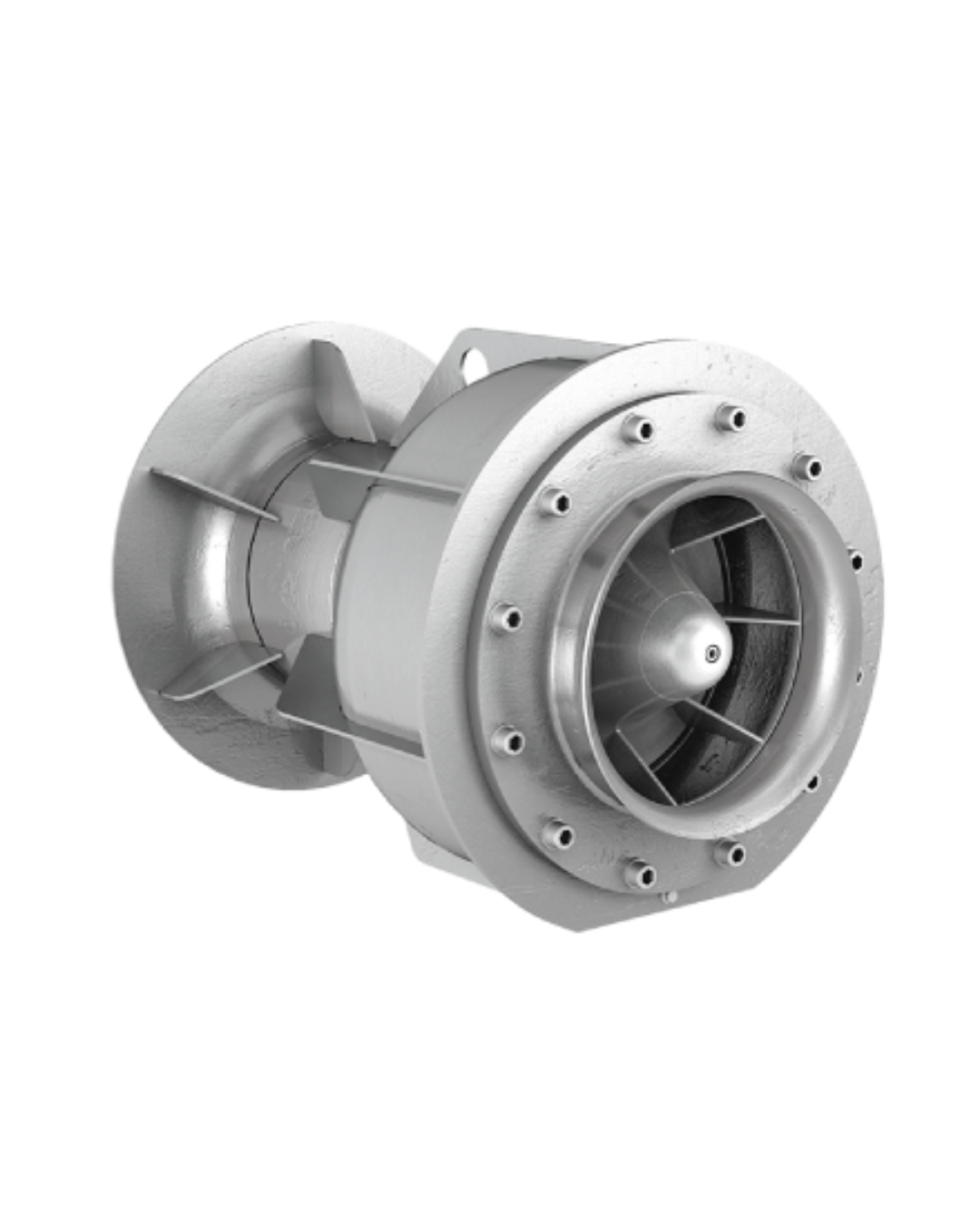
A maintenance shift at a coastal power plant turned tense when a nearby transformer failure produced a sudden pressure pulse through an exhaust shaft. The building’s ventilation alarm registered a sharp spike, and technicians watched as a correctly specified blast valve snapped shut, protecting the control room from reverse-flow debris and overpressure. That incident underscores the practical question many engineers and safety managers ask: how much air pressure can a blast valve handle?
What blast valves are?
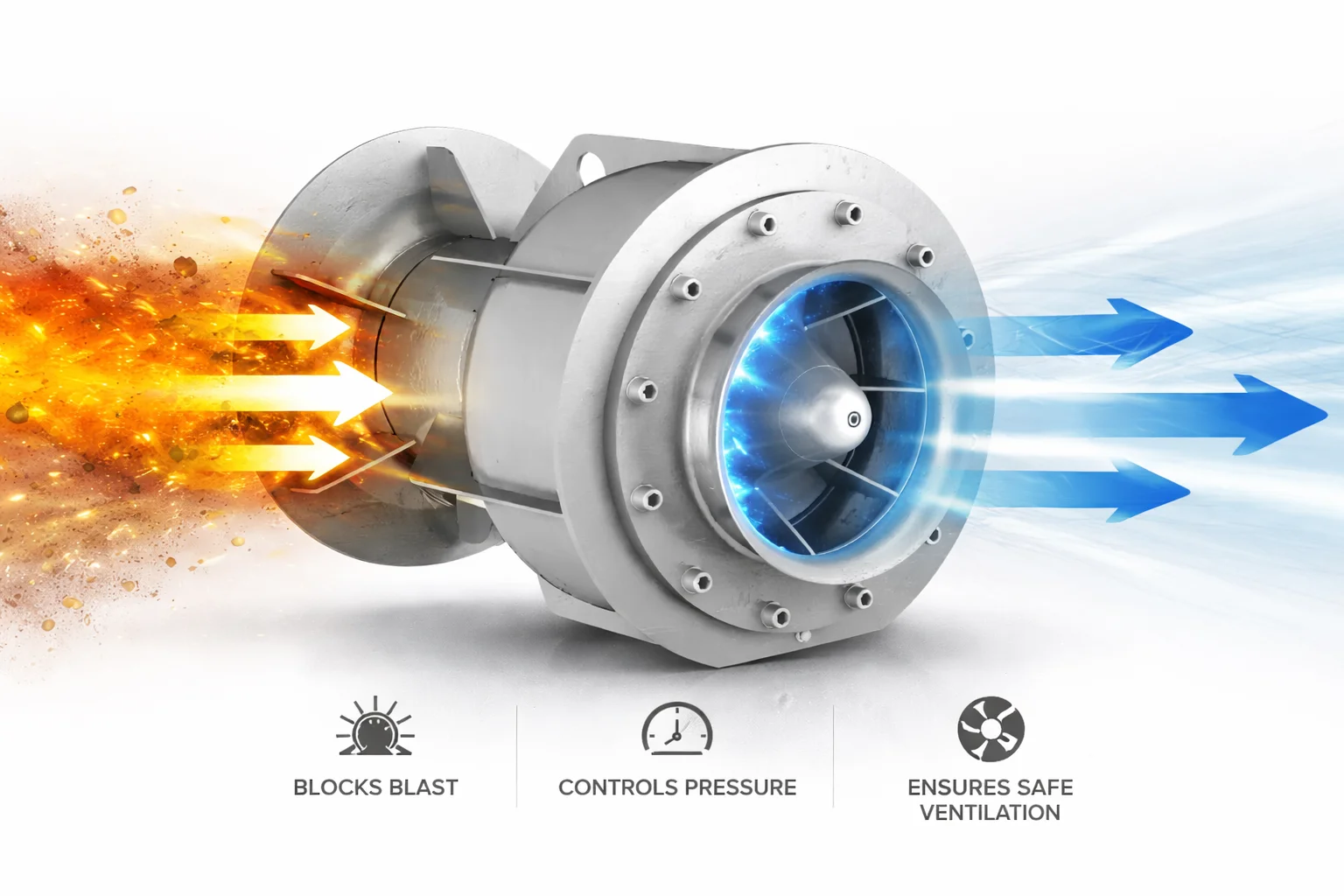
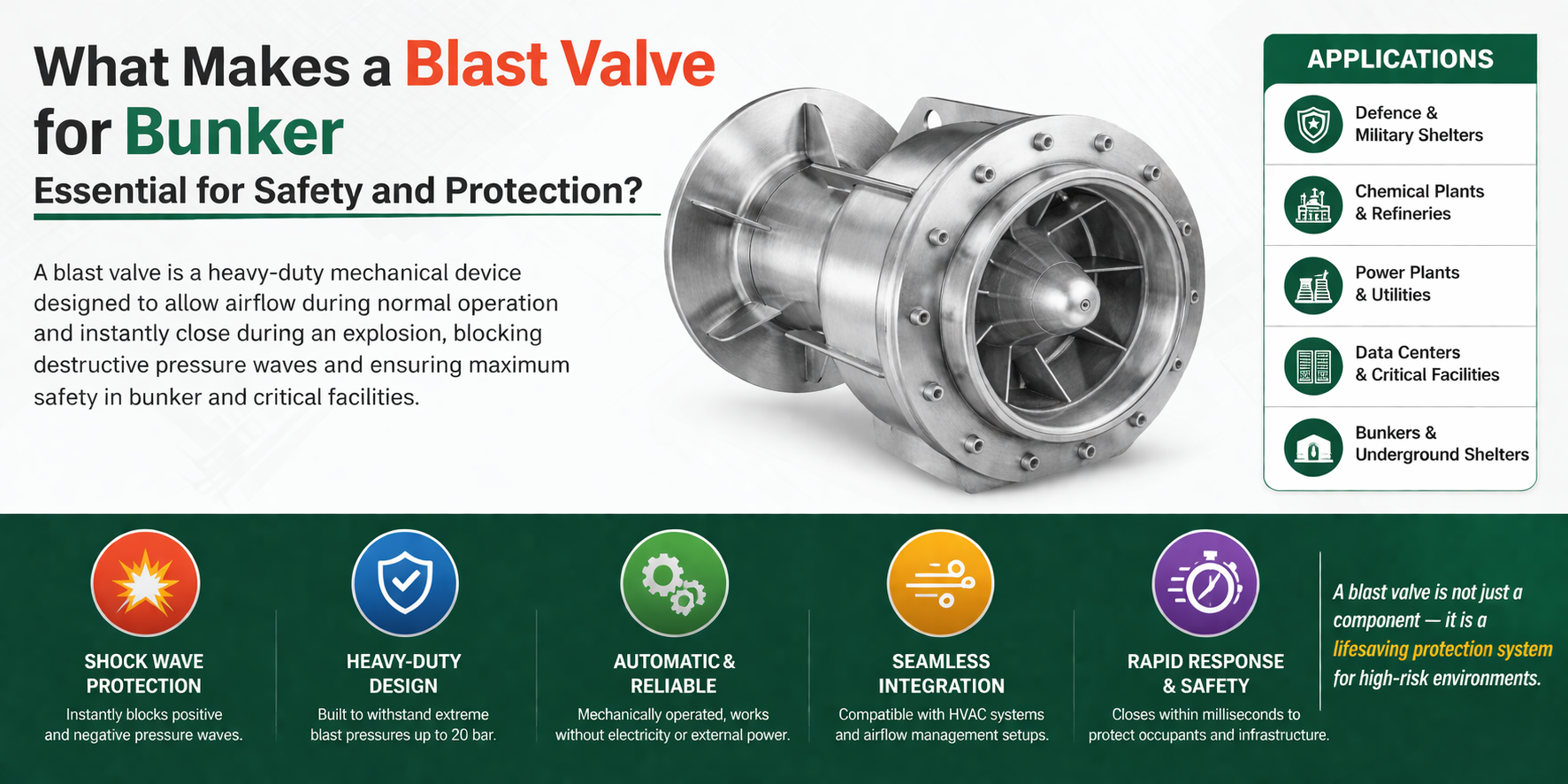
Blast valves are engineered closure devices that allow normal ventilation airflow but rapidly isolate a protected volume when exposed to blast overpressure or shockwaves. They differ from ordinary HVAC dampers or blast gates by being structurally reinforced, tested to sustain impulsive loads, and designed to seal reliably under dynamic pressure.
Purpose, function, and roleThe primary role of blast valves is life-safety and asset protection. In bunkers, command centers, industrial enclosures, and critical HVAC ducts they prevent shockwave transmission, protect filtration systems, and maintain survivable internal pressures. They also reduce the risk of secondary damage from flying debris and reverse flow.
How blast valves work under explosion pressure?
Blast valves rely on a mix of mechanical design and controlled response:
- Detection and trigger: many rely on the incoming pressure wave itself (mechanical activation) rather than electronic sensors, to avoid delays or power dependency.
- Rapid closure: closure elements — flaps, weighted plates, or piston assemblies — move within milliseconds to reduce the open area and block the shockwave.
- Pressure regulation: some designs vent impulse energy to sacrificial chambers or use staged closure to moderate pressure transmission.
- Return to service: after the event, valves often reset automatically or are inspected and manually reset depending on the design and damage sustained.
Designs vary, but the goal is predictable, repeatable performance under short-duration, high-amplitude loads.
How much pressure can a blast valve handle?
There is no single answer—blast valve capacity depends on rating and design. Typical industry ranges include:
- Low to medium protection: valves rated around 0.1–0.5 bar (10–50 kPa) of overpressure are used for lighter industrial risks.
- Medium to high protection: many military and hardened infrastructure valves are rated from 0.5–2.0 bar (50–200 kPa).
- Specialized high-performance: some bespoke valves or reinforced assemblies are designed for overpressures beyond 2.0 bar with tailored impulse and duration characteristics.
Important qualifiers:
- Overpressure vs. impulse: valves are rated for both peak overpressure and impulse duration (ms). A valve that survives a 0.5 bar short pulse might fail under a longer-duration blast with the same peak.
- Directionality: ratings may differ for incident (incoming) versus reflected pressure, and for positive (compression) versus negative (suction) phases.
- Certification and testing: true capacity is proven by blast testing, finite-element analysis, and fatigue testing; manufacturer data and third-party reports are essential.
Key features that determine capacity
A valve’s ability to handle pressure links directly to these attributes:
- Pressure resistance: validated peak overpressure and impulse acceptance.
- Structural strength: frame and closure materials sized to avoid plastic deformation.
- Corrosion resistance: material selection (stainless steel, coatings) to keep strength over life.
- Durability: resistance to cyclic loads and particulate erosion.
- Sealing efficiency: low-leakage seals to maintain protected-zone integrity.
- Airflow management: sufficient free area for normal HVAC duty without excessive pressure drop.
- Safety performance: redundancy, controlled failure modes, and proven reset/inspection processes.
Where blast valves are used
Common applications include:
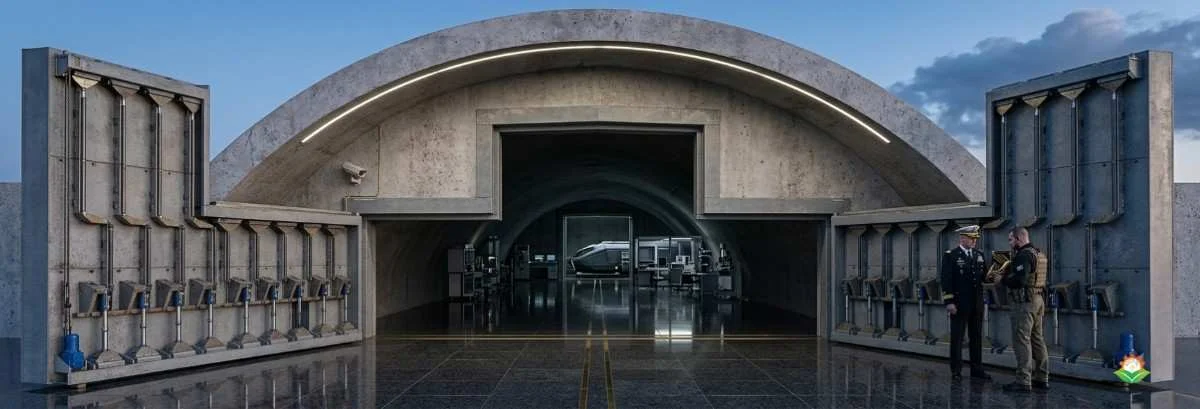
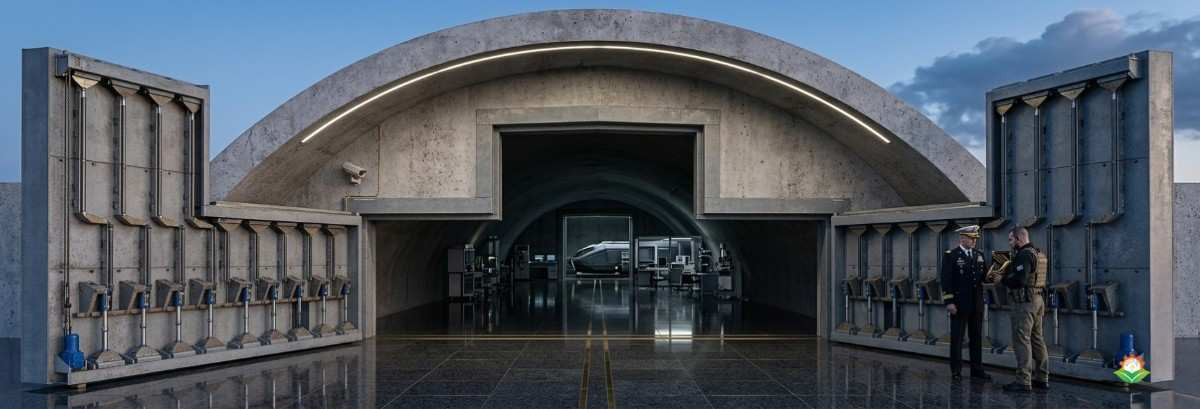
- Bunkers and shelters — blast valve for bunker installations enable habitability while protecting occupants from shockwaves.
- Industrial facilities — chemical plants, refineries, and storage vaults.
- Defense infrastructure — hardened command and munition storage sites.
- HVAC systems — blast valve HVAC integrations balance protection with climate control and filtration.
- Power plants — control rooms and generator housings.
- Hazardous environments — laboratories, battery stores, and disposal facilities.
Factors affecting blast valve price in India
Blast valve price varies with technical complexity and market factors. Key price drivers:
- Material quality: higher-grade alloys and protective coatings increase cost.
- Pressure rating: higher-rated valves need heavier construction and testing.
- Valve design complexity: multi-stage closures, hydraulic actuators, or sensor integration add cost.
- Custom engineering: site-specific geometry or retrofit requirements raise the price.
- Certification standards: third-party testing and compliance documentation add manufacturing costs.
- Installation environment: confined spaces, remote sites, or need for structural reinforcement raise total project cost.
- Manufacturing precision: tight tolerances and quality assurance increase production expenses.
- Size and airflow capacity: larger valves for high volumetric flow cost more in materials and handling.
How to choose blast valve manufacturers in India
Evaluate suppliers with these criteria:
- Industry experience: documented projects for blast valve for bunker and defense uses.
- Engineering standards: design calculations, FEA, and quality management systems.
- Product testing: independent blast, impulse, and fatigue test reports.
- Compliance certifications: adherence to national and international safety and construction codes.
- Customization capability: ability to tailor valves to existing HVAC or ductwork.
- Technical support: installation, commissioning, and maintenance services.
- Long-term reliability: warranties, spares availability, and service contracts.
Common mistakes to avoid when selecting solutions
Avoid these frequent errors:
- Choosing based only on price: low cost often means inadequate testing or materials.
- Ignoring pressure ratings: use facility-specific worst-case scenarios, not generic numbers.
- Poor compatibility with HVAC systems: mismatched valves create undue pressure drop and noise.
- Overlooking maintenance requirements: seals, bearings, and actuators need scheduled checks.
- Using incorrect specs for high-risk facilities: bunkers and control rooms require higher safety margins.
Conclusion
Blast valves protect people and infrastructure by responding rapidly to overpressure events, but capacity depends on detailed ratings for peak pressure and impulse. Choose valves with verified testing, appropriate materials, and compatible HVAC integration to ensure reliable performance. Prioritizing engineering, certification, and proper installation over initial blast valve price delivers dependable protection when it matters most.