Sign up with Google
 Sign in with Zoho

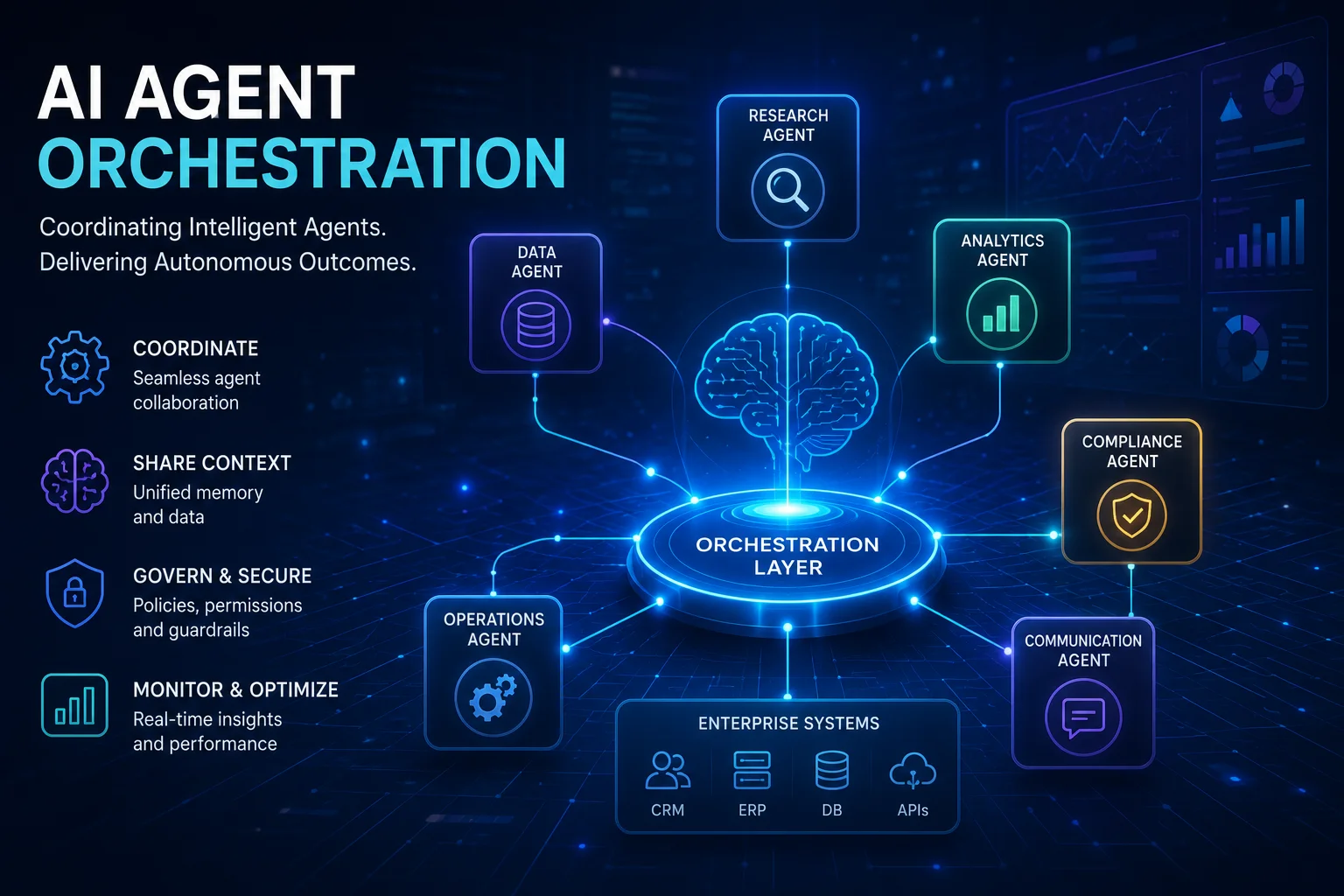
Artificial intelligence has evolved beyond simple chatbots and task-specific assistants. Today, enterprises are deploying multiple AI agents to automate customer support, document processing, compliance, software development, and business operations. While individual AI agents can deliver measurable value, managing dozens of autonomous systems introduces a new challenge—coordination.
This is where AI agent orchestration becomes essential. It provides the framework that enables multiple AI agents to communicate, share context, execute workflows in the correct order, and operate under consistent governance.
Why AI Agent Orchestration Matters
As organizations adopt more AI-powered tools, isolated agents often create fragmented workflows. One agent may retrieve customer data, another may generate reports, while a third validates compliance requirements. Without orchestration, these agents can duplicate tasks, produce conflicting outputs, or miss critical workflow steps.
An orchestration layer acts as the central coordinator. It assigns tasks, manages shared context, monitors execution, and ensures every AI agent contributes toward a common business objective. This transforms disconnected automation into an intelligent, enterprise-wide system.
Business Benefits
Organizations implementing AI agent orchestration can achieve significant operational improvements, including:
- Faster execution of complex business processes
- Reduced manual intervention and repetitive work
- Consistent decision-making across AI systems
- Better governance, monitoring, and auditability
- Easier integration with existing enterprise applications
Industries such as banking, insurance, healthcare, and manufacturing are increasingly adopting multi-agent architectures to improve productivity while maintaining compliance and security.
Building an Enterprise-Ready Orchestration Framework
Successful AI orchestration is not just about connecting multiple models. It requires a well-designed architecture that balances automation with governance.
Some key principles include:
- Start with focused use cases. Begin with a single workflow before expanding across departments.
- Maintain shared context. AI agents should have access to the same information to avoid inconsistent decisions.
- Implement governance controls. Define permissions, approval workflows, and monitoring for high-risk activities.
- Keep humans involved where needed. Financial approvals, legal reviews, and compliance decisions often require human oversight.
- Measure performance continuously. Track accuracy, execution time, cost savings, and business outcomes to optimize workflows over time.
Following these principles allows enterprises to scale AI adoption without sacrificing control or reliability.
The Role of Open Standards
Modern AI ecosystems increasingly rely on standardized communication protocols that allow agents developed by different vendors to work together. This interoperability reduces vendor lock-in, simplifies integration, and enables organizations to build flexible AI environments capable of evolving alongside new technologies.
Instead of replacing existing systems, AI agent orchestration connects enterprise applications, databases, APIs, and business workflows into a coordinated automation platform.
Looking Ahead
The future of enterprise AI is not about deploying more individual agents—it is about enabling them to work together efficiently. Organizations that invest in orchestration today will be better positioned to automate complex operations, improve decision-making, and respond more quickly to changing business needs.
As AI adoption continues to accelerate, enterprises need more than powerful language models. They need a structured orchestration strategy that combines automation, governance, security, and scalability.
AI agent orchestration is rapidly becoming the foundation for autonomous business systems. By treating orchestration as a core architectural capability rather than an afterthought, organizations can move beyond isolated AI pilots and build intelligent ecosystems that deliver long-term business value.