Sign up with Google
 Sign in with Zoho

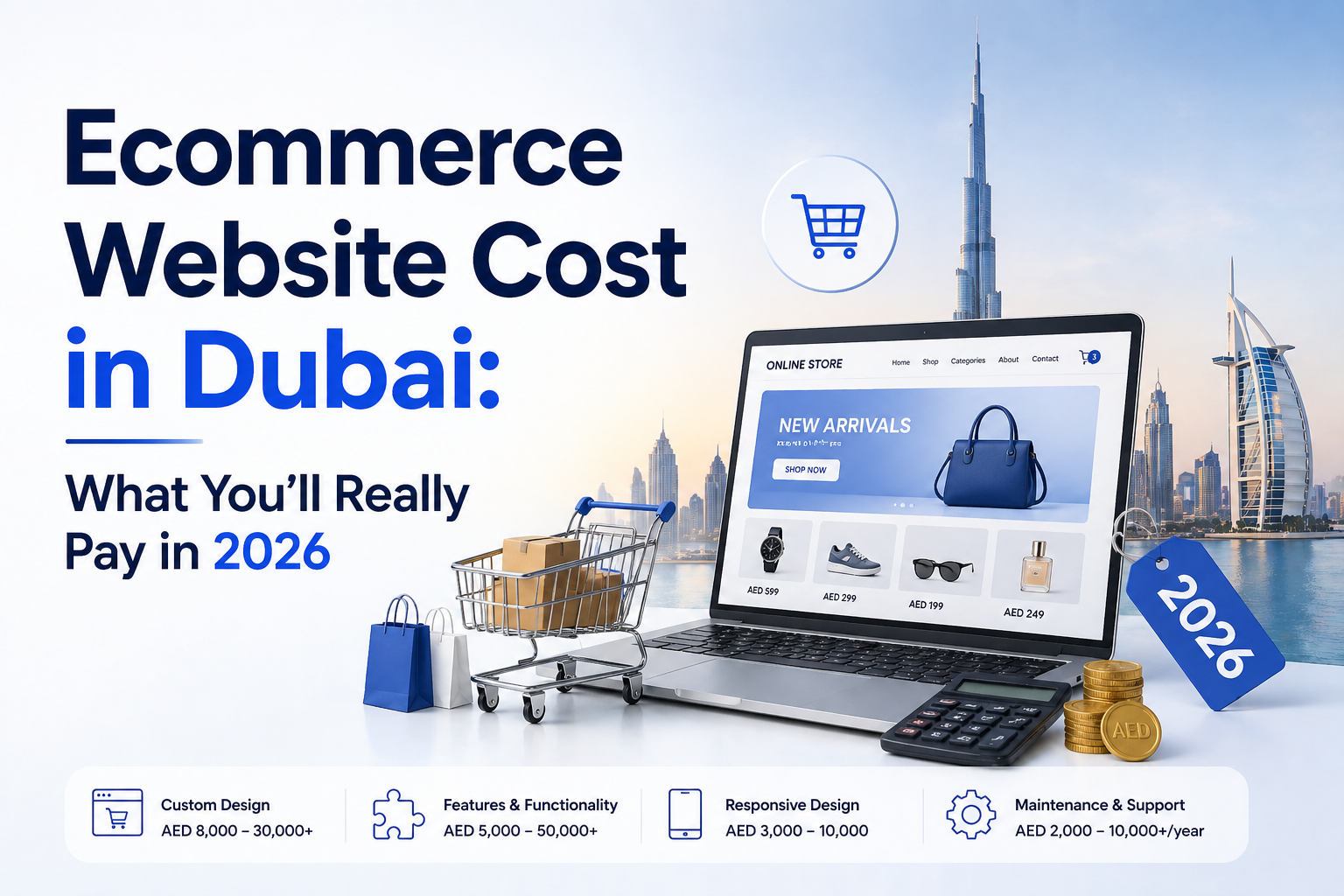
The UAE ecommerce market hit $8.2 billion in 2023, and it is still growing. If you are a business owner in Dubai thinking about selling online, the timing has never been better. But before you launch, you need an honest answer to the most common question: how much is this actually going to cost?
This guide breaks down ecommerce website costs in Dubai, not just the development bill, but everything else that comes with it. By the end, you will know exactly what to budget for and where it makes sense to spend more.
Why Ecommerce Costs More Than a Regular Website
Building an online store is fundamentally more complex than building a business website. A standard website shows information. An ecommerce website processes transactions, manages inventory, handles returns, integrates with payment gateways, sends automated emails, and needs to be fast and secure at all times.
In Dubai specifically, there are added layers of complexity:
- Bilingual support: Arabic and English are both standard expectations
- Local payment gateways: Telr, PayTabs, and Network International are popular in the UAE
- VAT compliance: UAE VAT (5%) must be correctly applied and displayed at checkout
- Delivery integrations: Aramex, Fetchr, and other UAE-based logistics APIs
- Mobile-first design: Over 70% of UAE online shoppers browse on mobile
Each of these adds to the cost. Knowing this upfront saves you from sticker shock later.
Ecommerce Website Cost Breakdown in Dubai (2026)
Here is a realistic cost breakdown based on the current market in Dubai:
Tier 1: Starter Ecommerce Store
Price Range: AED 8,000 – AED 18,000
This works for small businesses launching online for the first time, boutiques, home-based brands, or businesses with fewer than 50 products.
What is typically included:
- Shopify or WooCommerce setup
- Up to 50 products uploaded
- One payment gateway integration
- Basic shipping and tax configuration
- Mobile responsive design
- SSL certificate
- Basic SEO setup
Best for: Small retailers, fashion startups, artisan brands, home businesses going digital
Tier 2: Mid-Size Ecommerce Store
Price Range: AED 18,000 – AED 45,000
This is where most established Dubai SMEs land. You get a more customized design, better functionality, and integrations that support real business operations.
What is typically included:
- Custom or heavily modified design theme
- Up to 500 products
- Multiple payment gateways
- Arabic + English bilingual support
- Inventory management
- Email marketing integration (Mailchimp, Klaviyo, etc.)
- Advanced filters and search
- Analytics and conversion tracking setup
- Speed and performance optimization
Best for: Growing retail brands, multi-category stores, businesses replacing a physical-first model with online
Tier 3: Large or Custom Ecommerce Platform
Price Range: AED 45,000 – AED 150,000+
Businesses with large catalogs, complex logistics, or specific technical needs often require a fully custom-built platform. This is common among larger UAE retailers, supermarkets, and B2B companies moving to digital.
What is typically included:
- Fully custom frontend and backend development
- ERP or CRM integration (SAP, Salesforce, etc.)
- Custom product configurators or pricing logic
- Advanced delivery and warehouse management
- Multi-vendor or multi-store setup
- Dedicated QA and testing phases
- Ongoing development retainer
Best for: Enterprise retailers, B2B companies, supermarkets, multi-brand groups
Hidden Costs That Most People Miss
The development cost is just one part of the total investment. Here is what many Dubai business owners do not budget for upfront:
1. Payment Gateway Setup Fees: In the UAE, payment gateways like Telr and PayTabs charge setup fees (typically AED 500–2,000) plus transaction fees (1.5%–3% per sale). Factor this into your margin calculations from day one.
2. Product Photography: If your product images are not of professional quality, your conversion rate will suffer. Professional ecommerce photography in Dubai costs AED 50–200 per product. For a 100-product store, that is AED 5,000–20,000 before you even launch.
3. Content and Copywriting: Every product needs a description. A category page needs copy. Your homepage needs a headline that converts. Professional ecommerce copywriting in Dubai typically costs AED 50–150 per product description and AED 500–2,000 per page.
4. SEO and Digital Marketing: A new ecommerce store with zero marketing will generate zero sales. Budget for at least 3–6 months of SEO or paid ads to build traffic. SEO retainers in Dubai range from AED 2,000 to 8,000/month. Google Ads budgets depend on your category, but AED 3,000–10,000/month is common for starting out.
5. Ongoing Maintenance: Ecommerce websites need regular updates, platform updates, security patches, speed optimization, and bug fixes. Monthly maintenance packages in Dubai typically cost AED 800–3,000/month.
6. Annual Hosting: Good ecommerce hosting (fast, secure, with daily backups) costs AED 1,500–5,000/year, depending on your traffic volume and platform.
Platform Comparison: Shopify vs WooCommerce vs Custom
Choosing the right platform is one of the most important decisions in your ecommerce project. Here is how the main options compare for UAE businesses:
Shopify is the fastest to launch and easiest to manage. It works well for most small to mid-size UAE retailers. The tradeoff is monthly subscription fees and less flexibility for complex customizations.
WooCommerce gives you more control and lower ongoing costs, but requires more technical maintenance. It is a strong choice if you are already on WordPress.
Custom platforms make sense only when your business requirements genuinely cannot be met by existing solutions. For most UAE SMEs, they are overkill.
What a Realistic First-Year Ecommerce Budget Looks Like
Here is a full first-year cost estimate for a mid-size ecommerce store in Dubai:
This might look like a lot. But compare it to the cost of a retail lease in Dubai, which easily runs AED 80,000–300,000/year, and the math starts to look very different.
For more context on overall web design and development pricing in Dubai, this detailed breakdown of Website Development cost in Dubai is worth reading before you finalize your budget.
Tips to Keep Costs Under Control
You do not need to spend the maximum to get a great ecommerce store. Here is how to be smart about it:
Start smaller than you think you need: Launch with your top 20–50 products. Validate demand. Then expand. A lean launch is better than a bloated one that takes 6 months and burns your budget before you make a single sale.
Use a proven platform: Unless you have very specific requirements, Shopify or WooCommerce will serve you well at a fraction of the cost of a custom build.
Separate the must-haves from the nice-to-haves: Arabic support, mobile optimization, and payment gateway integration are must-haves in Dubai. A custom loyalty program and AI-powered recommendations can wait.
Get a fixed-price contract: Avoid agencies that quote on a time-and-materials basis for ecommerce projects. Fixed price means you know what you are spending. Any additions go through a formal change request.
FAQs: Ecommerce Costs in Dubai
Q1. How much does it cost to build an ecommerce website in Dubai?
It depends on the size and complexity. A starter store costs AED 8,000–18,000. A mid-size store with full features costs AED 18,000–45,000. Large custom platforms can exceed AED 150,000. Always get a detailed scope before comparing quotes.
Q2. Which is cheaper, Shopify or a custom-built ecommerce store?
Shopify is significantly cheaper upfront. A Shopify store can be set up for AED 8,000–25,000 with ongoing monthly plan fees. A custom-built store typically starts at AED 60,000 and involves higher long-term maintenance costs.
Q3. Do I need Arabic language support for my UAE ecommerce store?
If any portion of your target customers are Arabic speakers, which is highly likely in Dubai, yes. Arabic RTL support adds AED 3,000–8,000 to the project cost but can significantly expand your addressable market.
Q4. What payment gateways work best for UAE ecommerce?
Telr, PayTabs, and Network International are the most popular UAE-based options. Stripe also operates in the UAE now. Most agencies in Dubai will handle the integration as part of the build.
Q5. How long does it take to build an ecommerce website in Dubai?
A starter store takes 4–6 weeks. A mid-size store typically takes 8–14 weeks. Custom enterprise platforms can take 4–9 months. Timelines depend on how quickly you provide content, approvals, and feedback.
Q6. Is it worth building an ecommerce store in Dubai in 2026?
Yes. The UAE has one of the highest smartphone penetration rates in the world and a consumer base that is very comfortable with online shopping. The market is competitive, but there is genuine demand across almost every product category.
Q7. Can I run an ecommerce store in Dubai without a trade license?
No. UAE law requires a valid trade license to operate an ecommerce business. You will also need it to open a corporate bank account and set up a payment gateway. An e-trader license from Dubai Economy & Tourism is the most accessible starting point for home-based sellers.
Final Word
Building an ecommerce store in Dubai is an investment, not just in a website, but in a new revenue channel for your business. The costs are real, but so is the opportunity.
The businesses that succeed online in the UAE are not the ones that spent the most. They are the ones that planned carefully, chose the right platform, launched with a clear product focus, and invested consistently in marketing and optimization after launch.
Get your budget right from the start. Understand what you are paying for. And choose an agency that treats your business goals, not just your design brief, as the real project.