Sign up with Google
 Sign in with Zoho

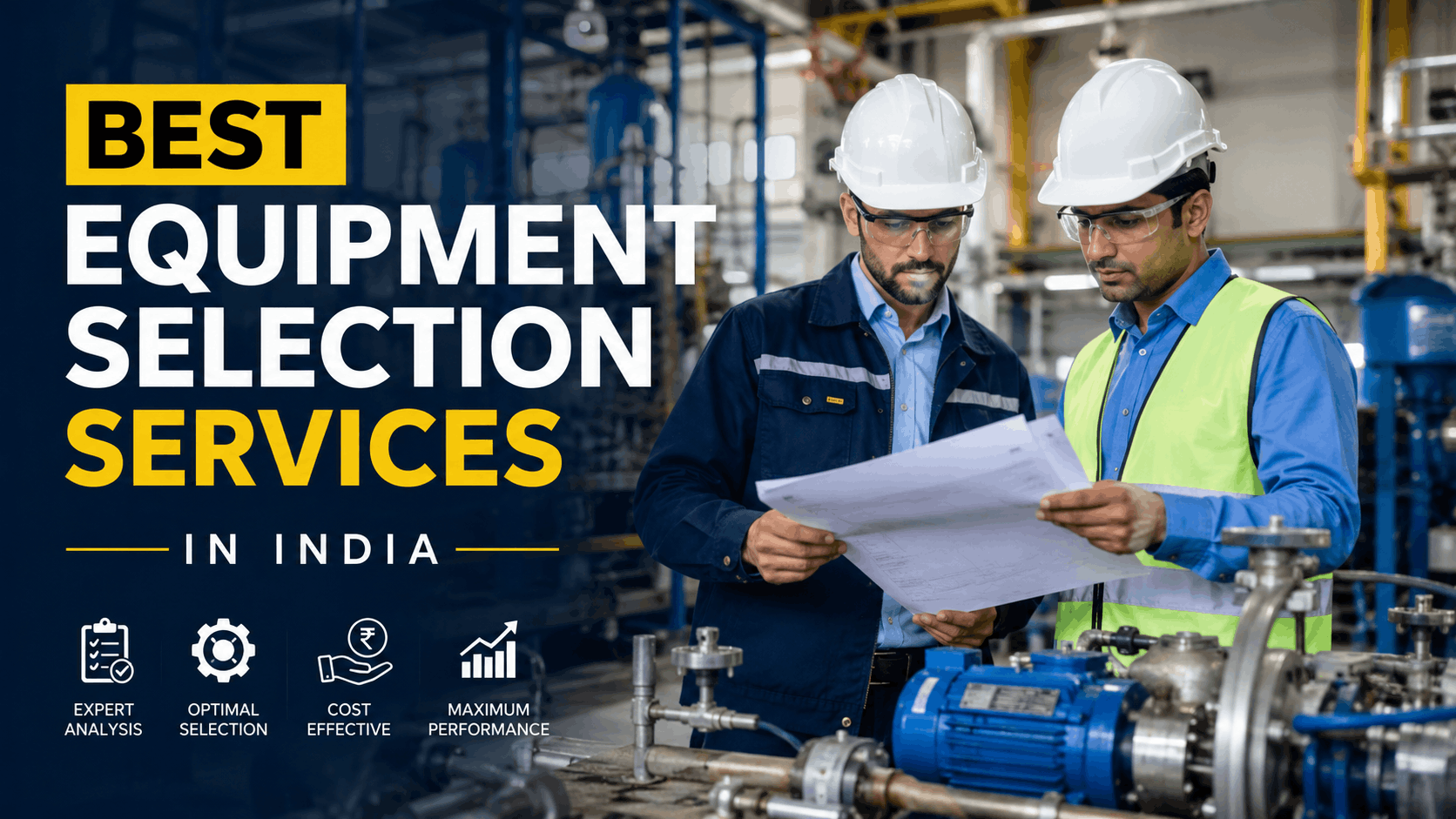
India's manufacturing sector is in the middle of its most ambitious capital deployment cycle in a generation. The industry is witnessing strong growth, driven by rising industrial development, infrastructure expansion, and increasing investment across sectors, with manufacturing CAPEX rising significantly in FY2024-25 and FY2025-26. Private corporate capital expenditure in manufacturing accounts for over 50% of total CAPEX in 2025-26. India's HSBC Manufacturing PMI hit a 17-year peak of 59.2 in July 2025, signalling robust expansion in output and new orders.
Behind each of these investments is a long list of critical decisions. And the most consequential of them, made before a single civil contract is awarded, is equipment selection. Choose wrong and you pay for it across the entire operating life of the facility, in underperformance, excessive maintenance, regulatory non-compliance, and capacity constraints that require expensive remediation. Choose right, with structured technical advisory, and the facility is competitive from day one.
Yet equipment selection in India is persistently underserved. Manufacturers frequently receive equipment recommendations from vendors with an obvious commercial interest, or from general-purpose consultants without deep sector knowledge. This is why professional equipment selection Services in India are becoming increasingly important for modern industrial and manufacturing projects.
Why Equipment Selection Is the Highest-Leverage Decision in Any Industrial Project
Every downstream decision in a manufacturing project flows from equipment selection. Civil and structural design is driven by equipment footprint, weight, and vibration loads. Utility sizing for power, steam, compressed air, water, and effluent treatment is derived from equipment consumption profiles. Regulatory approvals under Factory Act, PESO, IBR, CPCB, CDSCO, and FSSAI are conditioned on equipment specifications. Commissioning timelines depend on equipment delivery schedules and vendor support availability. Maintenance cost over the operating life is largely fixed at selection stage.
The compounding effect of a wrong selection at this stage is significant:
- Under-specified equipment constrains output and cannot be upgraded without significant capital expenditure
- Over-specified equipment generates excess capital cost and running cost with no operational return
- Equipment selected without Indian regulatory compliance verification requires costly modifications after import or local manufacture
- Vendor selection driven by price rather than whole-life cost analysis consistently delivers the highest total cost of ownership
- Equipment specified for ideal conditions without Indian operating environment consideration, including power quality, ambient temperature variation, dust, humidity, and utility supply intermittency, underperforms systematically and generates excessive maintenance burden
A qualified equipment selection consultant eliminates each of these failure modes through structured technical evaluation before any procurement commitment is made.
What a Structured Equipment Selection Service Covers
Equipment selection is not a vendor shortlisting exercise. It is a multi-stage technical advisory process that translates process requirements into equipment specifications, evaluates options against those specifications, and produces procurement-ready documentation that protects the owner's interest through the entire supply chain.
Stage 1: Process-Based Requirements Definition
Before any equipment is evaluated, the selection consultant translates process design into equipment duty specifications. This covers:
- Throughput requirements at nameplate capacity, design capacity, and future expansion targets
- Process fluid or material properties including corrosivity, viscosity, particle characteristics, temperature, and pressure
- Batch or continuous operation classification and cycle time requirements
- Cleaning-in-place (CIP), sterilisation-in-place (SIP), or washdown requirements for food, pharma, and dairy applications
- GMP, GAMP5, and clean utility standards for pharmaceutical and regulated sector equipment
- Redundancy requirements for critical process equipment where single-point failure generates unacceptable production risk
This specification work is done before vendor engagement, ensuring that evaluations are conducted against objective technical criteria rather than commercial presentations.
Stage 2: Technical Specification and BOM Development
From process requirements, the consultant develops formal technical specifications for each equipment item, including:
- Equipment type, capacity, and operational parameters
- Materials of construction with corrosion and contamination resistance verification
- Surface finish, seal type, and compliance standard for regulated sector applications
- Utility consumption for electrical, compressed air, steam, cooling water, and effluent
- Instrumentation and control interface requirements for SCADA, PLC, or DCS integration
- Vendor document requirements including drawings, manuals, test certificates, and FAT protocols
A complete Bill of Materials prepared at this stage supports accurate capital cost estimation, procurement planning, and schedule development. For lender-financed projects, the BOM and specifications form part of the independent engineer's technical assessment package.
Stage 3: Vendor Identification, Evaluation, and Qualification
India's equipment supply base for industrial and manufacturing projects spans domestic manufacturers, Indian subsidiaries of international OEMs, and direct imports. Each category has different cost, lead time, compliance documentation, and after-sales support profiles.
The selection consultant evaluates vendors across the following dimensions:
- Technical capability verification against equipment specifications
- Manufacturing quality system assessment including ISO 9001 status and sector-specific certifications
- Reference site verification for comparable applications and scale
- After-sales support infrastructure in India including spare parts availability, service engineer coverage, and response time commitments
- Financial stability assessment for vendors supplying long-lead critical equipment
- Regulatory compliance documentation including CE marking, ATEX certification for hazardous area equipment, IBR compliance for pressure systems, and sector-specific approvals
For critical equipment items, factory acceptance testing (FAT) at the vendor's facility, conducted by the owner's representative, is a standard risk mitigation measure that identifies specification non-conformances before dispatch rather than after installation.
Stage 4: Total Cost of Ownership Analysis
Purchase price is the least reliable indicator of equipment value. For industrial and manufacturing applications with 15 to 25-year operating lives, total cost of ownership analysis across capital cost, installation cost, energy consumption, maintenance, spares, and end-of-life considerations produces equipment rankings that differ significantly from price-only comparisons.
Energy cost alone illustrates the impact. A centrifugal pump with 5% lower efficiency than the optimal selection operating at 6,000 hours per year for 20 years generates energy cost differences that exceed the capital cost difference many times over. For a project with 50 to 100 such utility equipment items, the aggregate impact of efficiency-optimised selection is substantial.
Stage 5: Procurement Documentation and Tendering Support
The final deliverable of equipment selection is procurement-ready documentation: technical specifications for tendering, commercial terms for purchase orders, FAT and site acceptance test (SAT) protocols, and warranty condition frameworks. This documentation protects the owner throughout procurement by establishing clear, objective acceptance criteria that prevent scope creep, specification dilution, and vendor-driven substitution.
Sector-Specific Equipment Selection in India
Equipment selection requirements differ fundamentally by sector. A consultant without sector-specific knowledge will apply generic evaluation frameworks that miss the compliance and performance requirements that define fitness for purpose in regulated and technically complex applications.
Pharmaceutical manufacturing: GMP-compliant material of construction selection (316L SS with Ra surface finish verification, PTFE and USP Class VI polymer components), GAMP5-aligned control system specifications, CIP/SIP capability verification, IBR compliance for autoclaves and pressure vessels, and FDA/CDSCO audit-readiness documentation for all critical equipment.
Food and beverage processing: FSSAI-compliant food-contact material selection, EHEDG or 3-A hygienic design standard compliance, HACCP critical point instrumentation specifications, and cleaning validation compatibility assessment.
Chemical and specialty chemical: PESO and ATEX zone classification compliance for equipment in hazardous areas, materials selection for specific chemical compatibility including corrosion allowance calculations, pressure vessel design code compliance (IS 2825, ASME Section VIII), and environmental emission specifications for CPCB consent conditions.
Agrochemical manufacturing: ADG-compliant equipment for classified chemical handling, explosion-proof electrical area classification compliance, and CIB&RC registration-aligned production equipment specifications.
FMCG and consumer goods: High-speed packaging line equipment selection with OEE benchmarking against sector standards, changeover time optimisation for multi-SKU production, and total productive maintenance (TPM) compatibility assessment.
Common Equipment Selection Mistakes That Cost Indian Manufacturers Crores
Understanding where equipment selection fails helps manufacturers assess whether their current approach is adequate:
- Accepting vendor-recommended specifications without independent technical review creates a structural conflict of interest that consistently results in over-specified equipment, proprietary consumable dependencies, and inflated operating costs
- Ignoring Indian operating environment factors including power voltage variation (affecting motor and control system performance), high ambient temperatures (affecting cooling-dependent equipment), and particulate-laden air (affecting bearing and filtration service life)
- Selecting equipment on import lead time alone without verifying Indian after-sales support infrastructure, generating maintenance delays and extended downtime when specialist service engineers are not available in-country
- Failing to specify instrumentation and control interfaces at equipment selection stage, resulting in costly integration rework when SCADA or PLC integration is attempted post-installation
- Omitting FAT from the procurement process for critical equipment, discovering specification non-conformances at site where rectification cost and delay are substantially higher than at the vendor's facility
How IMARC Engineering Delivers Equipment Selection Services in India
IMARC Engineering provides equipment selection services in India across pharmaceuticals, food and beverage, chemicals, specialty chemicals, FMCG, agrochemicals, and industrial manufacturing. The service covers the complete selection lifecycle from process-based requirements definition through vendor evaluation, total cost of ownership analysis, and procurement documentation development.
Operating as an independent owner's representative with no commercial relationships with equipment vendors or suppliers, IMARC Engineering's equipment selection recommendations are made entirely on technical merit against owner-defined criteria. This independence is the foundational requirement for credible equipment advisory.
Key deliverables across an engagement include:
- Process-derived equipment duty specifications for every item in the equipment list
- Complete Bill of Materials with technical parameters and procurement specifications
- Vendor evaluation matrices covering technical compliance, quality systems, reference sites, and after-sales infrastructure
- Total cost of ownership analysis for capital equipment items with 15-year operating life modelling
- FAT and SAT protocols for critical equipment acceptance
- Procurement documentation including technical specifications for tendering, commercial terms, and warranty frameworks
For PLI scheme-linked manufacturing investments, equipment specifications are aligned with PLI performance threshold production volumes, ensuring that selected equipment can demonstrate the output levels required for incentive assessment. For lender-financed projects, equipment documentation is structured to meet independent engineer requirements and support draw-down milestone verification.
With India's manufacturing CAPEX at its highest level in a generation and production facilities across pharmaceutical, food, chemical, and FMCG sectors being commissioned at scale, the quality of equipment selection advisory has never been more consequential. Getting it right at selection stage costs a fraction of what remediation costs after commissioning.
Contact Us:
IMARC Engineering
Phone: +91-120-433-0800
Email: [email protected]
India: C-130, Sector 2, Noida, Uttar Pradesh 201301
LinkedIn: https://www.linkedin.com/showcase/imarc-engineering/


.webp)