
 Sign up with Google
 Sign in with Zoho

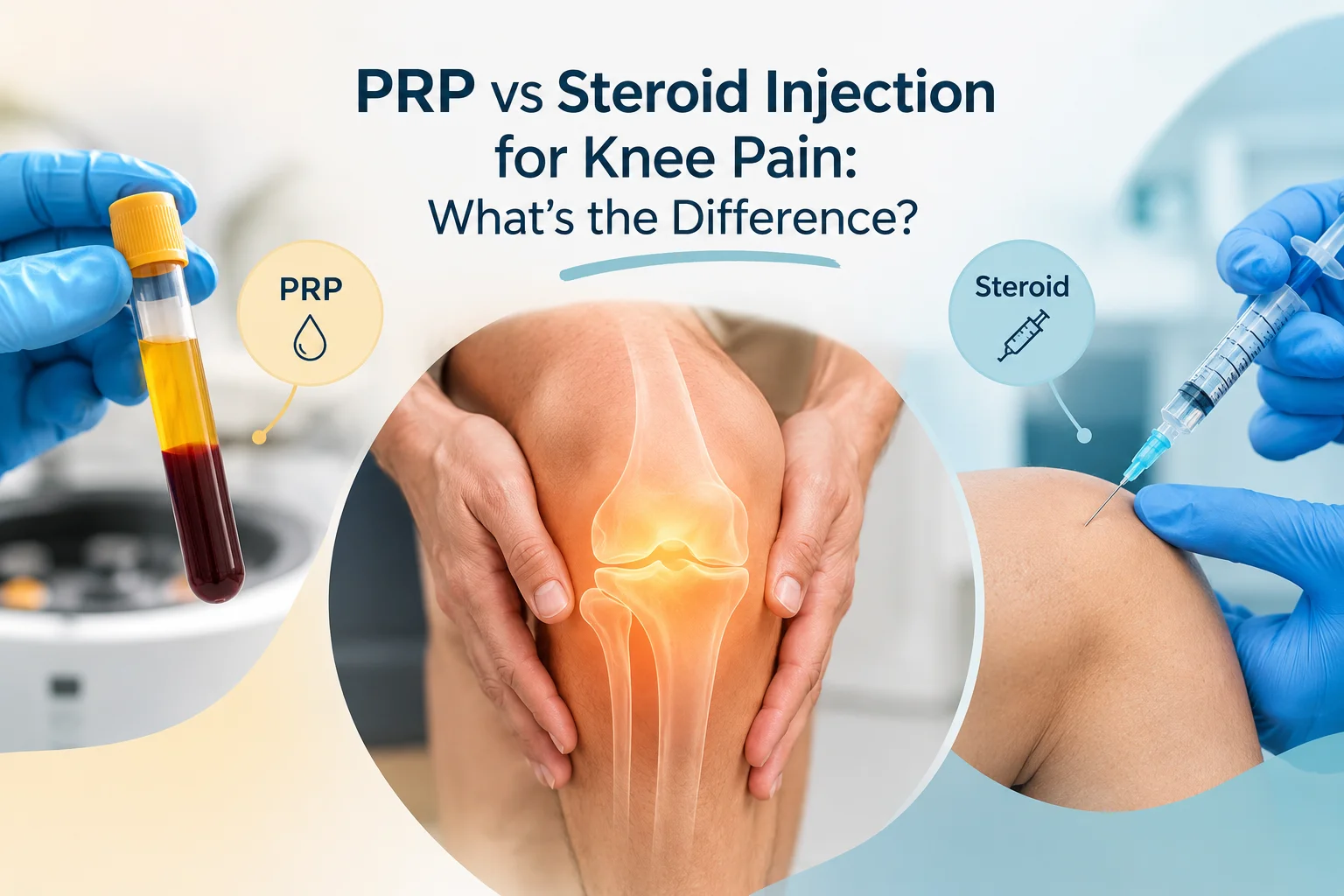
If knee pain is affecting walking, exercise or everyday activities, injections are sometimes considered when exercise, physiotherapy and other conservative measures have not provided enough relief. Two options that are often discussed are platelet-rich plasma (PRP) and corticosteroid injections. A PRP joint and soft tissue injection uses a preparation made from your own blood, whereas a corticosteroid injection uses an anti-inflammatory medicine delivered into or around the affected joint.
What is the difference between PRP and a steroid injection?
The main difference is what each injection is intended to do.
PRP is prepared from a small sample of your own blood. The blood is processed to concentrate platelets in plasma before the preparation is injected into the affected area. Platelets contain a range of biological substances involved in tissue repair and inflammation, although the exact mechanisms and clinical effects of PRP are still being studied. NICE notes that PRP for knee osteoarthritis involves injecting the preparation into the knee joint, commonly with ultrasound guidance.
A corticosteroid injection contains a medicine designed to reduce inflammation and ease symptoms. NICE recommends considering intra-articular corticosteroid injections for osteoarthritis when other pharmacological treatments are ineffective or unsuitable, or when they are being used to support therapeutic exercise. The guidance explains that the expected benefit is short term, generally around 2 to 10 weeks.
So, although both are injections for knee pain, they work in different ways and have different treatment goals.
PRP vs steroid injection for knee pain: how do the results compare?
Research comparing the two treatments has produced some encouraging findings for PRP, particularly over the medium and longer term, but the evidence is not completely uniform.
A 2024 systematic review and meta-analysis of 35 randomised controlled trials involving 3,348 people found that PRP produced greater improvements in some pain and function measures than corticosteroid injections at longer follow-up points.
Other reviews have reported similar findings. A 2021 meta-analysis of eight studies involving 648 people found better pain, stiffness and functional outcomes with PRP at three, six and nine months compared with corticosteroids.
However, this does not mean PRP is automatically the right choice for everyone. A 2025 systematic review of randomised trials concluded that both PRP and corticosteroid injections could reduce pain and improve symptoms, while noting that there was no clear consensus that one treatment was universally superior. The studies also differed in PRP preparation, injection protocols and follow-up periods.
This is important because research findings cannot always be applied to every person with knee pain in exactly the same way.
How long does each injection last?
Duration is one of the main differences people want to understand when comparing PRP with corticosteroids.
Corticosteroid injections are generally used for relatively rapid, short-term symptom relief. NICE states that the benefit for osteoarthritis is usually around 2 to 10 weeks.
PRP tends to be considered differently. It is not primarily used as a quick anti-inflammatory injection, and improvement may take longer to develop. Some studies have reported benefits lasting several months, with differences between PRP and corticosteroids becoming more noticeable at later follow-up.
The number of injections also varies between studies. There is no single PRP protocol used everywhere, which makes direct comparisons more difficult.
Is PRP suitable for knee osteoarthritis?
PRP has been investigated extensively for symptomatic knee osteoarthritis, particularly where pain, stiffness and reduced function are affecting everyday life.
NICE's guidance on PRP injections for knee osteoarthritis states that there are no major safety concerns identified by the available evidence, but it also highlights limitations in the quality of evidence around efficacy and recommends special arrangements around clinical governance, consent and audit or research.
That means PRP should not be presented as a guaranteed treatment or a way of reversing osteoarthritis. The underlying joint changes still need to be considered.
Assessment is particularly important because knee pain does not always come from osteoarthritis. Meniscal problems, tendon disorders, inflammatory joint conditions, ligament injuries and other causes can produce similar symptoms.
When might a steroid injection be considered?
A corticosteroid injection may be considered when knee osteoarthritis symptoms remain troublesome despite other measures, particularly where short-term pain relief could help someone take part in therapeutic exercise.
This distinction matters. The purpose is often to reduce symptoms enough to allow movement and rehabilitation rather than to treat the underlying structural changes permanently. NICE specifically recommends explaining the short-term nature of the benefit.
A clinician also needs to consider factors such as the diagnosis, previous treatments, other medical conditions and whether an injection is appropriate at all.
What should you consider before choosing PRP or steroids?
The decision should be based on the cause and severity of the knee problem rather than simply choosing the injection that sounds more advanced.
Important factors include:
- whether the pain is actually caused by osteoarthritis
- the severity and duration of symptoms
- previous treatments and their results
- your level of physical activity
- whether short-term or longer-term symptom control is the main goal
- the evidence and limitations of the treatment being considered
- whether imaging or further assessment is appropriate
- the risks, costs and practicalities of the injection
PRP preparation itself can also differ between clinics and studies, including platelet concentration and the presence of other blood components. This is one reason research results cannot always be transferred directly from one PRP protocol to another.
PRP vs steroid injection for knee pain: which should you choose?
There is no single injection that suits every person with knee pain.
Steroid injections have an established role in providing short-term relief for osteoarthritis, particularly when other treatments have not worked or when symptom control is needed to support exercise. PRP has also been studied extensively, with several systematic reviews reporting improvements in pain and function that persist beyond the short-term period seen with corticosteroids.
At the same time, NICE highlights the limitations and uncertainty surrounding the evidence for PRP, so it is important to discuss realistic expectations rather than assuming that PRP will produce a particular result.
A proper clinical assessment can help determine whether an injection is appropriate, which structure is causing the symptoms and what other measures should form part of the treatment plan. For many people with knee osteoarthritis, therapeutic exercise, strength work, weight management where appropriate and other conservative measures remain important alongside any injection treatment.
Frequently Asked Questions
Is PRP better than a steroid injection for knee pain?
Research has found that PRP can provide longer-lasting improvements in pain and function than corticosteroid injections in some studies, particularly at medium- and longer-term follow-up. However, results vary between studies and there is not enough evidence to say that PRP is universally better for every person.
How quickly does a steroid injection work for knee pain?
Corticosteroid injections are generally used for short-term symptom relief. NICE states that the benefit for osteoarthritis is usually around 2 to 10 weeks, although individual responses differ.
Does PRP permanently repair knee osteoarthritis?
No. PRP should not be described as a permanent cure for osteoarthritis. It is investigated as a treatment for symptoms such as pain and reduced function, but it does not mean that damaged cartilage is restored to normal.
Can PRP and steroid injections be used for every type of knee pain?
No. Knee pain can have many different causes, and an injection that is appropriate for osteoarthritis may not be suitable for a tendon, ligament, meniscal or inflammatory problem. Establishing the cause of the pain is an important part of deciding whether an injection is appropriate.