Sign up with Google
 Sign in with Zoho
India’s Ayurvedic industry is growing faster than ever. From herbal tablets and immunity boosters to skincare oils and wellness powders, consumers are actively choosing Ayurvedic products as part of their daily lifestyle.
According to industry reports, the Indian Ayurvedic and herbal products market is expected to continue strong growth in the coming years due to increasing awareness about natural healthcare, preventive wellness, and traditional herbal solutions. After COVID-19, demand for immunity products, herbal supplements, and plant-based wellness products increased significantly across India.
Because of this growth, many startups, doctors, wellness entrepreneurs, and healthcare businesses now want to launch their own Ayurvedic brands.
But one major question comes up before starting:
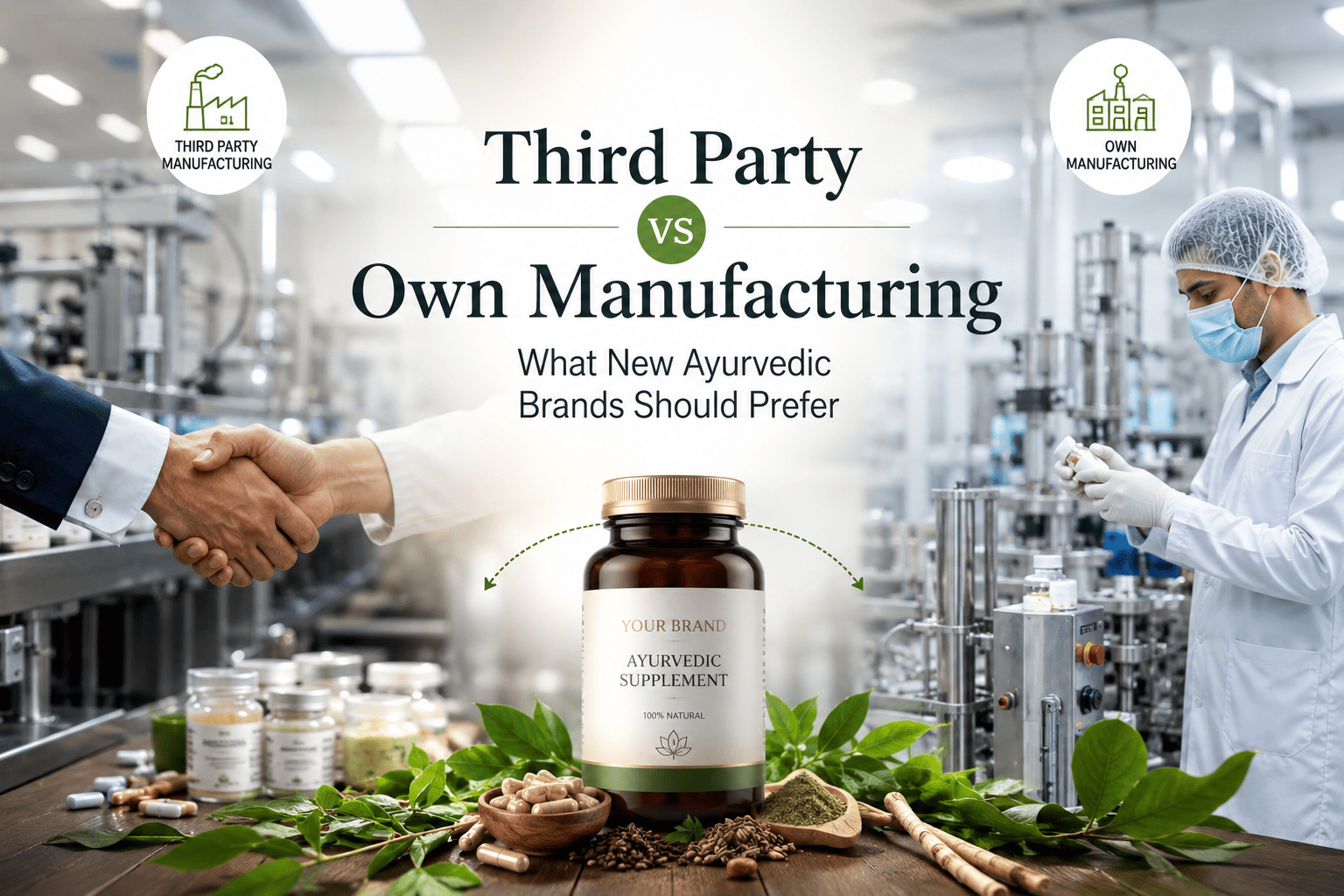
Should a new Ayurvedic brand invest in its own manufacturing facility or choose third-party manufacturing?
This is one of the most important decisions for any new business in the Ayurvedic industry because it affects:
- Investment cost
- Product quality
- Speed to market
- Scalability
- Business risk
- Profit margins
In this guide, we explain the complete difference between third-party manufacturing and own manufacturing for Ayurvedic brands in simple English with practical insights, real business considerations, and market realities.
If you are planning to launch an Ayurvedic brand in India, this article will help you make a practical and informed decision.
Understanding Third-Party Manufacturing in Ayurveda
Third-party manufacturing means outsourcing product manufacturing to an established Ayurvedic manufacturer.
In this model:
- The manufacturer produces the products
- The brand owner sells products under their own brand name
This is also called:
- Contract manufacturing
- Private labeling
For example:A startup may want to launch:
- Herbal capsules
- Ayurvedic syrups
- Immunity powders
- Herbal skincare products
Instead of setting up a factory, they partner with a GMP-certified Ayurvedic manufacturer who already has:
- Machinery
- Technical staff
- Manufacturing licenses
- Quality systems
- Packaging support
The products are then manufactured and packed under the startup’s own brand name.
This model has become extremely popular in India because it reduces investment and allows faster market entry.
Understanding Own Manufacturing
Own manufacturing means setting up your own Ayurvedic production facility.
In this model, the company:
- Purchases land or factory space
- Installs machinery
- Hires production staff
- Obtains licenses
- Manages quality control
- Handles production operations internally
This gives complete control over:
- Manufacturing
- Product development
- Capacity planning
- Production schedules
Large Ayurvedic companies often prefer own manufacturing because they have:
- Large budgets
- Established market demand
- Long-term expansion plans
However, own manufacturing also involves major investment and operational responsibilities.
Current Ayurvedic Market Growth in India
India’s Ayurvedic industry is expanding rapidly due to:
- Increased preference for natural products
- Preventive healthcare awareness
- Growing herbal supplement demand
- Government support for AYUSH products
- Rising e-commerce wellness sales
According to industry estimates:
- India’s herbal and Ayurvedic market continues to grow strongly year after year
- Immunity and wellness categories remain among the fastest-growing segments
- Demand for private-label Ayurvedic products has increased significantly
This growth has also increased demand for:
- Third-party Ayurvedic manufacturing
- Herbal contract manufacturing
- Private-label Ayurvedic products
Many startups now prefer outsourcing manufacturing because it helps them launch products faster in a highly competitive market.
Third Party Manufacturing vs Own Manufacturing
Below is a practical comparison table.
Why Most New Ayurvedic Brands Prefer Third-Party Manufacturing
For startups and emerging brands, third-party manufacturing usually offers several practical advantages.
1. Lower Initial Investment
Setting up an Ayurvedic manufacturing unit in India requires major investment.
Expenses include:
- Factory setup
- Machinery
- HVAC systems
- Testing equipment
- Licenses
- Technical staff
- Raw material storage
Even a small manufacturing setup can require significant capital investment.
Third-party manufacturing helps businesses avoid these costs.
This allows startups to focus their budget on:
- Branding
- Marketing
- Product launches
- Distribution
- Sales
2. Faster Product Launch
Launching products quickly is important in today’s competitive market.
Building your own manufacturing unit may take:
- Several months
- Sometimes years
This includes:
- Approvals
- Installation
- Compliance setup
- Staff recruitment
Third-party manufacturing allows brands to launch much faster because the infrastructure already exists.
This is especially useful for:
- Seasonal products
- Trend-based wellness products
- E-commerce brands
3. Access to Manufacturing Expertise
Experienced Ayurvedic manufacturers already understand:
- Formulation processes
- Raw material handling
- Stability requirements
- Packaging standards
- Compliance procedures
This reduces operational mistakes for new businesses.
For example, herbal formulations may require:
- Controlled moisture
- Proper extraction methods
- Stability management
- Taste masking
An experienced manufacturer can guide startups through these technical areas.
4. Easier Scalability
New brands often do not know exact future demand.
Third-party manufacturing allows businesses to:
- Start with smaller batches
- Scale gradually
- Test market response
This reduces inventory and operational risk.
If product demand increases, production can often be scaled more easily through the manufacturing partner.
5. Reduced Compliance Burden
Ayurvedic manufacturing in India requires:
- GMP compliance
- AYUSH licenses
- Documentation
- Hygiene standards
- Quality control systems
Managing all these internally can be difficult for new businesses.
Third-party manufacturing shifts much of this responsibility to the manufacturer.
Challenges of Third-Party Manufacturing
Although third-party manufacturing has many advantages, there are also some limitations.
Less Direct Production Control
Brands depend on the manufacturer’s:
- Production schedules
- Quality systems
- Capacity availability
This is why choosing a reliable manufacturer is extremely important.
MOQ Requirements
Some manufacturers require:
- Minimum Order Quantities (MOQs)
This may be difficult for very small startups.
However, many manufacturers today offer flexible MOQs for growing brands.
Dependency on External Partner
Production continuity depends on the manufacturing partner’s operations.
A poor manufacturing partner can affect:
- Product quality
- Delivery timelines
- Customer trust
This is why businesses should verify:
- Certifications
- Experience
- Product quality
- Communication transparency
Advantages of Own Manufacturing
Own manufacturing can be beneficial for certain businesses.
Complete Operational Control
Companies control:
- Raw materials
- Production schedules
- Product development
- Capacity planning
This can improve flexibility for large operations.
Better Long-Term Margins
If production volume becomes very large, internal manufacturing may improve profit margins over time.
However, this usually applies to:
- Established brands
- High-volume businesses
Stronger Brand Positioning
Some businesses use “own manufacturing” as part of their branding strategy.
Consumers may associate owned facilities with:
- Scale
- Stability
- Manufacturing authority
Challenges of Own Manufacturing
Very High Investment
Factory setup requires major financial commitment.
Costs include:
- Machinery
- Land
- Utilities
- Technical staff
- Compliance systems
This creates financial pressure for startups.
Operational Complexity
Manufacturing involves:
- Maintenance
- Staff management
- Audits
- Procurement
- Production planning
This increases operational burden significantly.
Slower Business Expansion
Managing manufacturing operations can reduce focus on:
- Branding
- Marketing
- Sales growth
For many startups, customer acquisition matters more in the early stage than owning a factory.
What Should New Ayurvedic Brands Prefer?
For most new Ayurvedic brands in India, third-party manufacturing is usually the more practical and lower-risk option.
This is especially true for:
- Startups
- D2C brands
- Doctors launching products
- Wellness entrepreneurs
- E-commerce sellers
Third-party manufacturing helps businesses:
- Launch faster
- Reduce investment
- Minimize operational complexity
- Focus on brand growth
Own manufacturing becomes more practical when:
- Demand becomes very large
- Product volumes are stable
- The company has strong financial resources
- Long-term manufacturing expansion is planned
Many successful Ayurvedic brands actually begin with third-party manufacturing before later investing in their own facility.
How to Choose the Right Third-Party Ayurvedic Manufacturer
Before choosing a manufacturing partner, businesses should evaluate several factors.
Certifications
Check for:
- GMP certification
- AYUSH compliance
- ISO certification if available
Product Range
Choose manufacturers that support multiple formats such as:
- Tablets
- Capsules
- Syrups
- Powders
- Sachets
- Herbal oils
Quality Control
Verify:
- Raw material testing
- Batch consistency
- Documentation systems
Packaging Support
Good packaging improves:
- Product safety
- Shelf life
- Brand presentation
Communication and Transparency
Reliable manufacturers maintain:
- Clear timelines
- Proper documentation
- Open communication
The Future of Ayurvedic Manufacturing in India
India’s Ayurvedic sector is expected to continue expanding because consumers increasingly prefer:
- Natural wellness
- Herbal supplements
- Preventive healthcare
- Traditional ingredients
At the same time:
- Private-label Ayurvedic brands are growing rapidly
- E-commerce wellness brands are increasing
- Export opportunities are expanding
This trend is likely to increase demand for third-party Ayurvedic manufacturing across India.
Final Thoughts
Both third-party manufacturing and own manufacturing have their advantages, but the right choice depends on:
- Business stage
- Budget
- Growth strategy
- Market goals
For most new Ayurvedic brands, third-party manufacturing offers:
- Faster market entry
- Lower investment
- Reduced operational risk
- Better flexibility
Own manufacturing may become useful later when the brand reaches large-scale production and long-term operational stability.
At AYDIS LABS PRIVATE LIMITED, we support Ayurvedic and nutraceutical brands through third-party manufacturing, private labeling, and custom formulation services.
We work with startups, healthcare businesses, wellness brands, and doctors who want quality-focused manufacturing support for:
- Tablets
- Capsules
- Powders
- Sachets
- Syrups
- Suspensions
We believe successful manufacturing partnerships are built on quality, consistency, transparency, and long-term trust.