Sign up with Google
 Sign in with Zoho

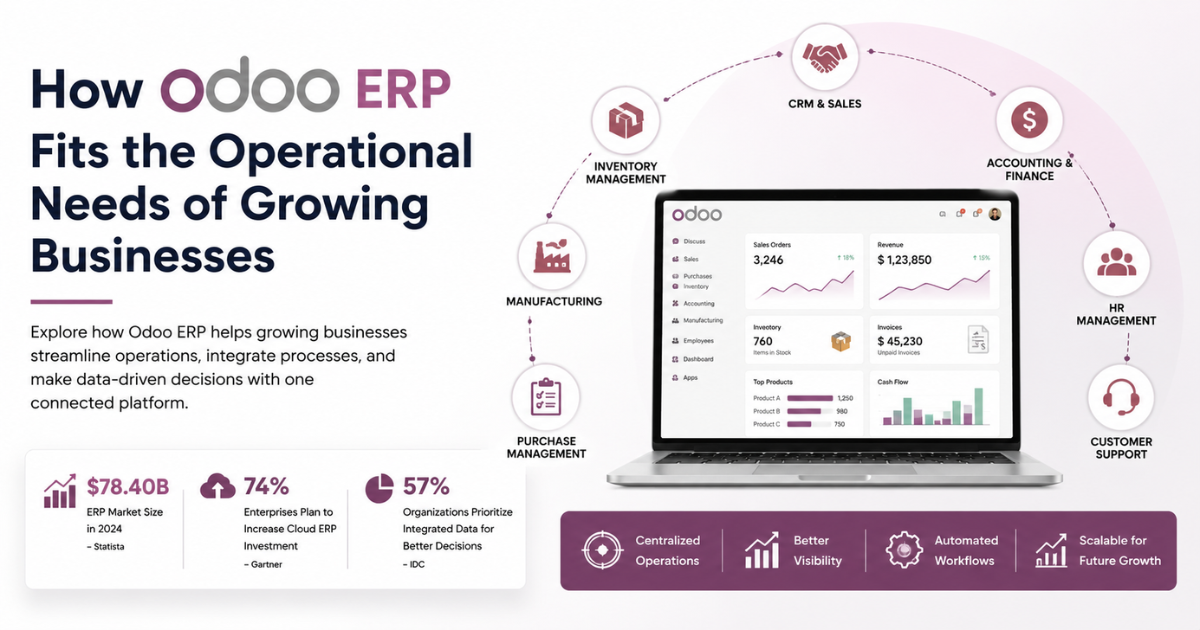
Growing businesses often reach a stage where managing operations through separate tools starts creating friction. Sales works on one platform, finance uses another, inventory is tracked elsewhere, and customer support runs on a different system. Over time, this disconnected setup leads to delays, duplicate work, reporting gaps, and limited visibility across the business.
Market trends show why companies are moving toward connected ERP systems. Statista estimates the global ERP software market surpassed $78 billion in 2024, while Gartner reports that over 70% of organizations are increasing investment in cloud-based business applications to improve operational efficiency. IDC also notes that businesses increasingly prefer integrated platforms that offer centralized data access for faster and better decision-making.
Why Growing Businesses Need a Connected ERP System
As businesses grow, operations become harder to manage. More sales, larger inventories, increasing customer demands, and complex financial processes often create gaps when teams rely on separate tools or manual systems.
Many companies begin facing issues like duplicate work, delayed reporting, scattered data, and poor coordination between departments. According to Gartner, businesses are increasingly adopting connected ERP platforms to improve operational visibility and decision-making.
A system like Odoo helps by bringing core business functions into one platform, making operations easier to manage, data more accessible, and workflows better connected across teams.
Modular Design That Matches Business Growth
One reason businesses choose Odoo is its flexibility.
Many ERP platforms force organizations into large deployments from day one. Odoo takes a different approach. Companies can begin with only the modules they need and expand later as operational demands change.
A business may initially implement:
- CRM
- Accounting
- Sales
- Inventory
Later, it can add:
- Manufacturing
- HR management
- Procurement
- Helpdesk
- Project management
- Field service operations
This modular approach reduces implementation pressure while supporting long-term operational planning.
Businesses often work with an experienced Odoo development company during this phase to identify the right module mix based on operational priorities rather than software availability.
Centralized Data Improves Operational Visibility
Operational visibility matters as companies scale.
Without a centralized platform:
Sales teams see pipeline data. Finance sees payments. Warehouse teams see stock levels. Leadership sees fragmented reports.
No one sees the full operational picture.
Odoo changes this by creating a single operational layer where departments work from connected data.
For example:
A confirmed sales order can automatically:
- update inventory
- trigger procurement alerts
- create invoicing workflows
- notify logistics teams
- update financial forecasts
That operational continuity reduces delays and improves coordination across teams.
Flexible Customization for Industry-Specific Workflows
No two businesses operate the same way.
A manufacturing company handles production planning differently from a healthcare provider. A logistics business manages operations differently from an e-commerce company.
Odoo’s architecture supports workflow customization without forcing businesses into rigid operating models.
Companies can customize:
- approval workflows
- invoice processing
- customer onboarding flows
- reporting dashboards
- warehouse routing logic
- manufacturing sequences
- automation triggers
This flexibility makes Odoo suitable for businesses with operational requirements that standard ERP systems often struggle to support.
Making Odoo Work with the Tools You Already Love
Let’s be honest: an ERP is rarely a "lone wolf." Most growing businesses already have a digital ecosystem they rely on every day. Whether it’s how you get paid, how you ship orders, or how you track your team’s performance, those tools are the backbone of your current operations.
The reality is that ripping and replacing every single system is usually a recipe for chaos. It's expensive, disruptive, and—quite frankly—rarely necessary.
Your Current Tech Stack belongs in the Loop
You likely already have a favorite lineup of specialized software, such as:
- Payment & Banking: Stripe, PayPal, or direct bank feeds.
- Sales & Growth: Shopify, WooCommerce, or Salesforce.
- People & Logic: Legacy HR tools or specialized BI dashboards.
- Moving Goods: Shipping and logistics platforms.
Bridge the Gap, Don't Build a Wall
Instead of forcing you to start from scratch, Odoo is designed to be a "team player." Through API-based integrations, it can plug directly into your existing infrastructure. This means you can:
- Modernize at your own pace: Upgrade your core workflows without breaking what already works.
- Maintain "Single Source of Truth": Keep your data synced so your BI dashboards and CRM are always looking at the same numbers.
- Reduce Friction: With the help of an experienced development partner, you can build stable middleware that acts as a translator between Odoo and your other apps.
In short, Odoo doesn't ask you to choose between "old" and "new." It simply gives your existing tools a more powerful engine to run on.
Real-World Example: Mid-Sized Manufacturing Operations
A mid-sized industrial equipment manufacturer faced operational bottlenecks caused by disconnected systems.
Their setup included:
- spreadsheets for procurement
- standalone accounting software
- separate inventory tracking
- manual production scheduling
- fragmented reporting systems
After implementing Odoo:
Procurement is linked directly with inventory planning. Production schedules reflected livestock availability. Finance received automated invoice updates. Leadership gained real-time operational dashboards.
Business outcomes within 12 months:
- 26% reduction in procurement delays
- 19% lower inventory holding costs
- 31% faster reporting cycles
- 22% improvement in order fulfillment speed
These are operational improvements, not software vanity metrics.
ROI and Business Impact
ERP investments should produce measurable business value.
Businesses adopting Odoo commonly report improvements in:
- Operational efficiency: Manual administrative work decreases through automation.
- Reporting accuracy: Teams work from one shared source of operational data.
- Process consistency: Departments follow standardized workflows.
- Cost control: Inventory, procurement, and operational planning become more predictable.
- Scalability: Operations expand without rebuilding systems repeatedly.
Organizations working with strong Odoo Consulting Services often see faster implementation maturity because process planning happens before technical deployment.
Common Implementation Considerations
ERP success depends on planning.
Businesses should evaluate:
- data migration readiness
- process mapping
- module selection
- employee onboarding
- system integrations
- reporting requirements
- long-term support planning
Technology alone does not solve operational problems. Process alignment matters equally.
That is why businesses often involve both implementation specialists and an experienced Odoo development company during ERP planning.
Final Thoughts
Growing businesses need systems that support operational clarity, process consistency, and long-term scalability. Odoo ERP fits those needs because it combines modular deployment, customization flexibility, integrated workflows, and centralized business visibility in one connected platform.
Its value goes beyond software features. It gives businesses a stronger operational foundation as they grow.
When supported by proper planning, technical implementation, and informed Odoo Consulting Services, Odoo can become a practical system for managing business operations with greater control, better visibility, and measurable business impact.