
 Sign up with Google
 Sign in with Zoho

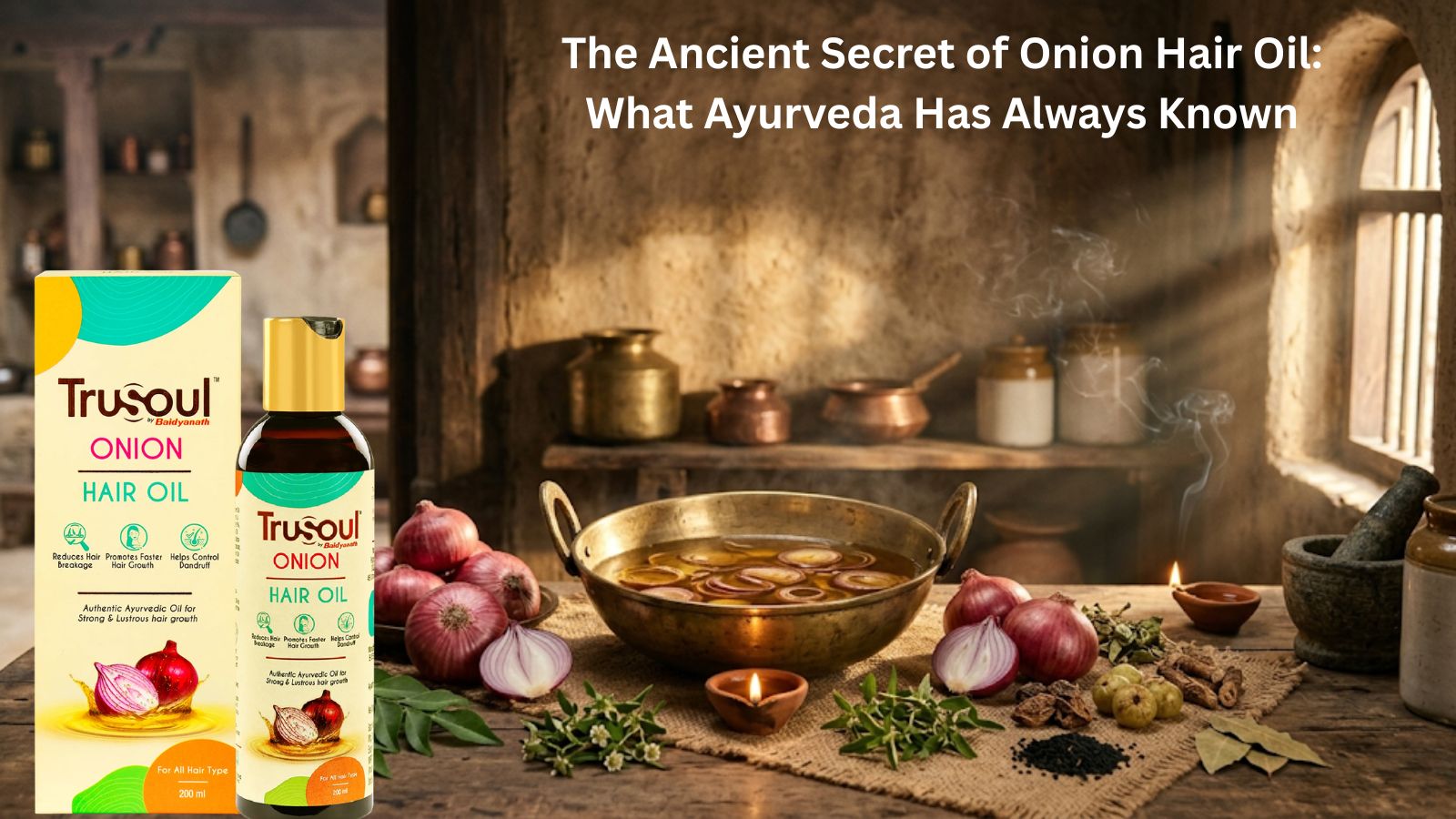
Long before the age of serums and scalp treatments, ancient Indian households kept a simple secret tucked in their kitchens: the humble onion. In Ayurveda, the science of life that has guided holistic healing for over 5,000 years, the onion — known as Palandu — was never merely a culinary ingredient. It was medicine. It was a tonic. And for generations of Indian women with long, lustrous hair, it was the backbone of their hair care ritual.
Today, as the world rediscovers the power of nature over chemicals, onion hair oil is having its moment. But for those rooted in Ayurvedic tradition, this is no trend — it is a homecoming.
What Ayurveda Says About the Onion
In the classical Ayurvedic text Charaka Samhita, Palandu (onion) is described as Snigdha (unctuous), Guru (heavy), and Ushna (warm in nature). These qualities make it a potent herb for pacifying Vata dosha — the energy that governs movement and is closely linked to dryness, brittleness, and hair fall when out of balance.
Vata imbalance is one of the most common root causes of hair loss in Ayurvedic diagnosis. When Vata is elevated — due to stress, erratic lifestyle, poor sleep, or processed food — it dries out the scalp, weakens the hair roots (Keshamoola), and disrupts the nourishment flowing through the Siras (micro-channels) that feed each follicle.
Onion, with its warm and nourishing qualities, directly addresses this. When infused into a carrier oil and massaged into the scalp, it stimulates Agni (digestive fire) at the tissue level, improves local circulation, and feeds the hair roots with the sulphur compounds that Ayurveda recognises as essential to tissue strength.
The Science Behind the Tradition
Modern research has now confirmed what Ayurveda intuited centuries ago. The key lies in sulphur — the mineral that gives onion its characteristic pungency and its healing power.
Sulphur is a building block of keratin, the protein that makes up 95% of your hair strand. When your scalp receives adequate sulphur, it produces stronger, thicker, more resilient hair. When sulphur is deficient, hair becomes thin, breaks easily, and sheds prematurely.
Onion is one of the richest natural sources of organosulphur compounds and quercetin, a powerful antioxidant that protects hair follicles from oxidative stress — the cellular damage caused by pollution, UV exposure, and internal inflammation.
A notable study published in the Journal of Dermatology found that participants who applied onion juice to their scalp twice daily experienced significant hair regrowth compared to those who did not — with over 73% of participants showing noticeable improvement after just four weeks.
But in the Ayurvedic approach, raw juice alone is only half the story. The true potency comes from infusing onion into a base oil, which carries its active compounds deeper into the scalp while adding its own nourishing benefits.
Why Oil Infusion Matters
In Ayurveda, Taila (medicated oil) is the preferred vehicle for scalp and hair treatments. Oil possesses a unique quality called Sukshma — the ability to penetrate deeply into tissues, far beyond what water-based treatments can reach.
When onion is slow-cooked into a base oil, the sulphur compounds, quercetin, and flavonoids are transferred into the oil matrix. Carrier oils like coconut oil, sesame oil, or castor oil each bring their own Ayurvedic properties:
- Coconut oil (Narikela Taila) — cooling, deeply moisturising, naturally antibacterial. Excellent for inflamed or itchy scalps with excess Pitta.
- Sesame oil (Tila Taila) — the most revered oil in Ayurveda, warm and nourishing, ideal for Vata-related dryness and hair fall.
- Castor oil (Eranda Taila) — heavy and penetrating, stimulates hair follicles and promotes thickness. Used for generations in India for eyebrows, lashes, and hairline density.
Together, onion and oil create a treatment that does not just sit on the surface of the scalp — it works at the root.
Five Core Benefits of Onion Hair Oil
1. Reduces Hair Fall at the Root Cause
From an Ayurvedic lens, hair fall (Khalitya) is rarely a surface-level problem. It is a signal that the hair roots are not receiving adequate nourishment. Onion hair oil, massaged in circular motions, stimulates Rakta Dhatu (blood tissue) circulation to the scalp — ensuring that nutrients reach every follicle.
2. Fights Scalp Infections and Dandruff
The Ushna (hot) nature of onion makes it naturally antifungal and antimicrobial. Dandruff (Darunaka in Ayurveda) is classified as a Vata-Kapha imbalance — characterised by dryness, flaking, and sometimes itchiness. Onion oil addresses both: its warmth counters Kapha build-up, while the carrier oil soothes Vata dryness.
3. Promotes New Hair Growth
Quercetin in onion has been shown to inhibit an enzyme called 5-alpha reductase — the same enzyme targeted by many modern hair loss medications. This enzyme converts testosterone into DHT, a hormone that shrinks hair follicles over time. By naturally slowing this process, onion supports the growth of new, healthy strands.
4. Adds Strength and Lustre
Sulphur directly strengthens the disulphide bonds within keratin — the structural links that give hair its elasticity and shine. Regular onion oil application visibly improves hair texture over 4–8 weeks: strands become less prone to breakage, feel smoother to the touch, and reflect light better.
5. Premature Greying Prevention
Ayurveda links premature greying (Palitya) to excess Pitta dosha — particularly stress-related Pitta and poor nutrition. Onion is rich in catalase, an enzyme that breaks down hydrogen peroxide in the scalp (hydrogen peroxide accumulation is linked to greying). Regular oil massage also brings Shanti (calm) to the nervous system, indirectly addressing stress as a contributing factor.
The Right Way to Use Onion Hair Oil — The Ayurvedic Method
In Ayurveda, how you apply oil matters as much as what you apply. The practice of Shiro Abhyanga (head oil massage) is a cornerstone of hair care — and it goes far beyond simply rubbing oil into the scalp.
Step 1: Warm the oil slightly — never apply cold oil to the scalp. Warming activates the oil's ability to penetrate tissue (Ushna guna) and makes the massage experience calming rather than shocking.
Step 2: Section and apply — part your hair into four to six sections and apply oil directly to the scalp (not just the hair length) using your fingertips.
Step 3: Massage with intention — use slow, circular movements for 10–15 minutes. Ayurveda teaches that the direction and pressure of massage influence the doshas: gentle, slow movements pacify Vata; firm, structured movements address Kapha; light, cooling application suits Pitta.
Step 4: Leave for at least one hour — ideally, apply the night before and sleep with the oil in, covering your hair with a soft cotton cloth. This allows the oil's compounds to work through the full Prajagara (waking) cycle and into Nidra (sleep), when cellular repair is most active.
Step 5: Wash out gently — use a mild, sulphate-free shampoo. Avoid harsh scrubbing. In Ayurveda, the hair is washed with the same gentleness with which oil was applied.
Frequency: 2–3 times per week for those experiencing active hair fall; once a week for maintenance.
A Word on Choosing Your Onion Hair Oil
Not all onion hair oils are created equal. Many commercial products use onion fragrance or extract at negligible concentrations, combined with silicones and preservatives that provide no actual benefit to the scalp.
An authentic Ayurvedic onion hair oil should contain:
- A genuine onion infusion (not just onion fragrance)
- A high-quality base oil (coconut, sesame, or castor — ideally cold-pressed)
- Complementary Ayurvedic herbs like Bhringraj (Eclipta alba, the king of hair herbs in Ayurveda), Amla (Indian gooseberry, rich in Vitamin C), or Brahmi (known to strengthen hair roots)
- No mineral oil, no synthetic fragrance, no parabens
For those seeking a ready-to-use option rooted in this philosophy, Trusoul's Onion Hair Oil combines traditionally sourced onion extract with a blend of Ayurvedic carrier oils and herbs — formulated without chemicals, the way this remedy was always meant to be made.
Closing Thought: Trust What Has Endured
There is a reason Ayurveda has survived five millennia. Its principles were not derived from trends or marketing cycles — they were arrived at through careful observation of the natural world and the human body over generations. The onion's role in hair care is one such principle: simple, affordable, and remarkably effective.
In a world of complicated twelve-step routines, it is worth pausing to ask: what did our grandmothers know that we have forgotten? Quite often, the answer is already in the kitchen.