Sign up with Google
 Sign in with Zoho

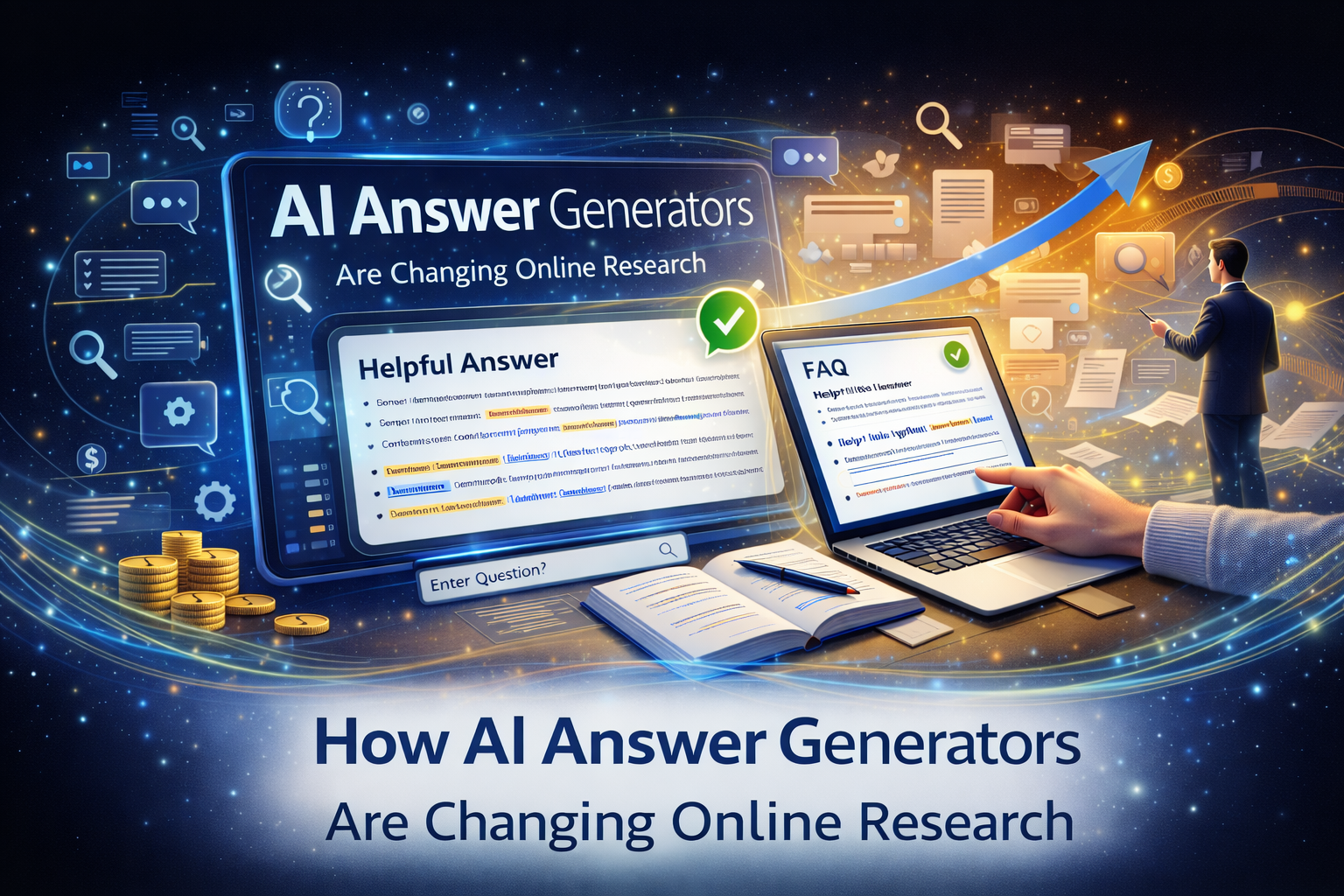
The way people search for information online has evolved dramatically over the past two decades. What began as simple keyword searches in early search engines has transformed into a dynamic experience powered by artificial intelligence. Today, AI answer generators are reshaping how individuals, students, professionals, and businesses conduct online research. These tools do more than retrieve links—they analyze, summarize, and present information in a clear and structured way.
As digital information continues to grow at an overwhelming pace, the need for smarter research tools becomes more important. AI answer generators are stepping in to simplify this process, offering faster insights, contextual understanding, and improved efficiency. This shift is not just a technological upgrade; it represents a fundamental change in how knowledge is accessed and processed.
How Direct AI Responses Are Replacing Classic Search
Traditional search engines provide users with a list of links ranked by relevance. While effective, this method requires users to open multiple pages, scan content, compare sources, and piece together information manually. This approach can be time-consuming and, at times, confusing.
AI answer generators take a different approach. Instead of simply displaying links, they interpret the user’s question and provide a structured response. By analyzing large volumes of data and identifying patterns in language, these systems generate answers that are concise and focused on the user’s query. This reduces the time spent navigating between websites and allows users to grasp key information more quickly.
The emphasis has shifted from searching for information to receiving synthesized knowledge.
Saving Time and Increasing Efficiency
One of the most noticeable impacts of AI answer generators is the speed at which research can be completed. Students working on assignments, professionals preparing reports, or entrepreneurs analyzing market trends can gather foundational information within seconds.
This efficiency does not eliminate the need for critical thinking or verification. Instead, it streamlines the initial stages of research. Users can quickly understand the basics of a topic before diving deeper into specialized sources. In many cases, AI-generated answers serve as a starting point, helping researchers refine their questions and identify areas that require further exploration.
Time saved on basic fact-finding can then be redirected toward analysis, creativity, and decision-making.
Improving Accessibility to Information
Not everyone has the same level of research skills. Some individuals may struggle with forming effective search queries or evaluating complex academic language. AI answer generators help bridge this gap by presenting information in a simplified and understandable format.
By breaking down complicated concepts into clear explanations, these tools make knowledge more accessible to a wider audience. This is particularly valuable in educational settings, where learners with different backgrounds and abilities can benefit from tailored explanations.
In addition, AI-powered tools can assist non-native speakers by interpreting questions phrased in everyday language and delivering coherent responses. This inclusive aspect contributes to a more equitable digital learning environment.
Enhancing Question Clarity and Context
One limitation of traditional search methods is the reliance on exact keywords. If a query is poorly structured, the results may be irrelevant. AI answer generators are designed to understand context rather than just keywords. They can interpret conversational questions, follow-up prompts, and even ambiguous phrasing.
This contextual awareness allows users to refine their research naturally. Instead of repeatedly adjusting keywords, they can ask clarifying questions conversationally. The experience feels less mechanical and more intuitive, resembling a dialogue rather than a static search.
As a result, online research becomes more interactive and user-friendly.
Supporting Academic and Professional Research
In academic settings, AI answer generators can assist with brainstorming, outlining topics, and summarizing complex materials. They can provide overviews of historical events, scientific principles, or theoretical frameworks, helping students grasp foundational ideas before consulting primary sources.
Professionals also benefit from these tools. Market researchers, content creators, and analysts can use AI-generated summaries to stay informed about trends and developments. Instead of reading dozens of lengthy articles, they can review concise explanations and then explore authoritative sources for deeper insights.
While powerful, AI demands responsible and mindful usage. While these tools offer convenience, they should not replace original research or proper citation practices. Critical evaluation of information remains essential.
Reducing Information Overload
The internet contains an enormous amount of content, much of which is repetitive, outdated, or unreliable. Sorting through this content can be overwhelming. AI answer generators help filter noise by focusing on relevant information related to the specific query.
By synthesizing data from multiple perspectives, they provide a streamlined overview that highlights essential points. This can reduce cognitive overload and improve focus. Instead of feeling lost in endless search results, users receive a coherent summary that guides their understanding.
That said, users must remain aware that no system is perfect. Confirming details with credible references strengthens the reliability of your work.
Encouraging Curiosity and Deeper Exploration
Interestingly, AI answer generators can also encourage curiosity. When users receive a clear and concise explanation, they may feel more confident exploring advanced aspects of a topic. The barrier to entry becomes lower, making learning feel more approachable.
For example, someone curious about renewable energy might begin with a simple question and receive a structured explanation of key concepts. This foundational knowledge can inspire further research into policy implications, technological innovations, or environmental impact.
In this way, AI tools can act as gateways to deeper intellectual engagement rather than shortcuts that discourage learning.
Ethical Considerations and Responsible Use
As AI answer generators become more integrated into research workflows, ethical considerations must be addressed. Users should understand that these tools generate responses based on patterns in data rather than independent reasoning. This means that errors or biases may occasionally appear.
Responsible use involves cross-checking important information, especially for academic, medical, or financial decisions. Educational institutions and organizations should guide how to integrate AI tools ethically and effectively.
Transparency about the role of AI in content creation and research also fosters trust. Used with intention, AI supports and amplifies human skills rather than replacing them.
The Future of Online Research
The rise of AI answer generators signals a broader transformation in digital information systems. As these tools continue to improve, they will likely become more personalized, context-aware, and integrated with other platforms. Future developments may include real-time data updates, advanced source attribution, and improved collaboration features.
Online research is moving toward a model where information is not only searchable but also intelligently organized and presented. The focus is shifting from navigating content to understanding it quickly and accurately.
This evolution does not eliminate the value of traditional research methods. Instead, it complements them. Libraries, academic journals, and expert analysis remain critical components of credible research. AI answer generators simply make the initial stages faster and more efficient.
Conclusion
AI answer generators are transforming online research by delivering direct, contextual, and accessible responses to user queries. They save time, reduce information overload, and make learning more inclusive. By shifting the focus from link-based searching to synthesized answers, these tools redefine how people interact with digital knowledge.
However, their effectiveness depends on responsible use. Critical thinking, verification, and ethical awareness remain essential. When combined with human judgment and reliable sources, AI answer generators become powerful allies in the pursuit of knowledge.
As technology continues to evolve, the partnership between human curiosity and artificial intelligence will shape the future of research. Rather than replacing traditional methods, AI enhances them—making information more reachable, understandable, and actionable for everyone.