Sign up with Google
 Sign in with Zoho
Daniel is a 52-year-old accountant from Atlanta. Quiet guy. Methodical. The kind of person who files taxes in January, changes smoke detector batteries on schedule, and keeps a first aid kit in every car he owns.
He thought about getting CPR certified at least a dozen times over the years. His gym offered it. His daughter's school sent home a flyer. His company HR department sent an email about an upcoming BLS training session with free lunch included.
Every time, something came up. A deadline. A family obligation. The vague sense that he'd get around to it when things slowed down.
Things never slow down. That's the part nobody warns you about.
Last Thanksgiving, Daniel's brother-in-law collapsed in the kitchen twenty minutes after dinner. Fifty-three years old. No prior history of cardiac problems. There were eleven people in that house — children, adults, a retired schoolteacher, a nurse who had let her certification lapse years ago.
Nobody in that kitchen knew what to do.
The ambulance took nine minutes. Daniel's brother-in-law did not survive.
Daniel got CPR certified in December. He talks about it openly now — not to punish himself, but because he believes with quiet certainty that if one person in that kitchen had been trained, the outcome might have been different. He wants people to hear that and do something about it before their own Thanksgiving comes.
The Story We Keep Repeating — Unnecessarily
Daniel's story is not unusual. Change the names, the city, the occasion — and some version of it plays out thousands of times every year across this country.
Someone collapses. People panic. Time passes. Help arrives too late.
What makes it quietly devastating is that cardiac arrest, unlike so many medical emergencies, has a known intervention that dramatically improves survival when applied immediately. CPR— performed by an ordinary bystander with basic certification — can double or triple survival rates from out-of-hospital cardiac arrest. That's not a marginal improvement. That's the difference between a family that stays whole and one that doesn't.
The intervention exists. The training is accessible. The courses are short, affordable, and widely available. And yet the gap between knowing this and actually getting certified remains stubbornly, tragically wide for most people.
Understanding why that gap exists — and deciding to close it personally — is the entire point of this article.
Cardiac Arrest Is Not What Most People Think It Is
There's a widespread misunderstanding about cardiac arrest that's worth addressing directly, because it contributes to the sense of helplessness that keeps people from acting.
Many people confuse cardiac arrest with a heart attack. They're related but different.
A heart attack is a circulation problem — a blockage preventing blood from reaching the heart muscle. The person is usually conscious, often in pain, and needs urgent medical care. A heart attack can lead to cardiac arrest, but it isn't the same thing.
Cardiac arrest is an electrical problem — the heart's electrical system malfunctions, causing it to stop beating effectively. The person loses consciousness immediately. There is no pulse. Without intervention, brain damage begins within minutes and death follows shortly after.
This distinction matters because cardiac arrest looks different from what most people expect. There's no clutching of the chest in slow motion. No dramatic final words. Often it's exactly what happened to the woman at Marcus's farmers market, to Daniel's brother-in-law in the kitchen — a person simply goes down without warning, and the people around them have seconds to recognize what's happening and respond.
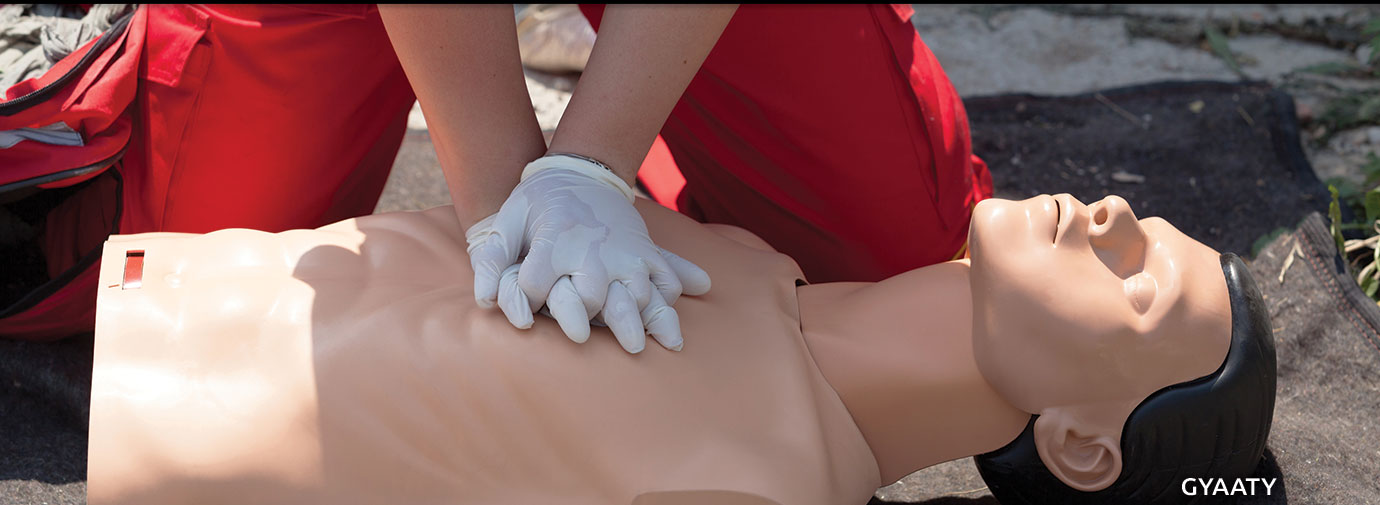
CPR keeps blood and oxygen moving through the body while the heart cannot do it independently. An AED can potentially restore normal electrical rhythm. Together — applied quickly, by someone with training — they represent the most powerful emergency response tool available to ordinary people.
The healthcare system can do extraordinary things. But it cannot do them in the first eight minutes. Only you can do something in those first eight minutes.
BLS Certification — What It Is and Why It Goes Deeper Than Basic CPR
When people talk about CPR training, they often mean a general awareness of the technique. BLS — Basic Life Support — is the structured certification that takes that awareness and turns it into something that actually holds up when everything is going wrong around you.
BLS certification is used across the healthcare system as a baseline requirement for clinical staff. But it's not exclusive to healthcare professionals — it's designed to be completed by anyone, and its value for non-medical people is arguably even greater, because non-medical people are far more likely to be the first responder in a real emergency.
Here's what distinguishes BLS from casual CPR awareness:
Structured skill progression Each component — compressions, rescue breathing, AED use, team coordination — is taught sequentially and practiced until performance meets a measurable standard. You don't leave with a general idea. You leave with a demonstrated skill.
Scenario-based training BLS courses simulate real conditions — multiple bystanders, incomplete information, someone calling 911 while you manage compressions, a second person arriving to help mid-rescue. These scenarios are uncomfortable by design. They're meant to approximate the chaos of a real emergency so that chaos feels slightly less paralyzing when it actually arrives.
Pediatric components Infant and child CPR involve different technique from adult CPR — adjusted compression depth, different hand positioning, smaller rescue breaths. BLS certification covers all three, which matters enormously for parents, teachers, childcare workers, and lifeguards.
First Aid integration Many BLS courses bundle comprehensive First Aid training — severe bleeding control, choking response, burn management, fracture stabilization, anaphylaxis response. The complete package prepares you for the full range of emergencies, not just cardiac events.
Renewable credentials BLS certification requires renewal every two years. This isn't bureaucratic inconvenience — it's the mechanism that keeps skills sharp and current as guidelines evolve. A certification that expired four years ago is not the same as current training.
The People in Your Life Who Are Counting on You Without Knowing It
There's a way of thinking about CPR certification that makes it feel abstract — something that might matter someday, in some hypothetical emergency, involving some unspecified person.
There's another way to think about it that's considerably more concrete.
Picture the people you spend the most time with. Your partner. Your children. Your parents. Your closest friends. Your coworkers you see every single day. The neighbors you've known for years.
Statistically, cardiac arrest is most common in adults between 40 and 70. Think about how many people in your immediate circle fall into that range. Think about the fact that 70% of cardiac arrests happen at home — in the exact spaces where you spend time with the people you love most.
Now think about what happens in that space if something occurs and nobody present has CPR training.
This reframing isn't meant to generate anxiety. It's meant to replace the comfortable abstraction of "someday I might need this" with the more accurate and motivating reality: the people around you, in the spaces you already inhabit, are the most likely beneficiaries of your certification.
You are not preparing for strangers in hypothetical emergencies. You are preparing for the people who matter most to you, in the places where life actually happens.
The Roles Where This Responsibility Is Sharpest
Lifeguards carry a weight that deserves specific acknowledgment. In an aquatic environment, the margin for error is essentially zero. Drowning progresses silently, rapidly, and without the dramatic signals most people expect. A struggling swimmer can lose consciousness before a bystander recognizes something is wrong. The lifeguard — often young, sometimes the youngest adult present — is the entire safety infrastructure for everyone in that water. Their CPR and First Aid certification, maintained and current, is the reason families leave the pool together at the end of the day.
Parents of young children face the particular vulnerability of loving someone who is simultaneously fearless and fragile. Kids choke. They have near-drowning incidents in shallow water. They occasionally have undiagnosed cardiac conditions that announce themselves without warning. Pediatric CPR training is one of the most direct expressions of parental responsibility available.
Adult children of aging parents occupy a quiet position of emergency responsibility that increases with every passing year. If your parent or grandparent is over 65 and you are their primary support system, you are — whether you've thought about it this way or not — their designated first responder. That role is already yours. Certification is simply the preparation it deserves.
Coaches, teachers, and youth program staff spend their professional hours responsible for groups of young people in environments where emergencies can and do occur. The coach who is certified, the teacher who is trained, the program director who carries current First Aid credentials — they represent a layer of protection for every child in their care that no policy document can replicate.
Healthcare adjacent workers — people who work near clinical environments without being clinical themselves — often assume that qualified help is always within reach. Sometimes it is. Sometimes the qualified person is occupied, unavailable, or simply not close enough. CPR certification in non-clinical healthcare staff fills gaps that proximity to a hospital doesn't automatically close.
Getting Honest About the Barriers
The barriers to CPR certification are real but smaller than they feel. They deserve honest examination.
Time — Most courses run between four and eight hours. Blended formats reduce in-person time significantly. This is one Saturday, or two weekday evenings, or a Friday afternoon that your company offered with free lunch. The time exists. The question is whether it gets prioritized.
Cost — Many employers cover certification costs. Community organizations, local fire departments, the American Heart Association, and the Red Cross all offer subsidized and sometimes free options. For most people in most places, cost is not the genuine barrier it feels like.
Anxiety about medical topics — Jenny was queasy around healthcare. Priya fainted at the sight of needles. These are real responses, and they are manageable within the structure of a well-run certification course. Instructors work with people of every comfort level. The course is designed for ordinary people, not medical professionals.
The "not me" feeling — The sense that this skill belongs to a different category of person — braver, more medically inclined, more comfortable in emergencies. This feeling is the most common barrier and the least valid. Marcus taught history. Daniel filed taxes. Jenny graded art projects. The certification doesn't require a particular personality. It just requires showing up.
December Was Too Late for Daniel. It Doesn't Have to Be for You.
Daniel got certified in December. He renewed in February two years later. He keeps his card in his wallet next to his driver's license because he wants to see it every time he reaches for his ID.
He can't go back to Thanksgiving. Nobody can. But he has made a decision — quiet and firm and permanent — that nobody in a room with him will ever go without CPR because the person standing closest didn't know what to do.
He talks about it when it comes up. He bought his daughter a certification course for her birthday. He mentioned it to his entire team at the January staff meeting.
He says: "The class takes a few hours. The regret lasts forever. There's really only one option that makes sense."
He's right.
Find a course today. Not next month. Not when things slow down — they won't slow down. Today, or this weekend, or next Saturday at the absolute latest.
Block the time. Show up. Learn the skill.
Do it for the people in your kitchen at Thanksgiving.
Do it because the eight-minute gap is real, and you are the only one who can close it.