Sign up with Google
 Sign in with Zoho

Salesforce Consulting Services | Hire Certified Experts
Salesforce powers some of the world’s successful businesses. But building and maintaining it takes more than a few automations.
Whether you are customizing a CRM or building a SaaS product from scratch, you need a structured and adaptable lasting life cycle for better impact.
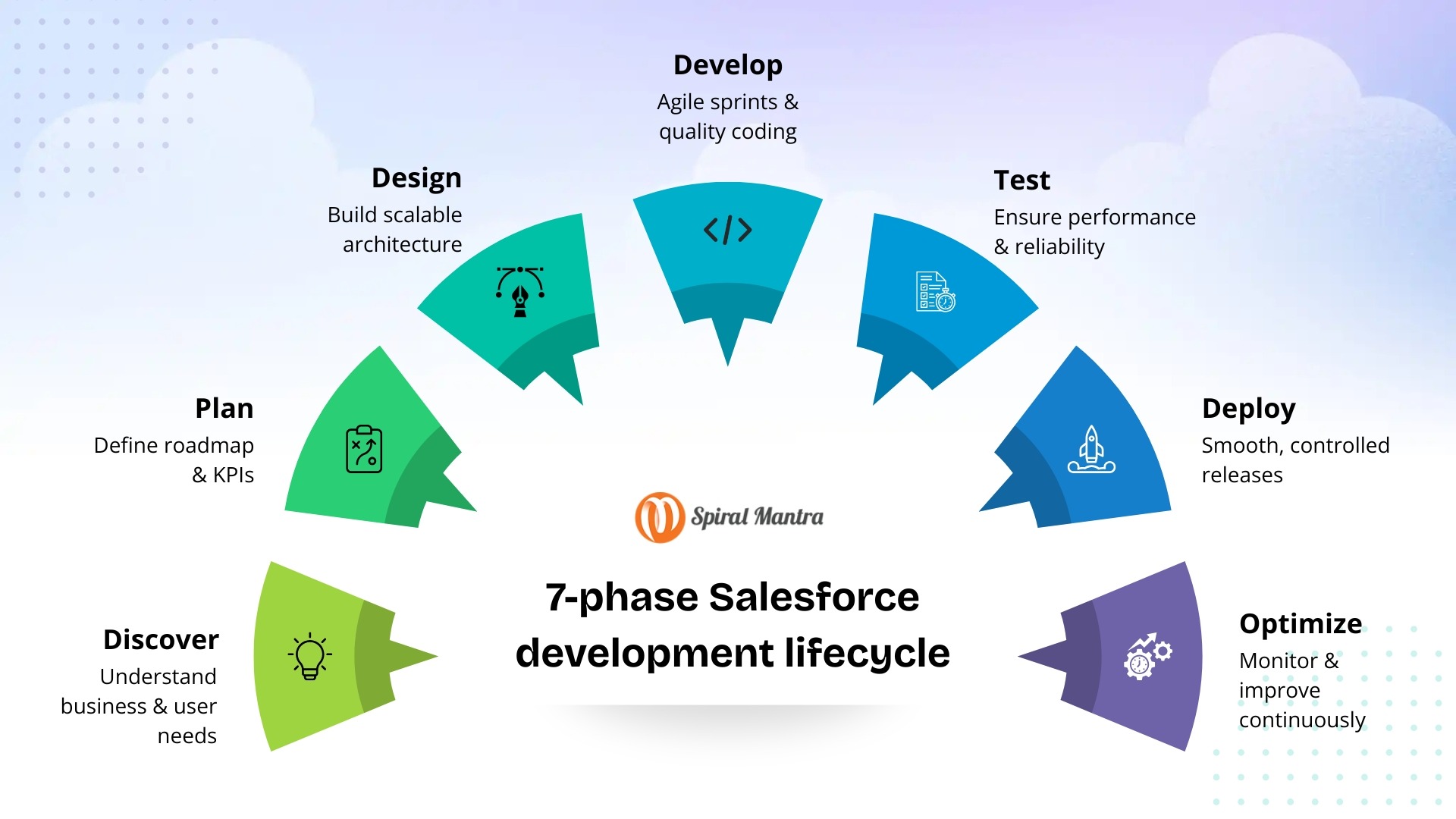
In this guide, we’ll walk you through the complete 7-phase Salesforce development cycle.
Salesforce development lifecycle: Definition
Salesforce development lifecycle refers to the simple process of creating, deploying, and maintaining custom solutions on the platform.
Teams follow this framework to move from initial idea to delivering a fully deployed product.
It defines how you plan, design, build, test, release, and evolve Salesforce applications. And without a proper structure teams often battle with inconsistent workflows, technical debts, and poor user adoption.
Begin The Groundwork Before Building the Lifecycle
The success of any Salesforce project starts way before writing the code. Here’s a list of our must-have prerequisites:
-Tie every phase to clear business objectives. Define exactly what the larger goal is.
-There are two main models. Decide between the Organization Development -Model and the Package Development Model based on your team size, release processes, and business complexity.
-Assign clear roles from the start to make sure each member is aware of their responsibility.
-Ensure early compliance with security and audit requirements.
-Plan to adapt continuously, especially as Salesforce rolls out new features every season.
-Choose the right tools for the job. Use declarative automation (Flows) when possible, and rely on Apex, Lightning Web Components, or third-party integrations only when necessary.
Phases of Salesforce Development Cycle
A high-performing Salesforce product is often defined by the clear and strong process you set for your team to follow.
Phase 1
The discovery phase sets the momentum. And this is why it’s important for one’s team members to understand the business and user needs before jumping onto the product. At Spiral Mantra, a certified Salesforce consulting services company, here’s how we do it:
- We begin by asking what specific problem the product wants to solve.
-Who are the users and what are their pain points?
-Will the product integrate well with the existing system?
-What does success look like to the team?
In short, a solid discovery sprint often saves the team from painful rework. A proper road map with achievable KPI is what sets the best apart from the better.
Phase 2
Once the vision is clear, it's time to move on to the next, i.e., technical groundwork for the entire lifecycle.
Sharing a sample of how we do it:
- Begin by choosing the right Salesforce environments (e.g., Developer Orgs, Sandboxes, Scratch Orgs).
- Set up version control using Git (branching, merging) and establish CI/CD pipelines using tools like Salesforce DevOps Center, Copado, Gearset, Flosum, AutoRABIT, or Jenkins.
-Define metadata movement across environments (how code will flow from dev to QA, staging, and production).
- Select the development model by asking the right question. Will you use the Org Development Model for small teams or Package Development for modular, scalable releases?
In short, this phase is all about defining roles. Who manages environments? Who handles pull requests? Define these now to avoid confusion and bottlenecks later.
Phase 3
This stage is where the design of your data model, business logic, and security features take shape. Decisions made during this phase can either set your product up for long-term success or cause scaling and security problems that will be hard to fix later.
According to our experts, some of the important areas to focus on are:
-Data model design to ensure it supports automation, reporting, and data growth.
- Implementing multi-factor authentication (MFA), encryption, and data masking for security purposes.
-Set up role hierarchies and permission sets to restrict sensitive data access.
- Use Flows or Apex triggers for automation purpose.
Phase 4
This is where development begins. The mantra is agility, where teams should be able to work in short sprints to move ideas quickly and work on it without any delay. And here's how we do it:
- Understand user ownership clearly, focusing on real business value
- Prioritize tasks based on impact, not convenience
- Use version control, peer reviews, and automated tests to ensure code quality
-Conduct regular demos or sprint reviews to keep decision makers informed
-Understand challenges and work on bugs immediately to maintain speed at work
Phase 5
Most teams think this stage is just a formality. But in reality, this critical stage protects against future failures. And without structured testing, even the best development can fail.
Here's what we do to ensure everything is smooth-running:
-Write unit tests for Apex classes and triggers with at least 75% code coverage.
- Make sure that the declarative processes work as expected, with end-to-end testing.
-Test new features side by side with existing functions to ensure compatibility.
- Perform test data flows between Salesforce and external systems (e.g., ERP, marketing automation).
-Have real users approve the functionality before moving to production.
Phase 6
This is where code, configurations, and data finally reach production. But it’s not just about pushing the code into production. Here's what we follow at this stage:
-Have clearly defined steps for rollback planning and backups
-Use change sets, unlocked packages, or CI/CD tools to manage the release process.
-Conduct pre-deployment validation tests to catch issues like missing dependencies or schema mismatches.
-Coordinate releases with stakeholders on release timings and expected impacts.
-After deployment, conduct smoke testing and check performance metrics to measure success.
-Document everything, including release notes, so your team can track changes and troubleshoot easily.
Phase 7
The real work after deployment. The system is live and is still evolving. Therefore, keeping an eye on performance issues, user feedback, and new business needs is important.
To do this, some of the best practices we follow are:
-Regular usage monitoring to track adoption metrics and user activity.
- Identify friction in the user experience (UX).
-Conduct regular improvements to remove issues, look into edge cases, or feature requests.
Conclusion
A product’s success does not only depend on technical skills but on team collaboration as well.
Here’s how our Salesforce consulting services company does it:
-Motivate our developers and business analysts to work together.
-Invest in cross-functional knowledge so that non-technical users easily understand how Salesforce works.
-Have regular reviews so that failures can be noticed early.
-Appreciate team effort every now and then to improve their confidence.
Now that you know about our 7-phase lifecycle, follow it religiously to build a scalable, secure, and adaptable platform that grows along with your business.