Sign up with Google
 Sign in with Zoho

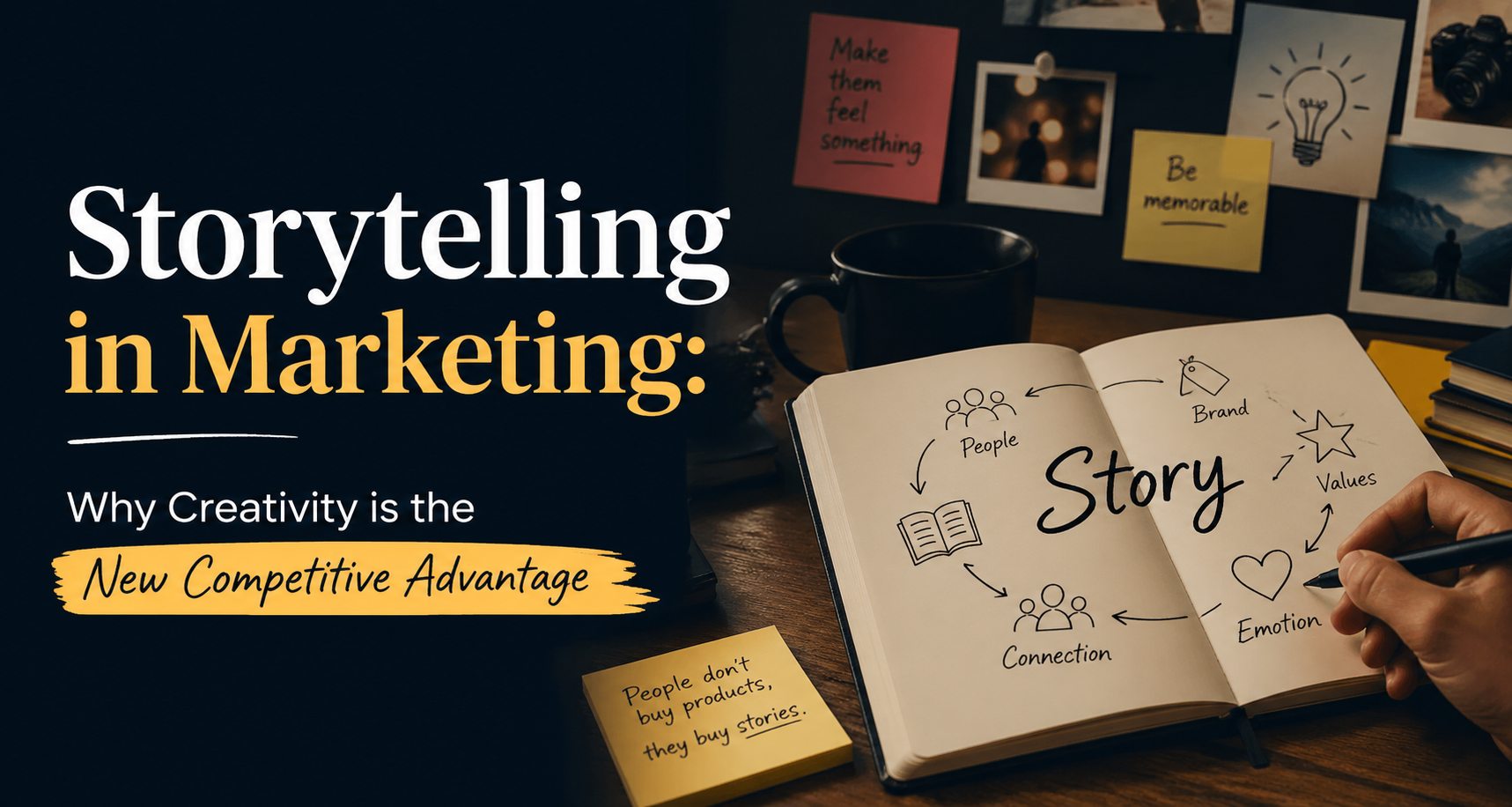
Every market is more crowded than it was two years ago. More competitors, more content, more ads, more noise fighting for the same finite pool of consumer attention. And yet, most businesses respond to this crowding by doing more of exactly what everyone else is doing — more targeted ads, more SEO content, more email sequences, more optimized funnels. The result is a market where everyone is technically competent and nobody is particularly memorable. You can out-optimize your competitors and still lose, because optimization is now table stakes, not differentiation.
The businesses pulling ahead in this environment aren't winning on budget or channel strategy alone. They're winning on story. They've understood something that performance dashboards don't capture cleanly: when a consumer can choose between two products at roughly the same price and quality, they choose the one they feel something about. And feeling is manufactured by narrative, not by feature lists. Storytelling in marketing has moved from a creative luxury to a strategic necessity — and the brands treating it as anything less are ceding ground to the ones that don't.
In this post, you'll learn why storytelling works at the neurological and psychological level, what separates a brand story that resonates from one that falls flat, and how to build a storytelling framework that works across every channel and campaign. Whether you're building this capability in-house or partnering with a creative agency in Kolkata, understanding the strategic mechanics of narrative is the starting point — because great stories don't happen by accident.
Why Storytelling Works
Before you can use storytelling strategically, you need to understand why it works at all — and the answer is biological, not cultural.
When the human brain processes a list of facts, only the language-processing regions activate — Broca's area and Wernicke's area, responsible for decoding words and syntax. The information enters, gets catalogued, and produces minimal emotional or behavioral response. This is what happens when a consumer reads a product specification page, a feature comparison table, or a corporate "About Us" paragraph written in passive voice about "delivering value to stakeholders."
When the brain processes a well-constructed story, something fundamentally different happens. Neural coupling occurs — the listener's brain begins to mirror the brain activity of the storyteller. Sensory cortices activate: if the story describes texture, the sensory cortex fires. If it describes motion, the motor cortex engages. The brain doesn't passively receive the story — it inhabits it. This is called narrative transportation, and it's the state in which persuasion is most effective and memory encoding is deepest.
The practical implication is this: a story doesn't just convey information more engagingly. It creates a fundamentally different cognitive experience — one in which the consumer is a participant rather than a recipient. And participants remember. Recipients forget.
This is why a creative agency in Kolkata that understands narrative craft isn't selling you creativity for its own sake. It's selling you access to the most powerful attention and memory mechanism the human brain possesses. The return on that investment compounds every time a consumer remembers your brand, retells your story, or chooses you over a competitor because of how you made them feel.
The Anatomy of a Brand Story That Actually Works
Not all stories create narrative transportation. Most brand "stories" are actually brand monologues — the company talking about itself, in flattering terms, to an audience that didn't ask. These don't work, and they don't work for a specific structural reason: they have no tension.
Every story that has ever moved a human being — from ancient mythology to modern cinema to the most effective marketing campaigns ever made — is built on the same structural foundation: a protagonist, a conflict, and a resolution. Remove the conflict and you don't have a story. You have a press release.
- The protagonist must be the customer, not the brand - This is the single most common structural failure in brand storytelling. Brands cast themselves as the hero — the innovative company, the disruptive solution, the team of passionate experts. But the consumer doesn't care about your journey. They care about their own. The brand's role in the story is not the hero — it's the guide, the tool, the catalyst that enables the hero (your customer) to overcome their conflict and reach their transformation.Donald Miller's StoryBrand framework captures this precisely: the customer is Luke Skywalker, the brand is Yoda. Yoda doesn't save the galaxy. He equips Luke with what he needs to save it himself. Brands that understand this relationship build stories that feel inclusive and empowering rather than self-promotional and alienating.
- The conflict must be real and specific - Vague struggles don't create narrative transportation. "Helping businesses grow" is not a conflict. "The moment you realize your best employee is leaving because your internal processes are broken" is a conflict — specific, emotionally charged, immediately recognizable to the target audience. The more precisely you name the conflict your customer lives with, the more powerfully your story lands.
- The resolution must be earned, not assumed - A resolution that arrives without struggle feels hollow. The transformation your customer experiences through your brand — whether it's a product that solved a real problem or a service that changed how they work — needs to be shown, not claimed. Testimonials, case studies, before-and-after narratives, and founder origin stories all work when they show the journey, not just the destination.
The Three Levels of Brand Storytelling
Effective storytelling in marketing operates at three distinct levels simultaneously — and brands that only work at one level leave significant impact on the table.
- The Brand Story: Who You Are and Why It Matters
This is the foundational narrative — the story of why the brand exists, what it believes, and what conflict it was created to resolve. It lives in your About page, your founder story, your brand manifesto, and the implicit narrative that runs through every piece of communication you produce.
The most compelling brand origin stories are built around a founder's genuine encounter with the problem the brand solves. Airbnb's founders couldn't afford rent, so they rented air mattresses in their apartment. Warby Parker's founders were tired of paying $500 for glasses. These stories work because they're true, specific, and rooted in a conflict the audience recognizes. They make the brand's purpose feel inevitable rather than manufactured.
- The Customer Story: Proof That the Brand Delivers
This is testimonial and case study content reframed as narrative rather than endorsement. Instead of "Client X achieved Y% results with our service," you tell the story of where Client X was before, what they were struggling with, what changed when they engaged the brand, and where they are now. The structure is identical to a three-act narrative — and it's dramatically more persuasive than a statistic presented without context.
Customer stories work because they shift the claim from the brand (who has obvious commercial motivation to be self-flattering) to a third party who the audience finds credible. They also create aspiration — the reader sees themselves in the customer's situation and begins to imagine their own transformation.
- The Campaign Story: Narrative Built Around a Single Insight
At the campaign level, storytelling means building communications around one emotionally resonant human insight rather than around product features or promotional mechanics. The insight is the story's engine — the truth about human experience that the campaign illuminates, and that your brand is uniquely positioned to speak to.
Nike's campaigns are rarely about shoes. They're about the relationship between human will and physical limitation — a conflict every person who has ever tried to push themselves physically understands viscerally. The product is present, but the story is about the human truth. That's why those campaigns create emotional responses in people who aren't even in Nike's target market.
Creativity as Competitive Advantage: Why It's Harder to Copy Than Technology
Technology is the great equalizer. The CRM your competitor uses is available to you. The media-buying platform, the analytics stack, the e-commerce infrastructure — all of it is purchasable. Competitive advantages built on technology are real but temporary, because technology diffuses quickly across markets.
Creativity doesn't diffuse the same way. A brand's distinctive voice, visual sensibility, narrative perspective, and cultural point of view cannot be copied without it being obviously derivative — and derivative creativity signals inauthenticity, which is the one thing consumers punish brands for most severely.
This is why creativity has become the new competitive advantage — not creativity as aesthetic decoration, but creativity as strategic differentiation. The ability to see your market, your customer, and your product from an angle that nobody else has claimed, and to express that angle in a way that is genuinely surprising and emotionally resonant, is a capability that compounds over time.
The compounding works like this: distinctive creative builds brand recognition, recognition builds trust, trust lowers customer acquisition costs, lower acquisition costs fund more creative investment, better creative deepens distinctiveness. Brands that break this cycle — by treating creative as a cost to be minimized rather than a capability to be developed — find themselves in a perpetual battle for attention that they are structurally disadvantaged to win.
IPA (Institute of Practitioners in Advertising) effectiveness research — the most comprehensive longitudinal study of marketing effectiveness ever conducted — consistently finds that emotionally-driven creative campaigns outperform rationally-driven ones on long-term business metrics by a factor of roughly 2:1. That's not a marginal difference. That's a structural advantage that materializes in revenue, margin, and brand valuation over time.
How to Build a Storytelling Framework for Your Brand
Understanding that storytelling matters is not the same as knowing how to do it consistently. Most brands produce occasional good stories interspersed with generic content — and occasional is not a strategy.
A storytelling framework creates the conditions for consistent narrative quality across every piece of content, campaign, and channel your brand operates in. It has four components:
Brand Narrative Foundation: Your core story documented — the founding conflict, the protagonist (your customer), your brand's role as guide, and the transformation your brand enables. This is the master narrative that every subsequent story draws from.
Audience Insight Library: A documented repository of the specific conflicts, fears, aspirations, and language patterns of your target audience — built from real customer research, not from internal assumption. Great storytelling is precise, and precision requires genuine audience knowledge.
Story Templates by Channel: Different channels demand different narrative formats. A 30-second video ad tells a story differently than a long-form blog post, an Instagram carousel, or a sales deck. Defining the narrative structure appropriate for each channel — while maintaining thematic consistency with the brand narrative foundation — is what allows teams to produce channel-appropriate content without losing coherence.
Creative Principles: The specific creative rules that define how your brand tells stories — your tone of voice, your visual language, the types of conflict you engage with, the emotions you aim to evoke, the things you will never say or show. These principles are what distinguish your brand's storytelling from a generic storytelling framework — they make it yours.
The Role of a Creative Agency in Storytelling Strategy
There is a meaningful difference between a creative agency that executes briefs and a creative agency that builds narrative strategy. The former takes your brief and makes it look good. The latter helps you understand what brief you should be writing, why your current story isn't landing, and how to build creative infrastructure that produces consistent narrative quality over time.
The right creative agency in Kolkata approaches storytelling as a strategic discipline, not a production service. They begin with audience research and brand diagnosis before any creative concepting begins. They challenge briefs that ask for executions without insights. They push back when a client wants to lead with a product feature that the audience doesn't actually care about. And they build frameworks that transfer capability to the client team — rather than creating dependency on the agency for every piece of content.
This distinction matters enormously for growing businesses. If your brand's storytelling capability lives entirely in an external agency, you're vulnerable the moment that relationship changes. The goal of the right creative partnership is not just to produce great campaigns — it's to build the brand's internal understanding of its own story, so that narrative consistency becomes a competency, not a procurement decision.
Measuring the Impact of Storytelling in Marketing
The most common objection to investing in storytelling and creativity is that it's hard to measure. This objection is partly right and mostly wrong.
It's right that storytelling's impact doesn't appear cleanly in last-click attribution reports. A consumer who watches a brand film, feels something about the brand, and searches for the brand three weeks later will appear in your analytics as an organic search conversion — with no credit assigned to the story that created the intent.
It's wrong because there are meaningful ways to measure storytelling effectiveness — they just require different metrics than performance marketing. Track branded search volume over time. Measure share of voice in your category. Monitor NPS and customer-reported brand perception. Track the ratio of direct and organic traffic to paid traffic — as brand storytelling builds recognition, organic intent grows relative to paid acquisition. Monitor content engagement depth — time on page, scroll depth, video completion rates — which reveal whether audiences are actually being transported by the narrative or bouncing off it.
The brands that give up on storytelling because it doesn't show up in their last-click dashboard are optimizing for the measurable at the expense of the impactful. And in a market where everyone is optimizing for the measurable, the brands investing in what's harder to measure — genuine creative quality, narrative resonance, emotional distinctiveness — are building the advantages that matter most.
Conclusion: The Story You Tell Is the Business You Build
In a market saturated with competent competitors, operational excellence is the entry fee — not the prize. The prize goes to the brands that make people feel something, remember something, and choose something for reasons that go beyond a feature comparison or a promotional price point.
Storytelling is not a marketing tactic. It's the fundamental mechanism through which brands create meaning, build loyalty, and earn the mental real estate that converts to revenue over time. Every campaign that leads with a product feature over a human truth, every piece of content that informs without engaging, every brand communication that speaks to the business's identity rather than the customer's aspiration — each of these is a missed opportunity to do the one thing that actually separates memorable brands from forgettable ones.
Start with the customer's conflict. Build the story around their transformation. Let the brand be the guide, not the hero. Repeat it with discipline across every channel, every campaign, every touchpoint. Do it with the creative quality that the story deserves. Because the story you choose to tell — and the craft with which you tell it — is ultimately the brand you build.