Sign up with Google
 Sign in with Zoho

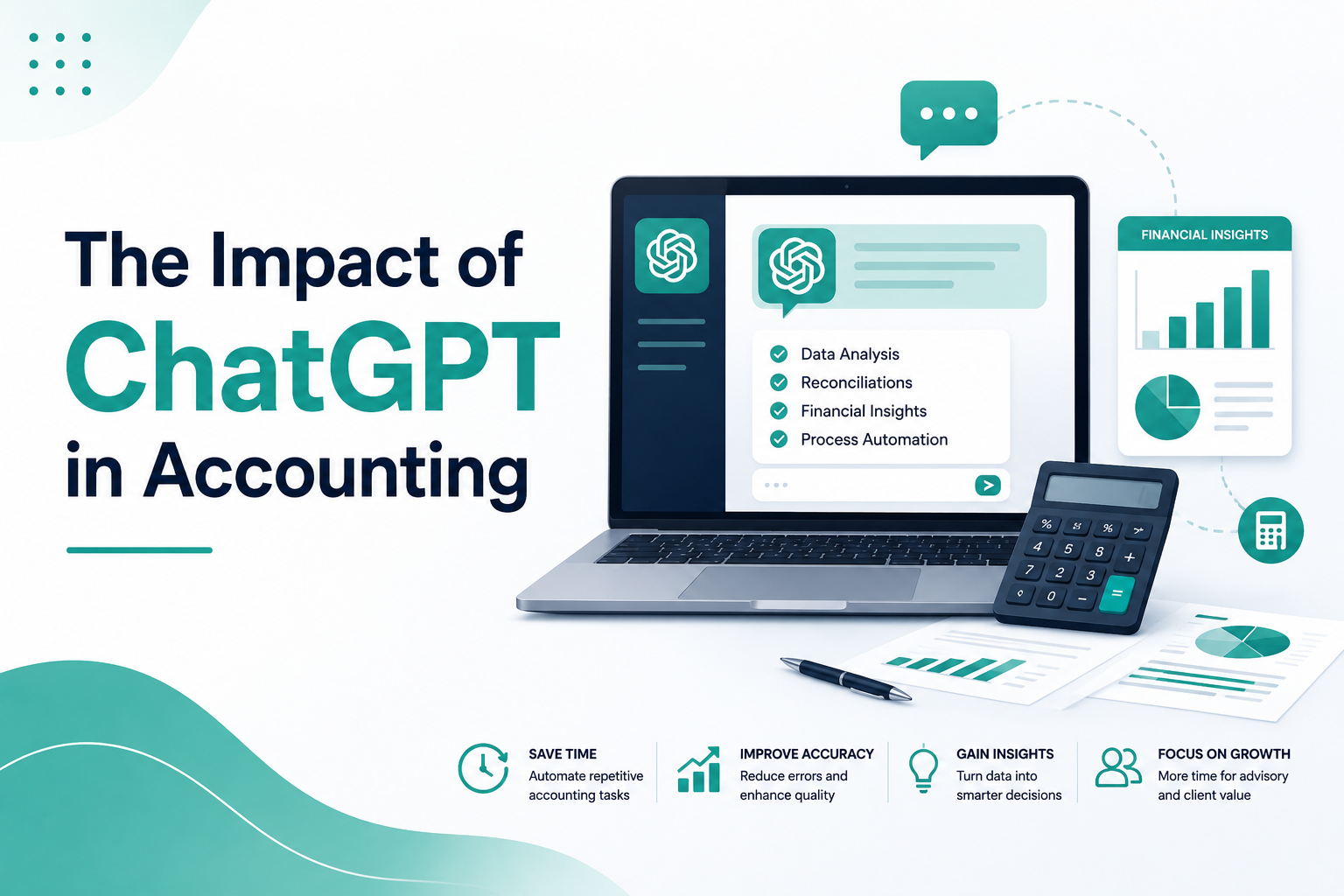
Few technologies have moved from curiosity to daily workflow as quickly as ChatGPT. In a profession built on precision, accountants were expected to be cautious. Instead, adoption accelerated. A 2026 Blue J and CPA.com survey of more than 1,000 tax professionals found that 60 percent now use AI for tax research at least weekly, nearly double the 33 percent reported a year earlier. Separately, the 2025 Intuit QuickBooks Accountant Technology Survey reported that 46 percent of accountants use AI every day.
The impact of ChatGPT in accounting is no longer theoretical. It is changing how firms draft communications, research questions, and onboard staff during stretched busy seasons. This article explains what ChatGPT does well, where it fails, the compliance questions every firm should ask, and how accounting professionals can prepare for what comes next.
Key Takeaways
- Adoption is mainstream: a majority of tax professionals now use AI tools weekly, with ChatGPT among the most common.
- The value is speed, not judgment: ChatGPT accelerates drafting, summarizing, and research framing, but it does not replace professional review.
- Risk is real: hallucinated outputs, data privacy exposure, and compliance gaps require firm-level policies.
- Preparation pays: firms that invest in AI training unlock meaningful capacity per employee each year.
What Is ChatGPT and How Does It Work?
ChatGPT is a generative AI tool built on a large language model (LLM). It produces human-like text by predicting the most probable next words based on patterns learned from vast amounts of training data. It does not look up facts in a database the way a search engine does. It generates language.
Generative AI refers to models that create new content, including text, code, and summaries, rather than simply retrieving stored answers. The engine behind ChatGPT relies on Natural Language Processing (NLP), which lets it interpret a plain-English prompt and respond in context.
Accountants are adopting these tools for a simple reason: much of the profession runs on language. Memos, client updates, policy explanations, and research summaries are all text-heavy tasks that an LLM can accelerate. Understanding this distinction matters, because it explains both the strengths and the limits covered below.
Why ChatGPT Is Gaining Attention in the Accounting Industry
Interest in ChatGPT did not appear in a vacuum. Several pressures converged at once:
- Talent shortages. Firms continue to struggle to hire and retain qualified staff, pushing leaders to find leverage in technology.
- Busy-season workload. Compressed deadlines during tax and audit seasons create demand for anything that saves hours.
- Productivity expectations. Thomson Reuters research projects AI will save professionals an average of five hours per week, valued at roughly 19,000 dollars per professional annually.
- Faster client response. Clients expect quicker answers, and AI helps teams turn around routine communication in minutes.
- Digital transformation. As firms migrate to cloud and automation, generative AI fits naturally into a modernizing tech stack.
The Impact of ChatGPT in Accounting Operations
ChatGPT is most useful in defined, language-driven tasks where a draft saves time and a professional reviews the result. Here are practical applications across a typical firm.
Tax Research Assistance
An accountant can ask ChatGPT to outline the general framework for a tax question, summarize a concept, or list issues to investigate. It works as a starting point that points the preparer toward the right authoritative sources, never as the final citation.
Drafting Client Communications
Routine emails, engagement reminders, and plain-language explanations of complex topics can be drafted in seconds, then personalized. This is one of the highest-value, lowest-risk use cases.
Financial Reporting Support
ChatGPT can help write the narrative sections of management reports, such as variance commentary, once the numbers are confirmed. It turns validated figures into readable prose.
Bookkeeping Process Assistance
It can document procedures, explain categorization logic to junior staff, and draft standard operating procedures, supporting the work rather than performing the entries.
Audit Documentation Preparation
Teams use it to structure workpaper narratives and summarize findings into clear language, with reviewers verifying every conclusion against evidence.
Data Analysis and Insights
When paired with verified data, ChatGPT can suggest ways to interpret trends or frame findings for a client conversation, helping translate analysis into advice.
Internal Knowledge Management
Firms use it to search internal documentation, answer policy questions, and speed up onboarding, giving new hires fast access to institutional knowledge.
Benefits of ChatGPT for CPAs and Accounting Firms
Used well, ChatGPT delivers measurable gains across the practice:
- Improved efficiency on repetitive, text-based work
- Time savings during peak season, when hours are scarcest
- Enhanced productivity per professional without adding headcount
- Better client service through faster, clearer responses
- Faster document drafting for memos, emails, and reports
- Reduced administrative burden on senior staff
- Wider knowledge accessibility for junior team members
According to Karbon research, accounting professionals are broadly enthusiastic about AI, yet only a minority of firms invest in formal training. The firms that do report unlocking the equivalent of several extra weeks of capacity per employee each year. The benefit is real, but it follows investment in skills, not the tool alone.
Limitations and Risks Accounting Professionals Must Understand
The same model that drafts a clean memo can also produce a confident, incorrect answer. Every firm should treat the following as non-negotiable awareness:
- Hallucinations. ChatGPT can invent citations, figures, or rules that look authoritative but are wrong.
- Data privacy. Information entered into public tools may not stay private, a serious concern for client data.
- Compliance risk. Outputs may not reflect current regulations or jurisdiction-specific rules.
- No professional judgment. The model has no fiduciary duty and cannot weigh context the way a CPA does.
- Confidential information handling. Entering client identifiers can breach confidentiality obligations.
- Mandatory human review. No output should reach a client or a file without a qualified professional checking it.
Compliance, Ethics, and AI Governance Considerations
AI governance is now a professional responsibility, not an IT afterthought. Firms should address each of these areas before scaling usage:
- Client confidentiality: define what data may never be entered into a public AI tool.
- Data security: favor enterprise or private deployments that contractually protect inputs.
- Responsible use: set expectations that AI assists with drafts, not decisions.
- Professional standards: align usage with applicable ethics rules and state board guidance.
- Documentation and review: record where AI was used and confirm human verification.
- Firm-level AI policy: publish a written policy so every team member follows the same rules.
Best Practices for Using ChatGPT in Accounting Firms
These six practices turn a risky experiment into a reliable workflow:
How Accounting Professionals Can Prepare for the AI-Powered Future
The professionals who thrive will not be those who avoid AI or those who trust it blindly. They will be the ones who learn to direct it. Preparation centers on a few priorities:
- Upskilling: build practical fluency with AI tools relevant to accounting tasks.
- AI literacy: understand how models work so you can spot when an output is unreliable.
- Technology adoption: integrate AI into existing workflows rather than bolting it on.
- Advisory focus: shift freed-up time toward higher-value advisory services clients will pay for.
- Continuous learning: treat AI as a moving target and keep current as tools evolve.
Continuing education is the practical bridge between awareness and competence. Platforms such as MYCPE ONE help accounting professionals stay informed about emerging technologies, regulatory developments, and CPA Continuing Education that supports long-term career growth in an AI-driven profession.
The Future of ChatGPT and AI in Accounting
The next phase is less about standalone chatbots and more about AI woven into the tools accountants already use. Expect to see:
- AI-assisted workflows embedded directly in tax, audit, and accounting software.
- Intelligent automation that handles routine processing while humans supervise exceptions.
- Predictive analytics that surface risks and opportunities before clients ask.
- Human-AI collaboration as the standard operating model, not the exception.
- Evolving roles that reward advisory skill, judgment, and client relationships over manual processing.
Conclusion
The impact of ChatGPT in accounting is significant and still growing. Used responsibly, it enhances efficiency and productivity, freeing professionals from repetitive drafting and research framing. What it cannot do is replace the judgment, ethics, and accountability that define the profession.
The firms best positioned for the years ahead will be those that adopt AI deliberately: clear policies, trained people, verified outputs, and a steady focus on the advisory work that machines cannot perform. Adaptation, continuous learning, and professional growth remain the constants. AI simply changes the tools you bring to them.
Frequently Asked Questions
How is ChatGPT used in accounting?
ChatGPT is used to draft client communications, summarize documents, frame tax research, write report narratives, and support staff onboarding. It accelerates language-heavy, repetitive tasks. Professionals then verify every output, since the tool assists with drafts rather than producing final, authoritative accounting work.
Can CPAs rely on ChatGPT for tax advice?
No. ChatGPT can outline issues or explain concepts, but it can produce inaccurate or outdated guidance and may invent citations. CPAs must verify everything against authoritative sources and apply professional judgment. It is a research aid, never a substitute for qualified tax advice.
What are the risks of using AI in accounting?
The main risks are hallucinated or incorrect outputs, client data privacy exposure, compliance gaps with current regulations, and over-reliance that bypasses professional judgment. Firms reduce these risks with written AI policies, restrictions on sensitive data, mandatory human review, and ongoing staff training.
Is ChatGPT replacing accountants?
No. ChatGPT automates routine, text-based tasks but cannot exercise professional judgment, assume accountability, or maintain client relationships. It shifts the accountant's role toward higher-value advisory work. The profession is changing, not disappearing, and human expertise remains essential to reliable, compliant results.
How can accounting firms use ChatGPT responsibly?
Firms should publish a written AI policy, prohibit entering confidential client data into public tools, require human verification of all outputs, train staff on effective use, and treat AI as a drafting aid. Responsible use pairs efficiency gains with professional judgment on every task.
What skills do accountants need in an AI-driven future?
Accountants need AI literacy to judge when outputs are reliable, practical fluency with relevant tools, stronger advisory and communication skills, and a commitment to continuous learning. Continuing education helps professionals keep pace as accounting technology and generative AI tools evolve.
Does ChatGPT improve accounting productivity?
Yes, when used well. Research suggests AI can save professionals around five hours per week, and firms that invest in training report meaningful added capacity per employee. The gains come from faster drafting and research framing, paired with consistent human review.
What is the future of AI in accounting?
AI is moving from standalone chatbots into the software accountants already use, powering intelligent automation, predictive analytics, and human-AI collaboration. Roles will increasingly reward judgment, advisory skill, and client relationships, while routine processing becomes automated and supervised rather than performed manually.