Sign up with Google
 Sign in with Zoho


Modern building design in the United States is more complex, more regulated, and more collaborative than at any point in the history of the AEC industry. Projects now demand integrated structural systems, high-performance building envelopes, complex MEP coordination, energy code compliance, and real-time collaboration across teams distributed across multiple offices and disciplines. Traditional CAD workflows were not built for this environment. Revit Architecture BIM Services were.
Autodesk Revit has become the dominant platform for Architectural BIM in the USA not because it is simply a 3D modeling tool, but because it fundamentally restructures how design knowledge is created, validated, shared, and translated into construction deliverables. This article explains why Revit Architecture BIM Services are changing how US design teams work, what technical capabilities drive that change, and what it means for Architects, BIM Managers, and AEC professionals operating at the frontier of modern building delivery.
The Technical Foundation of Revit Architecture BIM Services
Revit Architecture BIM Services are built on a single foundational principle that separates BIM from all previous design software. Every building element in a Revit model is an intelligent parametric object, not a line or a shape. Walls know their height, material composition, thermal resistance, fire rating, and structural function. Doors know their frame type, hardware group, acoustic rating, and accessibility compliance status. Windows carry glazing performance data alongside their geometric properties.
This intelligence is what makes Revit the engine of Architectural BIM Modeling rather than just a visualization platform. When design decisions change, parametric relationships propagate those changes automatically across geometry, documentation, and schedules. The model does not just look like the building. It knows how the building is built.
Autodesk describes Revit as purpose-built for Building Information Modeling, enabling teams to design, simulate, and document a building in a single environment. According to Autodesk's Revit platform overview, the software supports the full architectural, structural, and MEP design workflow within a coordinated data environment, making it the industry standard for BIM delivery in the USA.
How Revit Architecture BIM Services Are Changing Design Practice?
Parametric Design and Adaptive Modeling
One of the most significant ways Revit Architecture BIM Services are transforming building design is through parametric modeling capability. Architects and Architectural Designers no longer manually redraw geometry when a design evolves. Instead, they adjust parameters and the model responds. A floor-to-floor height change updates every wall, column, curtain wall panel, stair flight, and affected schedule line simultaneously.
Adaptive components in Revit allow design teams to create geometry that responds to site conditions, structural grids, or solar orientation. Complex facade systems that would require weeks of manual drafting in CAD can be modeled as parametric curtain wall families in Revit, with every panel dimension, material type, and glazing ratio defined by editable parameters. This design agility is what enables US firms to pursue complex architectural geometries on competitive delivery schedules.
Integrated Documentation and Drawing Production
Revit Architecture BIM Services eliminate the separation between the design model and the construction document set. In a fully implemented Revit workflow, floor plans, building sections, wall sections, reflected ceiling plans, interior elevations, details, door and window schedules, room finish schedules, and sheet indexes are all live model outputs. No manual drafting is required to maintain them. When the design changes, the documentation changes with it.
For BIM Managers and Coordinators overseeing large US commercial, healthcare, or educational projects, this integrated documentation workflow means that the construction document set is never out of sync with the design model. Every sheet issued for permit or construction reflects the actual, current state of the Architectural BIM model, eliminating the version control failures that generate costly RFIs and field conflicts.
Worksharing and Multi-User Collaboration
Large architectural projects require multiple team members working simultaneously on different areas of the same model. Revit Architecture BIM Services are built around a worksharing environment that allows distributed teams to work on a single centrally managed model using worksets. Each team member checks out the elements they are actively editing while others work on different worksets without conflict.
Cloud-based worksharing through Autodesk Construction Cloud extends this capability to geographically distributed teams, allowing project architects in New York, structural engineers in Chicago, and MEP consultants in Houston to work from the same coordinated model in real time. This is a fundamental change in how US design teams collaborate compared to the email-based drawing exchange workflows that Revit replaces.
Revit Architecture BIM Services and Multi-Discipline Coordination
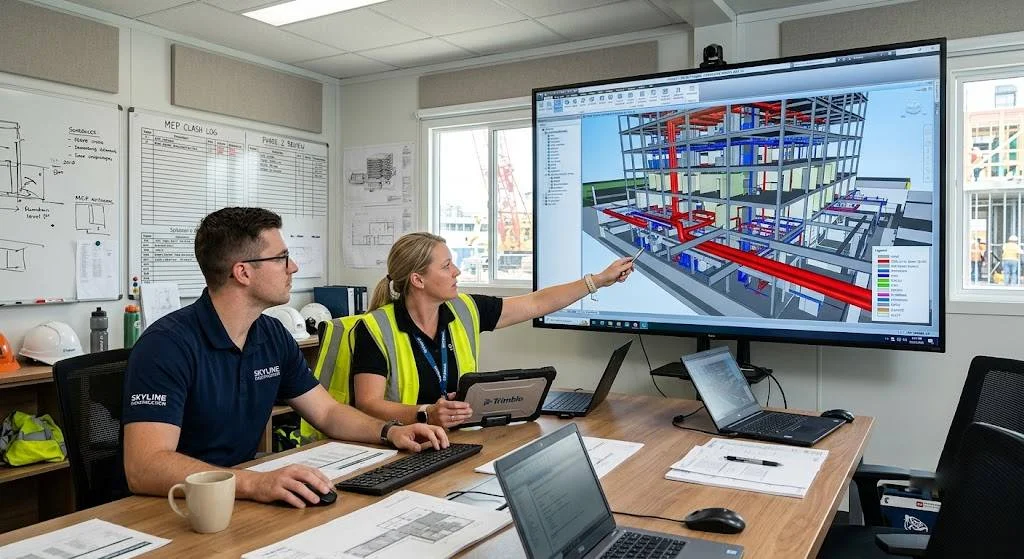
The most operationally impactful capability of Revit Architecture BIM Services on US construction projects is federated model coordination. Architectural Revit models are linked with structural Revit or Tekla models and MEP Revit or AutoCAD MEP models to create a single federated BIM environment. This environment is the foundation for pre-construction clash detection and spatial coordination.
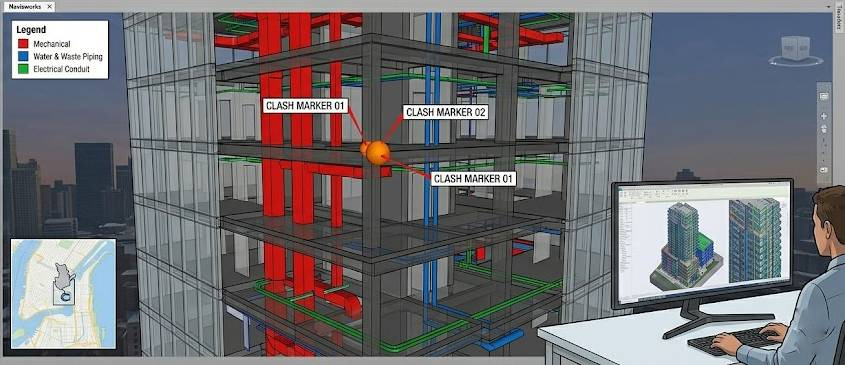
Pre-Construction Clash Detection Workflow
When the federated model is complete, BIM Coordinators run clash detection using Autodesk Navisworks. Hard clashes between structural and MEP elements, soft clashes where systems violate maintenance clearance requirements, and workflow clashes where construction sequencing conflicts occur are all identified and logged. Each clash is assigned a resolution responsible party, tracked through weekly coordination meetings, and resolved in the Revit model before construction begins.
For US projects where field labor costs make rework extremely expensive, this pre-construction coordination workflow using Revit Architecture BIM Services is one of the highest-value investments available. Clashes resolved in the model cost a fraction of what the same conflict costs when discovered during mechanical installation or structural erection.
IFC Export and Open BIM Interoperability
Revit supports export to IFC (Industry Foundation Classes) format, the open standard maintained by buildingSMART International for BIM data exchange across different software platforms. For US public sector projects, federally funded facilities, and international joint ventures, IFC compliance ensures that the Architectural BIM model data can be shared with project stakeholders regardless of their software platform. Structural engineers using Tekla, contractors using Trimble, and facilities managers using IBM Maximo can all receive and use model data exported from Revit in IFC format.
Why US AEC Firms Are Adopting Revit Architecture BIM Services at Scale?
The adoption of Revit Architecture BIM Services across the US construction market is accelerating because the business case is now well-documented across project types and scales. Firms that implement mature Revit BIM workflows report measurable improvements in design quality, documentation accuracy, coordination efficiency, and client satisfaction.
The driving factors behind accelerating Revit BIM adoption in the USA include:
- Owner and developer mandates requiring BIM deliverables as a contractual condition on commercial and institutional projects
- General contractor preference for BIM-coordinated design sets that reduce RFIs, change orders, and field coordination conflicts
- Federal and state agency requirements for BIM on publicly funded facilities including GSA, VA, and Department of Defense projects
- Insurance and risk management benefits from documented BIM coordination processes that demonstrate design due diligence
- Competitive differentiation for design firms that can offer integrated Revit BIM workflows as a project delivery capability
The Dodge Construction Network Smart Market Report on BIM consistently documents that BIM adoption rates among US AEC firms have increased year-over-year, with Revit remaining the dominant authoring platform across architectural and engineering disciplines.
What to Look for in a Revit Architecture BIM Services Provider?
For US project owners, developers, and design firms evaluating Revit Architecture BIM Services providers, capability assessment goes beyond software licensing. A high-performing Revit BIM team must demonstrate structured delivery capability across the full project lifecycle.
Critical capabilities to evaluate in a Revit Architecture BIM Services provider include:
- Parametric family library depth covering architectural, structural, and specialty building systems
- Experience delivering coordinated Revit models on US commercial, healthcare, and institutional project types
- Structured clash detection and coordination meeting workflow using Navisworks with documented resolution tracking
- Proficiency in Revit worksharing, workset management, and Autodesk Construction Cloud collaboration
- BIM Execution Plan authoring capability aligned with AIA E203 BIM Protocol and project-specific delivery requirements
- IFC export expertise for interoperability with structural, contractor, and facilities management platforms
- Staff credentials including Autodesk Certified Professional designations in Revit Architecture
Conclusion
Revit Architecture BIM Services are not simply replacing older software tools in the US construction market. They are replacing an entire approach to building design, one where drawings were static, coordination was manual, and information was fragmented across disconnected documents. Revit replaces that fragmentation with a single intelligent model that carries design intent, construction information, performance data, and regulatory compliance evidence in one coordinated environment.
For Architects, BIM Managers, Architectural Designers, and AEC professionals building careers and practices in the US construction industry, Revit Architecture BIM Services represent the technical language of modern building delivery. Firms that master this language, building deep parametric modeling capability, structured coordination workflows, and documentation discipline, are the firms that win complex projects, retain owner confidence, and consistently deliver buildings that perform as designed.
The revolution in building design that Revit Architecture BIM Services are driving is not a future development. It is the current state of professional practice for leading AEC firms across the United States, and it is deepening every year as project complexity, owner expectations, and coordination requirements continue to rise.