Sign up with Google
 Sign in with Zoho
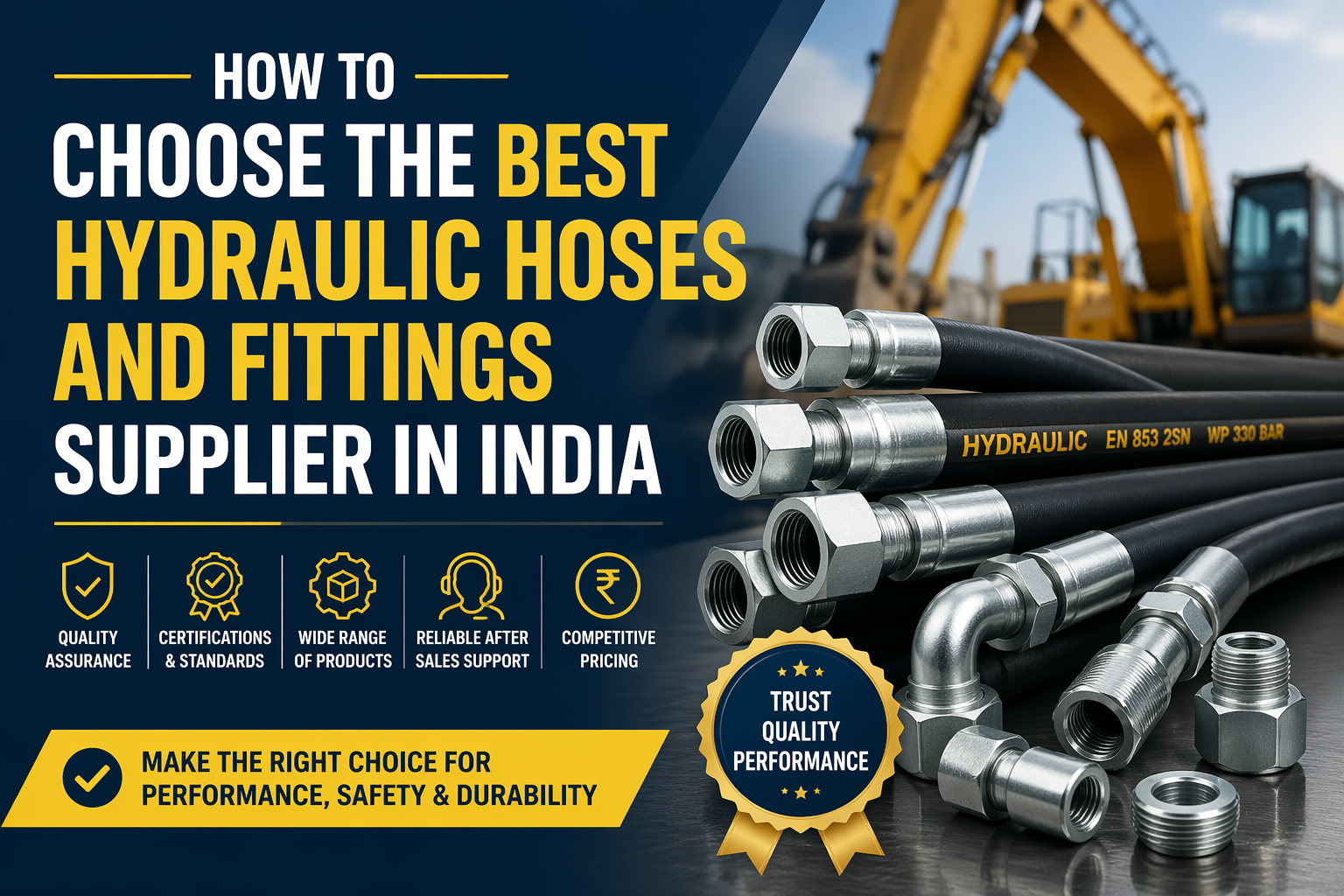
You don’t notice a bad Hydraulic Hoses and Fittings supplier during the quotation stage. It shows up three weeks later—when a batch fails pressure testing at 280 bar instead of the rated 350, and your client starts asking questions you can’t deflect.
That’s the real problem. Most buyers shortlist a Hydraulic Hoses and Fittings Wholesaler based on price sheets and catalog PDFs, not on how that supplier behaves when something goes wrong. Which means the risk is already baked into the deal before the PO is even raised.
What Actually Defines Quality in Hydraulic Hoses and Fittings
Pressure Ratings Are Not What They Seem
Here’s the catch. It does not imply that the hose can be operated under a pressure of 400 bar continuously. The recommended ratio for industrial purposes according to ISO 18752 is 4:1. Which means working pressure should stay closer to 25% of burst pressure.
Most buyers miss that.
A Hydraulic Hose Pipe Fittings Supplier in India who doesn’t explain working vs burst pressure is either careless—or counting on you not asking.
Material Composition and Reinforcement Layers
And yet, the real difference sits inside the hose. Wire braid vs spiral reinforcement changes everything—flexibility, fatigue life, and impulse cycles.
- 1-wire braid: up to ~225 bar
- 4-spiral: up to ~420 bar
- 6-spiral: extreme applications
That matters if your equipment runs 16 hours a day.
Fittings Compatibility and Thread Standards
Which means BSP, NPT, JIC, ORFS—these are not interchangeable, no matter what a catalog says. A mismatch here doesn’t fail immediately. It leaks slowly, then catastrophically.
The Detail Buyers Usually Skip — Impulse Testing
Nobody tells you this: impulse cycles matter more than static pressure ratings.
Impulse hose rated to withstand 1 million impulse cycles acts very differently compared to a hose with the rating of 200,000. This difference will be observed in contracts made, not during initial inspections.
The 5 Supplier Checks That Prevent Expensive Mistakes
1. Certification Isn’t the Question — Validity Is
Ask for ISO or test certificates. Then check the issue date.
Bad answer: “It’s certified, don’t worry.” That’s not an answer. That’s avoidance.
2. Batch Traceability
That’s where most suppliers go silent.
Good suppliers track batches down to raw material lots. A weak Hydraulic Hoses and Fittings Manufacturer will say, “We’ll replace if there’s an issue.” Replacement after downtime doesn’t fix your loss.
3. Lead Time vs Production Capacity
Here’s where deals fall apart.
Bad answer: “7–10 days for any quantity.” That’s unrealistic for large orders. Either they outsource—or they delay.
4. Testing Capability
Most buyers never ask to see the test rig.
If a High Pressure Hydraulic Hose Manufacturer cannot show hydrostatic or impulse testing in-house, they are depending on third parties. That slows everything down.
5. Defect Handling Policy
A supplier who says “case-by-case basis” doesn’t have a policy.
That’s a negotiation you lose after the shipment lands.
How the Right Supplier Protects Your Margins
A good supplier doesn’t just deliver product. They remove uncertainty.
- Fewer field failures → less warranty cost
- Consistent specs → easier bulk procurement
- Predictable lead times → better inventory planning
- Correct fittings → zero rework cost
- Tested hoses → reduced downtime
And here’s a number worth noting: unplanned downtime in manufacturing can cost ₹15,000–₹45,000 per hour depending on the industry. One failed hose can wipe out your entire margin on that order.
Availability of Hydraulic Hose Pipe Fittings Suppliers in India
India has no shortage of options. The problem is filtering them.
From Hydraulic Hose Pipe Fittings Manufacturers in India in industrial hubs like Ghaziabad, Pune, and Ahmedabad to export-focused High Pressure Hydraulic Hose Suppliers, availability isn’t the issue—consistency is.
Which means location is more than logistics.
A supplier based near NCR, for example, can reduce transit time by 2–4 days for North India buyers. That directly impacts inventory cycles and emergency replacements. And if you’re exporting, proximity to ICDs (Inland Container Depots) matters more than most buyers realise.
About N.T Associates
We’ve been in this space long enough to know where deals go wrong.
We’re not just another Hydraulic Hoses and Fittings Wholesaler listing products—we work with procurement teams who need consistency across repeat orders. Our hoses and fittings are tested, documented, and matched to actual application loads, not just catalog specs.
One thing most people don’t know: we stopped sourcing a particular reinforcement batch in 2022 after three clients reported early fatigue in high-cycle applications. We changed the source, re-tested, and absorbed the cost. That’s how long-term supply works.
Ready to Source Without Surprises?
If you’re evaluating a Hydraulic Hoses and Fittings Manufacturer, don’t send a generic inquiry.
Send us:
- Required pressure ratings
- Application type (static/dynamic)
- Quantity and delivery timeline
- Fitting standards (BSP/NPT/JIC)
We respond within 24 hours. MOQ depends on configuration, but most standard orders start from 100 units.
Final Thought
The question of which Hydraulic Hoses and Fittings Supplier in India you should choose is not really determined by who can offer you the lowest quote; it is determined by which one is the most reliable over the long run.
FAQs
1. Who are reliable Hydraulic Hoses and Fittings Manufacturers in India?
It is important to find companies that have their own laboratories and test every batch. In case you choose a company which outsources tests, there will be problems.
2. What should I check in a Hydraulic Hoses and Fittings Wholesaler?
Consistency, documentation, and the possibility of returning the products when required are important. Often wholesalers supply several different batches; therefore, the product’s consistency can suffer.
3. Are all Hydraulic Hose Pipe Fittings Suppliers in India the same?
Absolutely not. There are traders who specialize in export products, and there are traders who provide low-priced products domestically.
4. How do I choose between High Pressure Hydraulic Hose Suppliers?
It is essential to take into account impulse testing data. Otherwise, long-term behavior cannot be estimated.
5. What’s the difference between High Pressure Hydraulic Hose Manufacturers and traders?
Manufacturers have control over production and testing; traders rely on third parties.
6. Are Hydraulic Hose Pipe Fittings Manufacturers in India suitable for export?
Most likely but not everyone. The proper certification and packing is required. Not all of the suppliers comply with exporting requirements.
7. How long does a High Pressure Hydraulic Hose typically last?
Depends on usage. In high-cycle environments, even a good hose may need replacement within 6–12 months. Anyone promising longer without context is overselling.