 Sign up with Google
 Sign in with Zoho

Not long ago, most media companies only cared about one thing: launching fast.
If an OTT provider could put their videos online quickly with apps for mobile and TV, that was enough. Many businesses happily signed up for SaaS OTT platforms because the setup looked simple and affordable.
But after the initial growth phase, reality started hitting differently.
A lot of streaming businesses discovered they didn’t actually own much control over the platform they were building on.
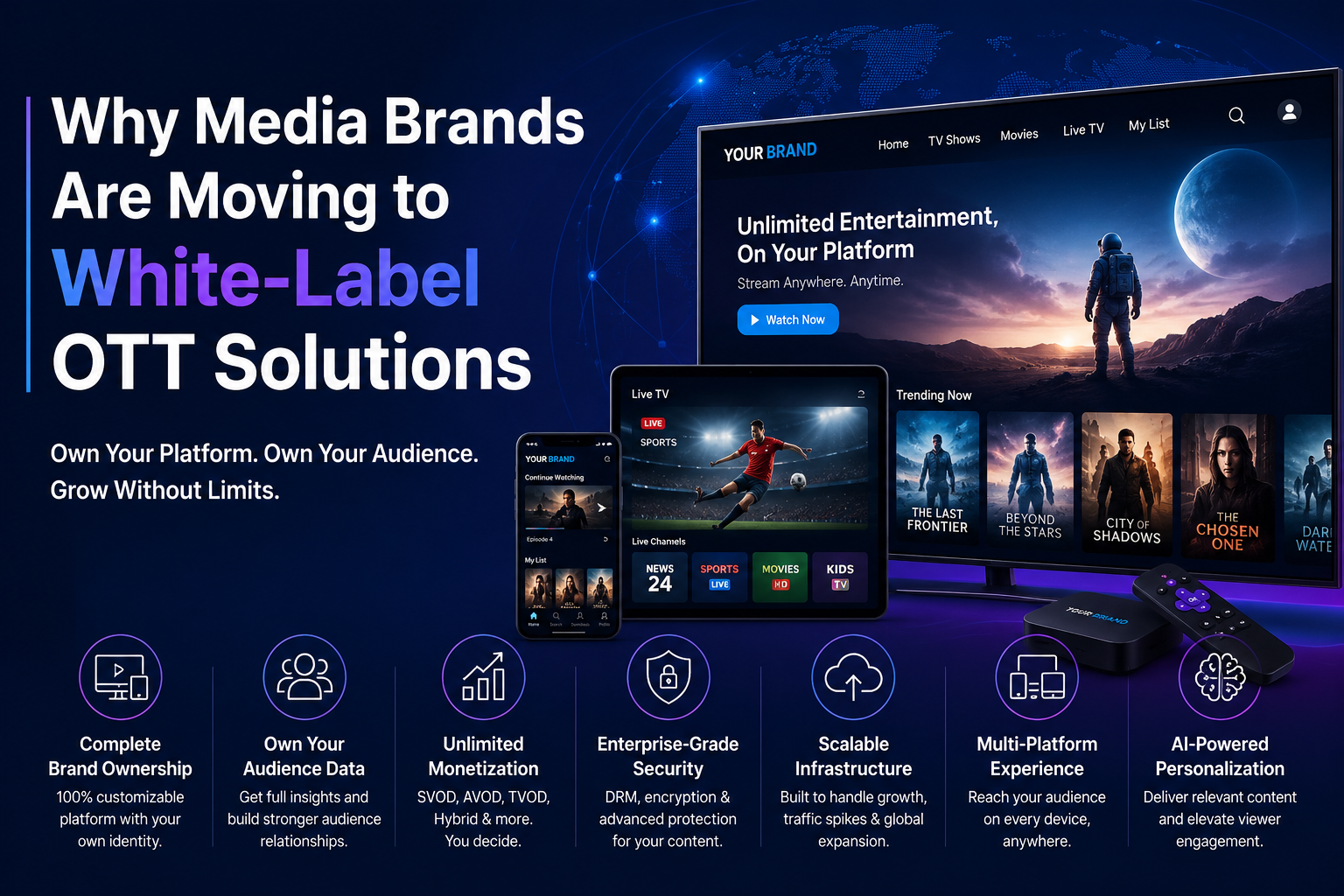
That realization is pushing many media brands toward white-label OTT solutions.
The “Quick Launch” Model Stops Working Later
In the early stage, SaaS OTT platforms feel convenient.
You choose a template, upload content, configure subscriptions, and launch. For small creators or first-time streaming businesses, that speed genuinely helps.
The problems usually appear later.
One media startup founder I spoke with last year mentioned something interesting. Their OTT app looked polished at launch, but after a few months they noticed several competing platforms using almost the exact same interface and feature structure because they were all built on the same SaaS system.
Their viewers couldn’t really differentiate the brand experience anymore.
That’s when they started exploring white-label alternatives.
Media Companies Want Their Own Identity
Streaming has become crowded.
People today jump between Netflix, YouTube, regional OTT apps, sports platforms, education platforms, and creator-led streaming services constantly. Because of that, branding matters more than ever.
Many businesses no longer want:
- Generic layouts
- Fixed UI structures
- Shared templates
- Restricted app customization
They want the platform to feel like their own digital property.
A white-label OTT setup gives companies much more flexibility to shape the user experience according to their audience instead of adapting to a one-size-fits-all SaaS framework.
That difference may sound small technically, but from a business perspective, it changes how viewers remember the platform.
Ownership Became a Bigger Discussion After Scaling
One thing that surprises many OTT businesses is how dependent they become on third-party providers.
At first, that dependency is easy to ignore because growth is the priority.
But later, companies start worrying about questions like:
- What happens if pricing changes suddenly?
- Can we launch custom monetization models?
- What if we need backend flexibility?
- Are we able to scale independently?
- Can we fully access our audience data?
Those concerns become more serious once the platform starts generating actual revenue.
Several growing media brands are now choosing infrastructure they can control more directly rather than depending entirely on SaaS limitations.
Audience Data Is Becoming Extremely Valuable
A few years ago, many streaming businesses didn’t think deeply about analytics beyond view counts.
That has changed.
Today, OTT companies study:
- Viewer watch patterns
- Drop-off rates
- Device behavior
- Regional engagement
- Subscription retention
- Watch-time trends
This information shapes business decisions.
For example, some platforms now decide future content investments entirely based on engagement analytics instead of assumptions.
With ownership-focused OTT infrastructure, businesses usually gain deeper visibility into audience behavior instead of relying only on limited dashboard summaries.
That becomes useful when trying to improve retention or increase monetization efficiency.
Monetization Needs Are Different Now
The OTT market itself has evolved.
Earlier, subscription-only models dominated. Now businesses are mixing multiple revenue streams together.
Some platforms use:
- Monthly subscriptions
- Ads
- Sponsored content
- Pay-per-view access
- Live event ticketing
- Hybrid models
The challenge is that not every SaaS OTT provider supports these approaches properly.
Several businesses eventually move toward white-label OTT systems simply because they need monetization flexibility that generic platforms cannot easily provide.
Scalability Problems Usually Appear at the Worst Time
Interestingly, many streaming companies don’t think much about infrastructure until a major traffic spike happens.
Usually it’s during:
- Live sports
- Viral content
- Major announcements
- Entertainment premieres
- High-demand webinars
That’s when buffering issues and playback instability suddenly become serious business problems.
And viewers rarely give second chances during live streaming failures.
Because of this, larger media brands increasingly prefer scalable OTT environments where they have better infrastructure control instead of relying fully on shared SaaS resources.
Security Expectations Have Increased
Premium content businesses are also paying more attention to content protection now.
Sports broadcasters, film distributors, and paid education platforms especially worry about piracy and unauthorized access.
As a result, businesses increasingly look for features like:
- DRM security
- Tokenized streaming
- Device authentication
- Geo-restrictions
- Secure payment systems
Earlier, these features were considered “advanced.” Now many OTT companies treat them as essential.
Self-Hosted OTT Is Becoming More Attractive
There’s also a noticeable shift toward self-hosted OTT infrastructure among growing brands.
Not every business wants a fully managed SaaS model forever.
Some companies eventually prefer more ownership because they want:
- Long-term flexibility
- Independent scaling
- Better backend access
- Custom integrations
- Infrastructure-level control
For established media brands, this often feels safer than building the entire business inside someone else’s ecosystem.
How Regal Streaming Solutions Helps Media Brands
Regal Streaming Solutions works with businesses looking for self-hosted white-label OTT infrastructure rather than restrictive template-driven SaaS systems.
The focus is on helping media brands build streaming platforms with:
- Full branding flexibility
- Multi-device streaming
- Independent monetization
- Scalable infrastructure
- Secure deployment environments
This approach is especially useful for companies planning long-term OTT growth instead of short-term launch convenience.
Final Thoughts
The OTT industry is changing in subtle but important ways.
Media companies are becoming more careful about ownership, scalability, audience data, and monetization control instead of only focusing on launch speed.
SaaS OTT platforms still make sense for some early-stage projects. But for businesses planning serious long-term streaming growth, white-label OTT infrastructure is becoming a much more practical choice.
For many media brands, the conversation is no longer just about streaming video online.
It’s about building a platform they truly control.