Sign up with Google
 Sign in with Zoho

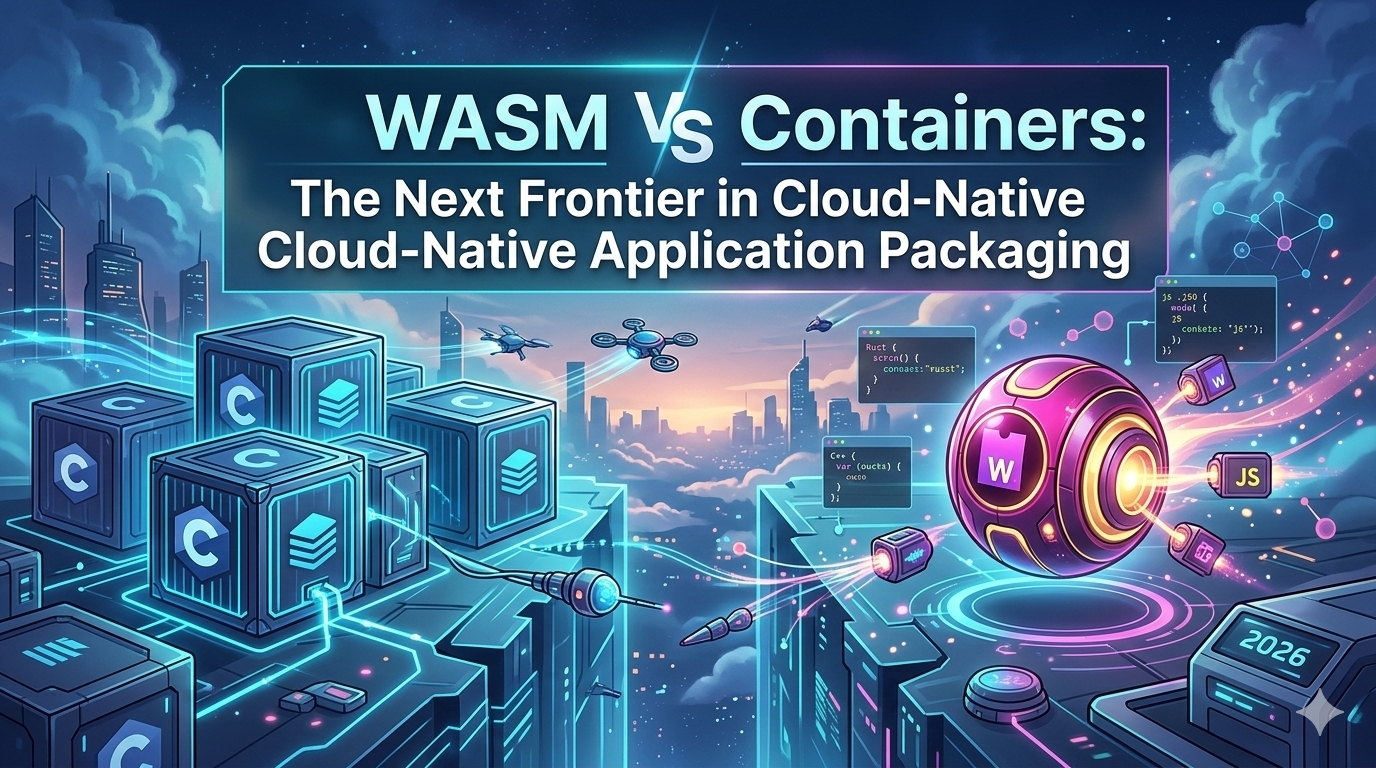
I remember the first time someone on my team mentioned running WebAssembly on the server side. My immediate reaction was wait, isn't that the thing that runs Figma in a browser?
Yes. And no. That mental model is already outdated, and if you're building scalable cloud application architecture today, this conversation is one you need to stop postponing.
Containers have been the undisputed packaging standard for nearly a decade. Docker changed how we think about shipping software. Kubernetes turned it into an industry. Nobody's arguing that. But something genuinely interesting is happening at the edges of this space, and dismissing WASM as a browser toy is the same mistake people made about containers when they first called them "just fancy chroot jails."
So let's have an honest conversation.
Why Containers Became the Default and What That Cost Us
Before containers, deployment was a mess of environment-specific configs, dependency conflicts, and "works on my machine" becoming a professional hazard.
Containers solved that. Package your app with everything it needs, run it anywhere Docker is installed. Clean, portable, predictable.
But containers brought their own weight.
A container image bundles an entire OS filesystem layer. Even a stripped down Alpine-based image carries a kernel interface, system libraries, a shell infrastructure that your actual application logic doesn't need and never touches. A Node.js API that serves JSON responses is dragging around a miniature operating system to do it.
Cold starts are slow. A container needs to pull an image, unpack layers, initialize the runtime, and boot the process. On a good day with warm caches, you're looking at seconds. In a serverless context where you're paying per invocation and promising low latency seconds matter.
And the attack surface is real. Every layer in that image is a layer that needs patching, scanning, and securing. Teams running hundreds of container images know this maintenance burden intimately.
None of these killed containers. They're still the right tool for the majority of workloads. But it opened a door.
What WebAssembly Actually Is Outside the Browser
WASM started as a compilation target for browsers a way to run C, C++, Rust at near-native speed inside a sandboxed browser environment. That origin story is now just history.
The core of what makes WASM interesting is not browser-specific at all. It's a binary instruction format that runs in a sandboxed, memory-safe virtual machine. It doesn't know what OS it's running on. It doesn't assume a filesystem or network stack. It just executes.
WASI the WebAssembly System Interface extended this to the server. Now WASM modules can interact with system resources in a controlled, capability-based way. You explicitly grant a module access to specific files, network sockets, environment variables. Nothing else is reachable. Not by default, not by accident.
The result is a runtime that is genuinely tiny. WASM modules start in milliseconds sometimes under a millisecond. The binary itself is compact. The sandbox is enforced at the instruction level, not the OS boundary level.
Solomon Hykes, the co-creator of Docker, put it plainly back in 2019: if WASM and WASI had existed in 2008, Docker would never have needed to be created. That's not a dismissal of Docker. That's an acknowledgment of what WASM fundamentally solves.
Where WASM Wins and Where It Doesn't
This is where most WASM articles go wrong. They either overhype it as a container killer or dismiss it as niche. Neither is accurate.
WASM genuinely excels at:
Edge and serverless functions. Sub-millisecond cold starts are transformative when you're running functions at Cloudflare's 300+ edge locations or Fastly's network. Containers can't compete here. Spin, the open-source framework from Fermyon, builds entire microservice architectures on WASM for exactly this reason.
Plugin systems and extensibility. Running untrusted third-party code safely is a notoriously hard problem. WASM's sandbox makes it tractable. Envoy proxy, the same one sitting inside your Istio service mesh, uses WASM for its plugin system. You write a filter in Rust, compile to WASM, load it into Envoy at runtime. No process boundary required, no security compromise.
Polyglot environments. WASM doesn't care what language you wrote your code in, as long as it compiles to the target. Rust, Go, C, AssemblyScript same runtime, same binary format, same performance profile.
Where containers still win:
Stateful, long-running workloads. A database, a message broker, a service that holds persistent connections aren't good WASM candidates. Containers are the right unit here, full stop.
Legacy application packaging. You're not recompiling your five-year-old Java monolith to WASM. Containerize it, ship it, move on.
Rich OS interaction. Applications that need deep filesystem access, OS-level threading, or hardware interfaces are better served by containers where the OS layer is a feature, not overhead.
The Convergence Nobody Is Talking About Enough
Here's what's actually happening in production right now, at the bleeding edge of scalable cloud application architecture it's not WASM replacing containers. It's both running side by side, managed by the same orchestration layer.
The CNCF's TAG Runtime has been exploring WASM as a first-class workload type in Kubernetes. Projects like runwasi and Wasmtime's Kubernetes integration let you run WASM modules as pods, same kubectl commands, same manifests, same cluster. The scheduler doesn't care if it's spinning up a container or a WASM module. You get to choose the right packaging format per workload.
This is the architecture pattern that will define the next five years. Not a rip-and-replace. A graduation to workload-appropriate packaging.
What This Means If You're Building Today
If you're designing a new service that lives at the edge, has cold start sensitivity, or needs to run untrusted plugins safely, evaluate WASM seriously. The tooling is maturing fast. Fermyon Cloud, Cloudflare Workers (WASM-native), and Fastly Compute are all production-grade today.
If you're running existing containerized workloads don't touch them. Containers are not going anywhere. The Kubernetes ecosystem, the tooling, the operational muscle memory your team has built that's real value.
The engineers who will look smart in three years are the ones building now with both formats in mind. Not chasing the new thing, not ignoring it either. Understanding where each one earns its place in the stack.
The Honest Takeaway
WASM is not a container killer. It's the next packaging primitive one that fills gaps containers were never designed to fill.
Cold starts, edge execution, sandboxed extensibility, tiny footprint these are real production problems that WASM solves better. Stateful services, legacy workloads, rich OS access containers still own that territory.
The next frontier in cloud-native application packaging isn't a battle. It's a both/and. Know which workload you have. Pick the right format. Stop treating this like you have to pick a side.






 (1) (1).webp)