Sign up with Google
 Sign in with Zoho
It Often Starts Small
In many businesses, the journey toward ISO 14001 certification doesn’t begin with a grand plan. It starts with something subtle—a rise in waste costs, an inefficient process, or a growing sense that things aren’t as controlled as they should be.
Nothing urgent. Nothing alarming.
But enough to make someone pause and think: “Could we be handling this better?”
That quiet realization is usually the first step. Not compliance. Not pressure. Just awareness.
What ISO 14001 Certification Really Means
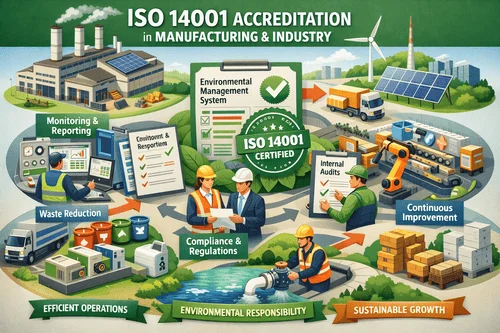
Strip away the technical terms, and ISO 14001 certification is simply a structured way to:
- Understand your environmental impact
- Identify risks early
- Manage processes consistently
- Improve over time
What makes it different is this: it doesn’t give you a fixed rulebook.
Instead, it asks:
- Where are your environmental risks?
- Which processes are creating unnecessary waste?
- What can be improved—realistically?
This flexibility is why it works across industries—from manufacturing plants to small processing units. The framework stays the same, but the application is always tailored.
The Cost of Waiting
There’s a common mindset in organizations: “We’ll fix it when it becomes serious.”
It sounds practical—but environmental issues rarely stay small.
- Minor waste → turns into disposal challenges
- Small inefficiencies → increase operational costs
- Overlooked risks → become compliance issues
By the time action is taken, the effort required is often much higher.
ISO 14001 certification shifts that timing.It encourages early action—when problems are still manageable.
When It Becomes Part of Daily Work
One of the most interesting changes happens gradually.
At first, employees follow procedures because they’re required to. It may feel like extra work.
But over time:
- Operators start noticing patterns
- Teams connect performance with environmental impact
- Supervisors ask more thoughtful questions
Eventually, environmental thinking becomes part of everyday work—not a separate task.
That’s when the system truly starts working.
Seeing Risks Clearly
Sometimes, the biggest challenge isn’t fixing environmental problems—it’s recognizing them.
ISO 14001 certification creates visibility.
It pushes organizations to step back and ask:
- Where does waste actually come from?
- Which activities have the highest impact?
- What could go wrong if controls fail?
This isn’t about overanalyzing—it’s about awareness.And once awareness improves, better decisions tend to follow naturally.
A Real Shift in Mindset
There comes a point where things change.
Instead of doing tasks just to meet requirements, teams begin to understand why those tasks matter.
Environmental management stops being a checklist and becomes intentional.
This shift doesn’t happen overnight. It builds through:
- Discussions
- Small improvements
- Trial and error
But once it happens, it sticks.
Documentation: More Helpful Than It Seems
Let’s be honest—documentation often gets a bad reputation.
Yes, ISO 14001 involves:
- Procedures
- Records
- Tracking systems
At first, it can feel overwhelming.
But over time, it actually simplifies things:
- Clear processes reduce confusion
- Records reveal patterns
- Updates ensure improvements last
It’s not about paperwork—it’s about consistency.
Audits That Add Value
Audits are often seen as stressful checkpoints.
But in reality, under ISO 14001, they serve a more useful purpose:
- Highlight what’s working well
- Identify gaps early
- Provide direction for improvement
Over time, organizations begin to see audits less as pressure—and more as an opportunity to refine their systems.
Common Misunderstandings
Many businesses hesitate because of assumptions like:
- “It’s too complex”
- “It’s only for large companies”
- “It will slow us down”
In practice, the opposite is often true.
Once implemented:
- Processes become clearer
- Responsibilities are better defined
- Decision-making improves
The system simplifies operations rather than complicating them.
Benefits That Build Over Time
Some benefits are obvious:
- Reduced waste
- Better environmental control
- Improved compliance
But others are more subtle:
- Stronger internal communication
- More consistent processes
- Greater operational stability
These changes don’t happen overnight—but they last.
Challenges Are Part of the Process
It’s not always smooth.
There can be:
- Resistance from teams
- Confusion during early stages
- Slow progress at times
But these are normal. In fact, working through them often leads to stronger, more practical systems.
Progress Over Perfection
One of the most important lessons:
You don’t need a perfect system. You need a consistent one.
Small, regular improvements matter more than big, occasional changes.
- Fix issues as they arise
- Learn from mistakes
- Keep refining processes
That’s how long-term success is built.
Leadership Makes the Difference
No system works without the right support from leadership.
When leaders:
- Stay involved
- Ask the right questions
- Support improvements
…the entire organization follows.
When they don’t, the system becomes weak.
ISO 14001 certification isn’t just technical—it’s cultural. And leadership sets that tone.
Continuous Improvement, Step by Step
The strength of ISO 14001 lies in its simplicity:
- Improve a process
- Reduce a risk
- Make something more efficient
Individually, these changes may seem small.But together, they create meaningful, lasting progress.
So, Where Does That Leave You?
If you’re considering ISO 14001 certification, don’t think of it as a perfect solution.
It isn’t.
Instead, think of it as a way to:
- Gain better control
- Reduce uncertainty
- Manage environmental risks more effectively
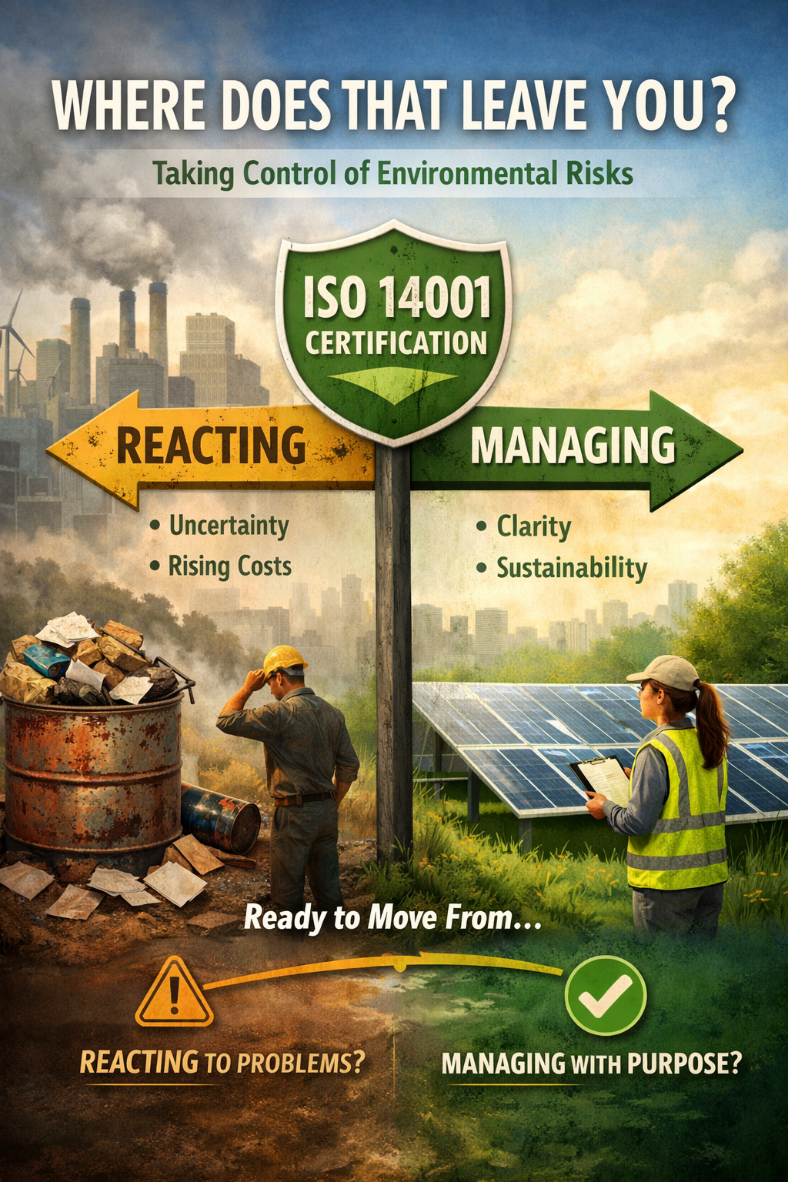
It helps you move from reacting to problems… to actually managing them.
And once that clarity sets in, it’s hard to go back to the old way of working.