
 Sign up with Google
 Sign in with Zoho
.webp)
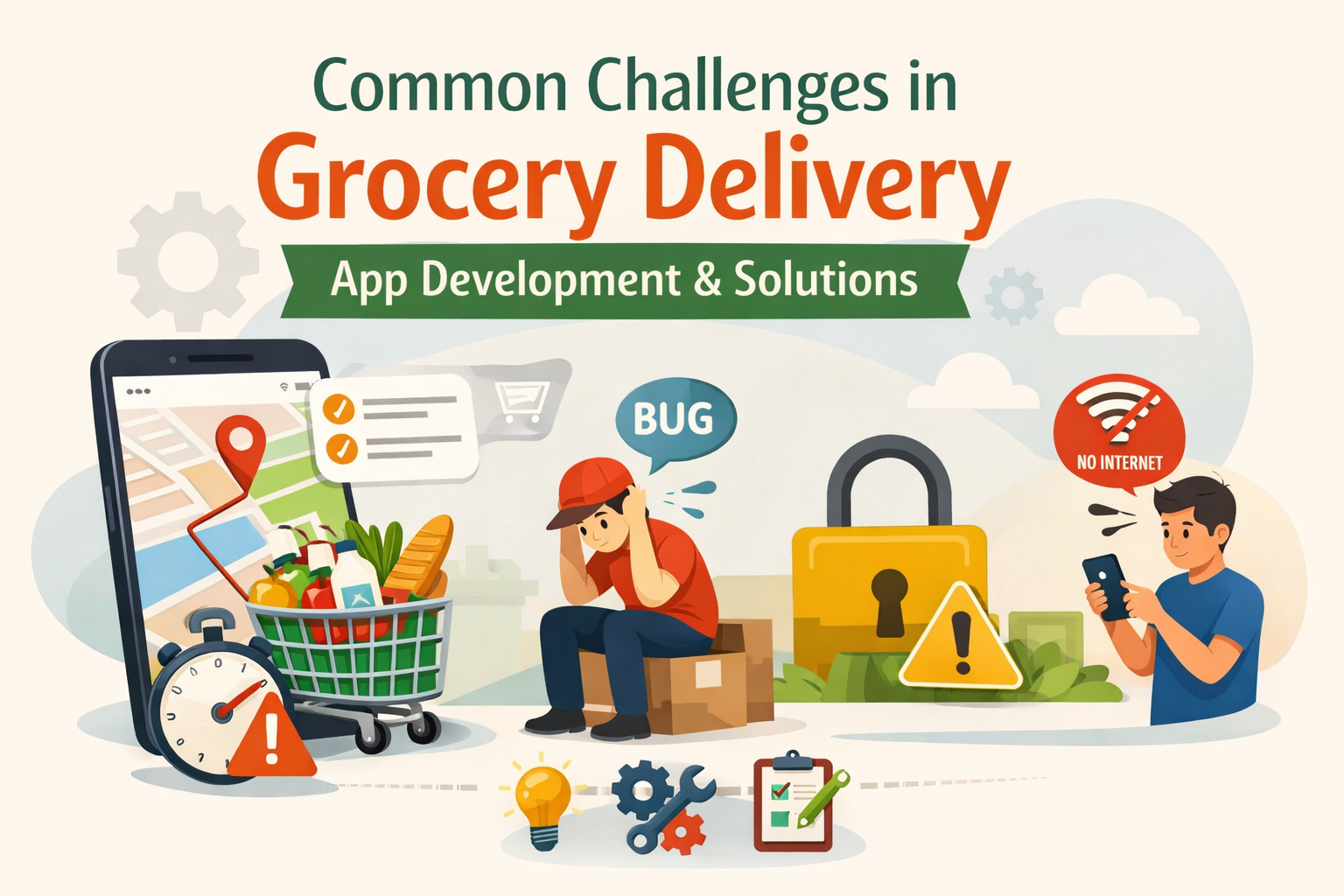
The grocery industry has undergone a seismic transformation in recent years. What was once a weekly errand has become an on-demand experience customers now expect fresh produce, dairy, and pantry essentials delivered to their doorstep within hours, sometimes minutes. But behind the seamless tap-to-deliver experience lies a complex web of technical, operational, and logistical challenges. If you're planning to enter this space, understanding these hurdles upfront is critical to building something that works at scale.
This blog explores the most common challenges in grocery delivery app development and the proven strategies to overcome them.
1. Real-Time Inventory Management
One of the first and most persistent challenges in grocery delivery app development is keeping inventory data accurate in real time. Unlike electronics or apparel, grocery items are perishable, high-turnover, and subject to sudden stockouts. A customer adding milk to their cart should never find out at checkout — or worse, at delivery — that the product was unavailable.
The core problem is synchronization. Most grocery stores run on legacy point-of-sale systems that weren't designed to communicate with mobile apps in real time. Bridging that gap requires robust API integrations, a centralized inventory management layer, and event-driven architecture that reflects stock changes instantly across the app interface.
Solution: Implement a live inventory sync engine that connects your app to warehouse and store management systems. Use websocket connections or push notification triggers to update product availability without the user needing to refresh. Building or integrating smart substitution logic — where out-of-stock items are automatically replaced with alternatives pending customer approval — significantly reduces order cancellations.
2. Hyperlocal Delivery & Route Optimization
Speed is the currency of instant delivery. Customers ordering through a grocery app don't want to wait two days — they want their order in 30–60 minutes. This creates enormous pressure on the delivery infrastructure, particularly route optimization.
Assigning the right delivery agent, calculating the fastest route through real-time traffic, and grouping multiple orders without compromising delivery windows is computationally demanding. Doing this poorly leads to late deliveries, unhappy customers, and high operational costs.
Solution: Invest in intelligent dispatch algorithms that factor in delivery agent location, store proximity, order size, and live traffic data. Leading instant delivery app development companies integrate third-party mapping APIs (Google Maps, HERE, or Mapbox) with custom scheduling logic to minimize delivery time and maximize agent efficiency. Geofencing technology also helps trigger automated alerts and updates when agents enter or exit designated zones.
3. Handling Perishable Products Across the Supply Chain
Groceries aren't like standard e-commerce products. Temperature-sensitive items — frozen foods, dairy, meat, fresh produce — require special handling throughout picking, packing, and delivery. Any break in the cold chain can result in spoiled goods, customer complaints, refunds, and regulatory issues.
This challenge extends beyond the app itself and into operational processes, but the app plays a supporting role through smart categorization, packing instructions for warehouse staff, and customer-facing communication.
Solution: Build product categories with temperature handling metadata baked in. The app should automatically flag temperature-sensitive items, suggest appropriate packaging during order fulfillment, and estimate delivery windows that keep perishables within safe limits. Apps that surface estimated freshness ratings or sourcing details also build greater consumer trust.
4. Scalability During Peak Demand
Weekends, public holidays, festive seasons, or even a viral social media moment can send order volumes through the roof. Many grocery delivery platforms have suffered embarrassing outages precisely when they needed to shine. A system that handles 500 orders per hour may collapse under 5,000.
This is a core engineering challenge that requires deliberate architectural decisions during the build phase, not as an afterthought.
Solution: Design for horizontal scalability from day one. Cloud-native infrastructure on AWS, Google Cloud, or Azure allows dynamic resource allocation as demand spikes. Microservices architecture decouples critical components — order management, payments, delivery tracking — so that a surge in one area doesn't bring down the entire system. Load testing under simulated peak scenarios should be a regular practice before every major feature launch.
5. Payment Security & Fraud Prevention
Grocery apps deal with frequent, low-ticket transactions, which makes them attractive targets for payment fraud. Stolen card details are often tested on platforms with high transaction velocity and relatively low per-order scrutiny. Beyond fraud, customers are increasingly cautious about sharing financial data with newer app platforms.
Solution: Partner with PCI-DSS-compliant payment gateways such as Stripe, Razorpay, or PayU depending on your geography. Implement tokenization to ensure that raw card data never touches your servers. Layer in fraud detection tools that flag suspicious patterns — multiple failed attempts, unusual order quantities, mismatched delivery locations — before they result in chargebacks. Offering UPI, wallets, and COD (cash on delivery) as payment options also increases trust among first-time users.
6. Building a Reliable Driver Network
The delivery experience is ultimately a human experience. Even the most technically sophisticated grocery delivery app can be undermined by unreliable drivers, poor service, or inconsistent handling of orders. Managing a gig workforce at scale — with varying availability, performance levels, and geographic coverage — is one of the toughest operational challenges any instant delivery app development company faces.
Solution: Build a dedicated driver-side app with features like optimized navigation, in-app customer communication, proof-of-delivery capture, and real-time earnings tracking. Gamification elements, performance-based incentives, and clear rating systems help maintain service quality. Automated driver allocation that accounts for proximity, past performance, and current workload reduces dependency on manual dispatch decisions.
7. User Retention & Personalization
Acquiring a customer is expensive. Retaining them is where profitability is won or lost. Grocery delivery is a repeat-purchase category by nature, but that doesn't guarantee loyalty. Customers will quickly switch to a competitor offering a better deal, a faster UI, or a more personalized experience.
Solution: Use purchase history and behavioral data to power personalized recommendations, smart reorder lists, and targeted promotions. Push notifications that remind users when they're likely running low on staples (based on past order cadence) are far more effective than generic discount blasts. A well-designed loyalty program that rewards consistent orders with cashback, free delivery, or priority slots significantly improves retention metrics.
8. Regulatory Compliance & Data Privacy
Operating a grocery delivery app means handling personal data, financial information, and sometimes health-related purchase data. Regulations like GDPR in Europe, India's DPDP Act, and various food safety laws create a complex compliance landscape that developers must navigate carefully.
Solution: Work with legal counsel to map data flows and ensure your app's privacy policy, consent mechanisms, and data storage practices meet local regulations. Build compliance into the architecture — data minimization, right-to-delete functionality, encrypted storage — rather than retrofitting it after launch.
Conclusion
Building a successful grocery delivery platform is as much an engineering challenge as it is an operational and product design challenge. The teams that succeed are those who anticipate these roadblocks before writing the first line of code. Whether you're a startup entering the space or an established retailer looking to go digital, partnering with an experienced instant delivery app development company gives you a significant advantage in navigating these complexities.
Grocery delivery app development rewards careful planning, scalable architecture, and a deep obsession with customer experience. Get those foundations right, and you'll be well-positioned to build something that not only works at launch — but thrives at scale.









 (1).webp)