Sign up with Google
 Sign in with Zoho

There's a conversation I've had more times than I can count. A founder or a head of marketing reaches out, frustrated, about three months after they signed up with a CPaaS platform. The onboarding took longer than promised. The WhatsApp Business API integration keeps throwing errors their team can't decode. And when they raise a ticket, the support response takes two days and says something vague about "checking with the technical team."
Three months in, and they've barely sent a single live campaign.
I've been working in enterprise communication infrastructure long enough to have seen this pattern repeat itself across industries real estate, BFSI, e-commerce, healthcare, education. And in 2026, with CPaaS vendors multiplying faster than you can evaluate them, this mistake is more common than ever.
So let me give you the framework I'd use if I were choosing a CPaaS platform in india. Not a generic checklist pulled from a whitepaper actual criteria that separate platforms that work for your business from ones that look good in a deck.
What "CPaaS" Actually Means (And Why the Definition Matters)
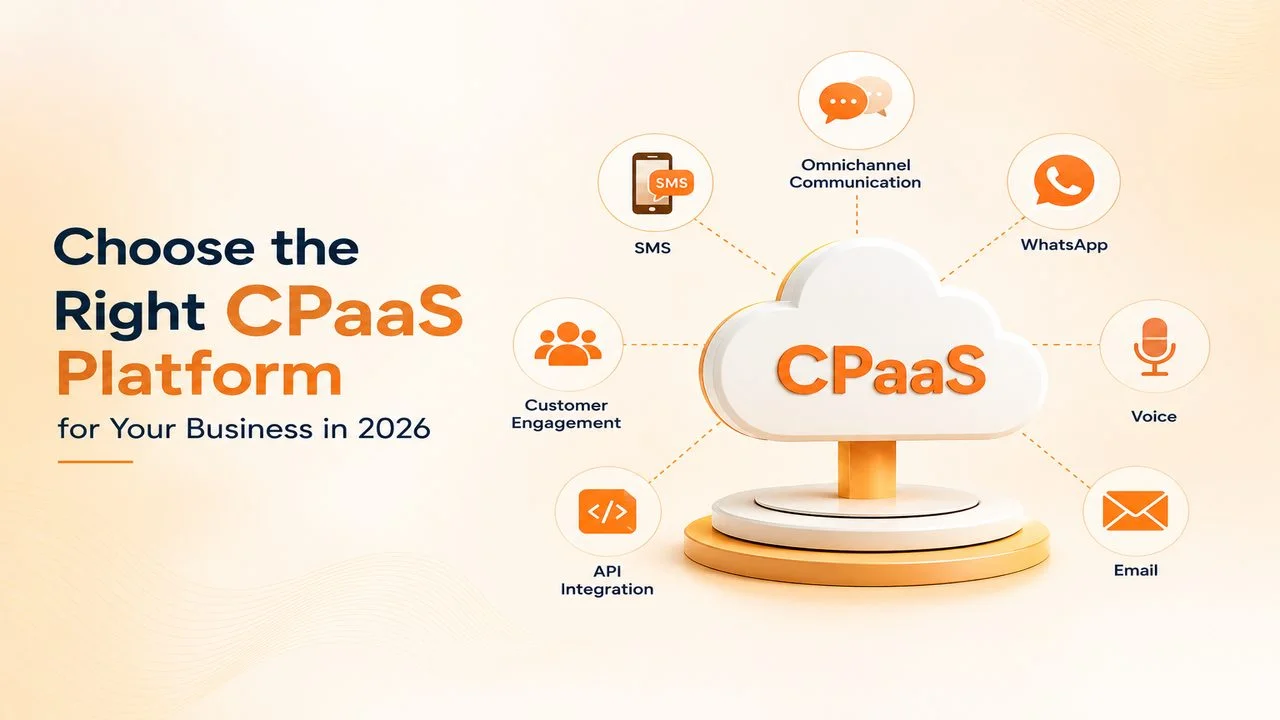
CPaaS Communication Platform as a Service refers to cloud-based infrastructure that lets businesses embed real-time communication into their existing applications and workflows via APIs. SMS, WhatsApp, RCS, voice calls, IVR, push notifications. The idea is that instead of building telecom-grade infrastructure from scratch (which would take years and millions), you plug into a provider's API and get those capabilities in weeks.
Sounds simple. And at the surface level, it is.
The problem is that "CPaaS" has become such a broad marketing term that it now covers everything from a basic SMS gateway with a simple API to a full omnichannel platform with AI chatbots, CRM connectors, analytics dashboards, and carrier-direct routing across five countries. A startup with one engineer and a $500/month budget calling itself a "CPaaS provider" sits in the same search results as an enterprise-grade platform with 99.9% SLA guarantees and a dedicated compliance team.
When you're comparing platforms, you're often not comparing apples to apples you're comparing apples to something that just happens to be the same shape as an apple.
So the first thing I'd recommend: before evaluating any vendor, write down what "CPaaS" means for your specific use case. Not the vendor's definition. Yours.
Do you need SMS only? Or SMS plus WhatsApp plus voice? Do you need API-first developer infrastructure, or a ready-made dashboard your marketing team can operate without engineering support? Do you need compliance management baked in DLT registration in India, Meta verification for WhatsApp or does your team have the bandwidth to handle that independently?
Your answers to those questions should narrow the field dramatically before you even look at a vendor's website.
The Channels Question: Resist the "Everything" Pitch
Most CPaaS vendors in 2026 will tell you they support every channel. SMS. WhatsApp Business API. RCS. Voice. Email. Push notifications. The full list, all ticked in their feature matrix.
Here's what that feature matrix doesn't tell you: not all channel integrations are built equally deep.
A platform that started as a pure SMS gateway five years ago and added WhatsApp as a bolt-on in 2023 does not have the same depth of WhatsApp implementation as a platform that built its WhatsApp integration from day one with Meta's BSP requirements and template approval workflows in mind. The former might technically work for basic sending but the moment you need multi-agent inbox support, automated chatbot flows, or detailed conversation-category billing breakdowns, the cracks start showing.
The question I'd ask every vendor isn't "do you support WhatsApp?" It's "walk me through what happens when my WhatsApp template gets rejected by Meta. How does your platform handle the error? What does the notification look like? How quickly can your team help us revise and resubmit?"
Their answer to that question tells you more about the real depth of their WhatsApp integration than any feature checklist ever will.
The same logic applies to voice. A vendor that says "yes, we do IVR and Voice OTP" might mean they have a basic outbound calling API. What they might not have is burst-capacity infrastructure that handles ten thousand simultaneous missed calls during a live TV campaign without dropping a significant percentage of them. If you're in a sector where voice campaigns spike unpredictably real estate launches, education admission seasons, FMCG promotions that distinction matters enormously.
My advice: pick three or four channels that represent at least 80% of your actual use case. Evaluate those channels deeply at each vendor. The rest of the channel list is secondary.
The DLT Compliance Dimension: Non-Negotiable in India
If you're running a business in India, compliance is not a differentiator it's table stakes. And yet it's the area where most businesses do the least evaluation before signing up with a CPaaS provider.
Let me be specific about what I mean. For bulk SMS in India, TRAI's DLT (Distributed Ledger Technology) framework requires that every entity sending commercial SMS must have their business registered on the DLT system, their sender headers (the 6-character alphanumeric codes) approved, and every single message template scrubbed and approved before a single message goes out. This is not optional. A non-registered template gets silently blocked at the telecom operator level your message simply never arrives, and there's often no clear error that tells you why.
For WhatsApp Business API, you're dealing with Meta's own verification and template approval system, which has its own separate requirements, its own approval timelines, and its own category-based pricing structure that changes how you think about cost.
The question you need answered for any Indian CPaaS provider: do they handle DLT registration on your behalf, or do you navigate that process yourself? Do they have people who understand the documentation requirements specific to Indian business structures GST, PAN, Udyam registration or are you getting a generic onboarding flow designed for a Western market?
I've seen businesses lose entire festive-season campaign windows because their CPaaS provider onboarded them but left DLT registration as "the client's responsibility," and the client didn't realize until two weeks before Diwali that they had no approved templates to send. That's a compliance gap that a good provider closes before you even ask about it.
The Technical Evaluation Nobody Actually Does
Businesses evaluate CPaaS platforms india based on pricing, channel support, and whether the sales team is responsive. Very few evaluate the actual technical infrastructure. And that's the gap that hurts them later.
Here's what I'd look at technically and you don't need to be an engineer to ask these questions.
1. Delivery receipts
Does the platform give you granular DLR (Delivery Receipt) data per message not just "sent" or "failed," but broken down by operator, by error type, by timestamp? Or does it aggregate everything into a bulk delivery rate that hides the real picture? If your SMS campaign shows 92% "delivered" but 8% failing silently with no error detail, you have no idea whether those failures are bad phone numbers, network congestion, or DLT compliance blocks three completely different problems with completely different solutions.
2. Failover routing
When the primary SMS route through one telecom operator experiences congestion, does the platform automatically reroute through an alternate operator? Or does it fail and wait for manual intervention? For a business sending OTPs during a high-traffic window, that difference is measured in minutes and lost transactions.
3. Uptime SLAs
What does the provider actually guarantee? 99.9% uptime sounds standard, but it's worth understanding what 0.1% downtime means in practice: about 8.7 hours of annual downtime. For a business with time-critical OTP delivery, that's not acceptable. What's their incident response protocol when a service goes down?
4. API documentation quality
Ask for access to their API documentation before you sign up. Seriously. A platform with thorough, well-maintained API docs is signaling that they care about developer experience and platform quality. Sparse, outdated, or vague documentation is a reliable predictor of a frustrating integration experience.
None of these questions are adversarial. Any good CPaaS provider should answer them confidently and specifically, not defensively.
Pricing: The Trap That Catches Almost Everyone
CPaaS pricing is genuinely complicated, and most businesses get burned by not understanding the full cost structure before committing.
For SMS, the headline price per message is just the starting point. What matters is whether you're on a shared sender ID or a dedicated one, whether you're paying for undelivered messages, whether there's a minimum monthly commitment, and what the pricing looks like for DLT-registered sends versus non-DLT (which, as noted above, are effectively useless in India anyway).
For WhatsApp Business API, the cost structure is completely different. Meta charges per conversation not per message with separate rates for marketing conversations, utility conversations, authentication (OTP), and service (customer-initiated) conversations. Marketing conversations are the most expensive. Service conversations are the cheapest. If your model involves heavy outbound marketing via WhatsApp, your cost per campaign conversation will be meaningfully higher than a model based primarily on inbound customer service.
The BSP (Business Solution Provider) sitting between you and Meta adds their own platform fee on top of Meta's pass-through rate. Some providers bury this in the overall per-conversation rate; others separate it clearly. Always ask for the breakdown.
The honest advice here: model your actual expected usage before comparing prices. How many SMS messages per month, across which categories? How many WhatsApp conversations, across which conversation types? A platform with a lower headline SMS rate might work out more expensive once you factor in minimum commitments, setup fees, and DLT management charges.
And whatever you do, don't evaluate on price alone. The cheapest CPaaS provider that fails during your peak campaign window will cost you far more in lost revenue than the difference in per-message pricing.
The Support Test: Do This Before You Sign Anything
I'm going to suggest something that most people skip because it feels uncomfortable: test the vendor's support before you become a paying customer.
Send their pre-sales support team a genuinely technical question not a pricing question, but something like: "How does your platform handle DLT template rejections? What does the error payload look like in the webhook, and what's your typical turnaround for helping a client resubmit a rejected template?"
Their response the speed, the specificity, the confidence tells you exactly what their post-sales support will look like. If they respond in 4 hours with a detailed, accurate answer from someone who clearly understands DLT, you're looking at a capable support operation. If they respond in two days with a vague link to a help article that doesn't answer the question, you know what you're getting.
This isn't cynical. It's just honest due diligence that most people skip because they're excited about the demo or under time pressure to make a decision.
Regional vs. Global: Why Local Presence Changes Things
For Indian businesses specifically, there's one more dimension worth weighing: whether your CPaaS provider has genuine regional infrastructure and support presence, or whether you're essentially a small account on a global platform that primarily serves Western markets.
This shows up in a few ways. Direct carrier routing does the provider have contracted direct routes into Jio, Airtel, and Vodafone Idea, or are they routing through aggregators? More hops in the routing chain means more latency and more points of failure. DLT expertise does their compliance team understand the specific documentation requirements for Indian business registrations, or are they adapting a generic framework that wasn't built for India's regulatory environment? And commercial terms are pricing and payment structures in INR with Indian bank transfer support, or are you dealing with USD pricing and international payment complications?
A regionally embedded provider who understands India's telecom regulatory landscape, commercial timing (Diwali, wedding season campaign surges, admission season spikes), and business documentation requirements is not the same thing as a global provider with an India sales contact. The difference becomes very obvious the first time something goes wrong and you need fast, contextually informed support.
The Decision Framework in Practice
So how does this all come together? Here's how I'd structure the evaluation:
Start by writing a one-page brief defining exactly what you need: which channels, which use cases, approximate volume, team technical capability (API-first or dashboard-first), compliance requirements, and the sectors you operate in. Are you looking for a business messaging platform your marketing team can run independently, or are you buying API infrastructure for developers to build on? Are you interested in conversational AI capabilities for customer support automation, or is your immediate need transactional alerts and OTPs? These distinctions sound minor but completely change which vendor fits. This brief doesn't need to be shared with vendors it's for you, to anchor your evaluation against your actual needs rather than vendor positioning.
Then shortlist three providers maximum. Any more than three and you're wasting time in evaluation that you could be spending on building your actual communication strategy.
For each of those three, run through the technical questions about delivery receipts, failover routing, and SLAs. Test pre-sales support with a real technical question. Ask specifically about DLT and WhatsApp compliance management. Get a full pricing breakdown modeled against your projected usage not a headline rate card.
Then and this is the one most people skip ask each provider for a reference from a business in your sector with similar scale. Not a case study from their website. An actual reference contact. A provider confident in their quality will give you one.
Closing Thought
Choosing a CPaaS platform in india is one of those decisions that looks easy from the outside. there are plenty of options, pricing is accessible, and onboarding timelines are quoted in weeks rather than months. But it's a decision that shapes your customer communication infrastructure for years. Getting it right means asking harder questions than most people ask. It means evaluating depth over breadth, support quality over headline features, and compliance competence over price.
if you're an Indian business trying to cut through the noise and find a CPaaS partner that actually understands DLT compliance, direct carrier routing, and the real pace of Indian enterprise operations Arihant Global is worth a conversation.
About the Author
This article was written by a CPaaS and enterprise communication specialist with experience across SMS gateways, WhatsApp Business API deployment, DLT compliance, and omnichannel infrastructure for Indian enterprises. Arihant Global provides enterprise-grade CPaaS services covering Bulk SMS, RCS, WhatsApp Business API, Voice OTP, and IVR solutions across India