Sign up with Google
 Sign in with Zoho

Introduction
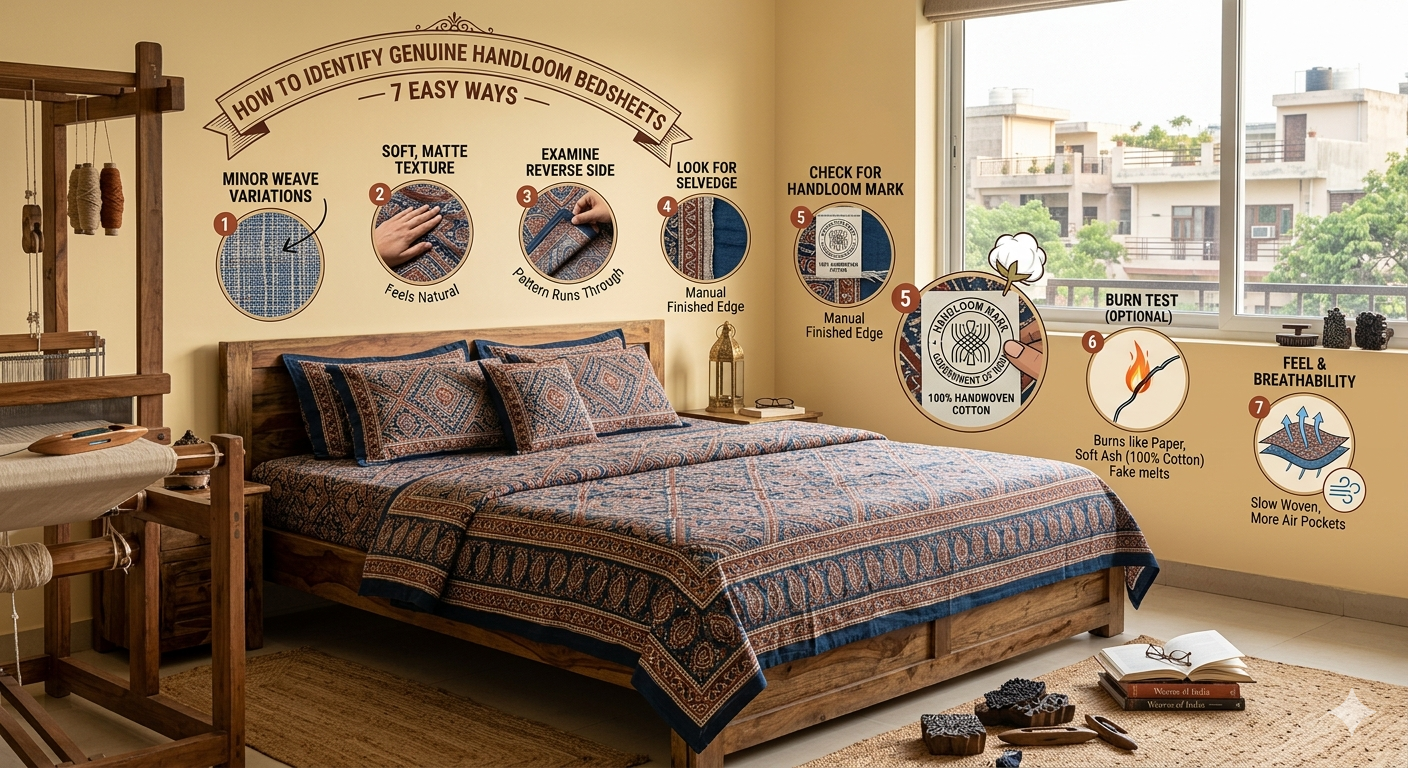
Genuine handloom bedsheets are not easy to fake perfectly - but that does not stop people from trying. Walk into any home textile store or scroll through any bedding website and you will find dozens of products using the word handloom. Some are genuine. Many are power loom fabric sold under the handloom label because it sounds better and commands a higher price.
The problem for buyers is that both look similar in product photos. The difference shows up in how the fabric feels, how it behaves after washing, and in specific physical details that mill-made fabric simply cannot replicate.
This guide gives you 7 practical ways to check - things you can do with your hands and eyes before buying, whether you are shopping in a store or reading a product listing online.
Why This Matters Before You Buy
Genuine handloom cotton costs more than mill-made fabric. That price difference reflects real things - a weaver spending 4 to 8 hours at a loom, regional cotton, no chemical finishing, and fabric that genuinely improves with every wash.
When you pay handloom prices for power loom fabric, you get none of that. You get a sheet that looks similar on day one but behaves like ordinary mill cotton within six months - pills, thins, stiffens, and fades.
Knowing how to identify genuine handloom before you buy protects your money and ensures you actually get what you are paying for.
7 Ways to Identify Genuine Handloom Bedsheets
Way 1 - Check the Selvage Edge
The selvage is the finished edge that runs along the length of the fabric - the long sides of the bedsheet. This is the single most reliable physical indicator of genuine handloom.
What genuine handloom selvage looks like:
- Slightly tighter than the body of the fabric
- Mildly uneven - small variations in tension visible along the edge
- Sometimes slightly wavy or puckered at intervals
- Woven threads loop back naturally at the edge
What power loom selvage looks like:
- Perfectly straight and uniform along the entire length
- Machine-consistent tension throughout
- Clean, flat, precise edge with no variation
A handloom weaver controls shuttle tension manually. That creates small but visible differences along the selvage. A power loom runs at consistent mechanical tension - the selvage is perfectly even every time.
Data point: In handloom production, the shuttle is thrown manually across the warp at 60 to 80 picks per minute. In power loom production it travels at 300 to 500 picks per minute under mechanical control. That speed difference is exactly why selvage consistency differs.
Way 2 - Look for Natural Weave Variation
Hold the fabric up to light - natural light works best. Look at the body of the weave across a 30 to 40 cm section.
Genuine handloom shows:
- Slight variation in thread spacing - some picks sit marginally closer or farther apart
- Occasional minor texture difference - a slightly thicker or thinner line here and there
- Overall consistency but not machine-perfect uniformity
Power loom and mill-made shows:
- Completely uniform thread spacing throughout
- Identical picks from one end of the fabric to the other
- Perfect consistency with zero variation
This variation in handloom is not a defect. It is the physical result of a human being operating a loom. No two passes of a hand-thrown shuttle are mechanically identical. That is the point.
Important: Variation should be minor - a slight texture difference, not gaping holes or dramatically uneven sections. Large defects are just defects. Small natural variation is authenticity.
Way 3 - Feel the Initial Stiffness - Then Wash It
A new genuine handloom bedsheet feels slightly stiff - sometimes noticeably so on first touch. This is sizing - a light rice starch or maize starch coating applied to warp threads during loom preparation to strengthen them for weaving.
What this tells you:
- Stiffness that completely washes out after one cold wash = genuine handloom sizing
- Stiffness that remains after washing = chemical finishing or a stiff weave structure
- Fabric that is immediately very soft straight from packaging = likely has chemical softener applied
The test: Wash the sheet once in cold water and feel it again. Genuine handloom cotton changes noticeably after the first wash - the sizing comes out, the cotton opens up, and the real texture of the fabric appears. It continues to soften over the next 5 to 10 washes.
Mill-made fabric treated with silicone softeners starts soft and stays flat - it does not improve because the chemical coating, not the fabric, was creating the hand-feel.
Way 4 - Check for the Handloom Mark
The Handloom Mark is a government-issued certification by the Ministry of Textiles, Government of India. It is the only official verification that a fabric was woven on a non-power loom.
What it looks like:
- A small woven or printed label with a stylised loom image
- The words "Handloom Mark" and sometimes a registration number
- Sometimes on a separate tag, sometimes woven into the selvage
What to do if there is no Handloom Mark:
- Ask the seller specifically - legitimate handloom sellers know about the certification
- Absence of the mark does not automatically mean fake - many small weavers do not go through the certification process
- But presence of the mark is a reliable positive confirmation
Data point: The Handloom Mark scheme was launched in 2006 by the Government of India to protect buyers and weavers from powerloom products being sold as handloom. Over 35 lakh handloom products carry the mark annually across registered weaver cooperatives.
Way 5 - Thread Count Reality Check
Genuine handloom cotton falls between 80 and 180 thread count. This is not a limitation - it is what the manual weaving process produces and it is exactly what creates the open, breathable weave.
Red flags to watch for:
High thread count requires tighter weave - tighter weave requires faster, mechanically controlled production. A hand-thrown shuttle physically cannot produce 400 TC fabric consistently. When a product claims both "handloom" and very high thread count, one of those claims is wrong.
Way 6 - Do the Light and Breathability Test
Hold a section of the fabric up to bright light.
Genuine handloom plain weave:
- Light passes through visibly - you can see the weave structure against light
- Individual threads visible in the weave
- Fabric feels light and airy when you blow through it gently
Mill-made high TC fabric:
- Much less light passes through
- Weave is too tight to see individual threads easily
- Feels denser against air movement
This test works particularly well for plain weave handloom cotton in the 90 to 120 GSM range - the most common type for bedsheets. The openness of the weave that makes it breathable at night is directly visible in this test.
Practical use: If you are buying in a physical store, always do this test before purchasing anything claimed as handloom. If buying online, ask the seller for a close-up image of the fabric against light.
Way 7 - Ask About the Weaving Cluster
Genuine handloom sellers know exactly where their fabric comes from. Ask directly:
- Which weaving cluster or region is this from?
- Who are the weavers - cooperative, individual family, or cluster?
- What yarn count is used?
- What dye type - reactive, natural, or pigment?
What genuine answers sound like:
- "This is from Pochampally weavers in Telangana - 60s combed cotton, reactive dyed"
- "Kuthampully cluster in Kerala - plain weave, 100 GSM, indigo dyed"
- "Bhujodi artisans in Gujarat - natural dyed with madder"
What vague answers sound like:
- "It is pure handloom cotton" with no further detail
- "We source from various artisans" with no location
- "It is certified handloom" with no certification name
A brand that works directly with weavers knows exactly who made their fabric and where. A brand reselling power loom fabric as handloom cannot answer these questions specifically because they do not have the information.
Genuine Handloom vs Power Loom vs Mill-Made - Full Comparison
Pros and Cons of Buying Genuine Handloom
Pros
- Breathes better than any machine-made equivalent - real difference in Indian summers
- No chemical finishing - what touches your skin is fabric only
- Improves with every wash - softens progressively over months
- Longer lifespan - 5 to 8 years vs 2 to 4 years for mill-made
- Direct support to weaver families and traditional craft clusters
- Traceable origin - genuine sellers know exactly who made it
- Natural and reactive dye options - safer for sensitive skin
Cons
- Harder to verify online without knowing what to look for
- Many products falsely claim handloom - requires careful checking
- Higher price than mill-made - reflects real labour cost
- Slight weave variation can look like defects to buyers used to machine uniformity
- Initial stiffness can be off-putting before first wash
- Wrinkles more than chemically finished fabric
Expert Tips
Buy from sellers who can tell you the weaving cluster. This is the fastest filter. If a brand can name the specific village, cluster, or cooperative their fabric comes from - Pochampally, Kuthampully, Bhujodi, Chanderi - they are almost certainly working with actual weavers. If they cannot answer this question, do not trust the handloom claim.
The first wash is the real test. Buy one sheet, wash it cold, feel it again. If the texture changes noticeably and the fabric feels softer and more alive - that is genuine handloom sizing coming out. If nothing changes, you have mill-made fabric with or without a handloom label.
Minor variation is good. Major defects are not. Small thread spacing differences and slight texture variation are authenticity markers. A large dropped thread, a visible hole, or dramatically inconsistent weave is a manufacturing defect - those should be returned regardless of whether the fabric is genuine handloom or not.
Check the GSM, not just the thread count. Genuine handloom bedsheets list GSM because that is what actually tells you about fabric weight and feel. Brands that only list inflated thread counts and skip GSM are usually hiding something.
Natural dye means longer dyeing process - and higher price. A naturally indigo-dyed handloom bedsheet costs more than a reactively dyed one because natural indigo dyeing requires 8 to 12 dip and oxidation cycles over 2 to 3 days. If a "natural dye handloom" sheet is priced the same as a basic reactive dye option, question the natural dye claim.
Use-Case Sections
If you are buying online and cannot feel the fabric
Focus on Ways 4, 5, and 7 - Handloom Mark, thread count reality check, and asking about the weaving cluster. Any genuine seller should be able to answer cluster and yarn count questions directly. Check thread count claims against the 80 to 180 TC range. Ask for a close-up photo of the fabric against light.
→ Our https://www.theindiglobal.com/collections/handloom-bedsheets lists weave type, GSM, yarn count, and dye type on every product.
If you are buying in a physical store
Do the selvage check (Way 1), weave variation check (Way 2), and light test (Way 6) in that order. These three together give you a strong indication within two minutes of handling the fabric.
If you have already bought and want to verify
Wash it once in cold water (Way 3). The before and after tells you almost everything. Genuine handloom transforms noticeably. Mill-made stays flat.
If you are buying as a gift
Ask the seller specifically about the weaving cluster and Handloom Mark (Ways 4 and 7). A genuine handloom gift set should come with traceable origin - that story is part of the gift.
→ Browse our Wedding Bedsheets and Corporate Gifting options - origin and weave details on every listing.
Top Recommendations - Where to Buy Genuine Handloom Bedsheets
Conclusion
Identifying genuine handloom bedsheets is not complicated once you know what to look for. The selvage edge, the weave variation, the sizing stiffness that washes out, the thread count range, the light test, the Handloom Mark, and the seller's ability to name a specific weaving cluster - these seven checks together give you a clear picture of what you are actually buying.
Most of these checks take two minutes in a store. For online buying, three questions to the seller - cluster, yarn count, dye type - filter out most fake claims quickly.
Genuine handloom costs more and is worth it. But only if you are actually buying genuine handloom.
→ Shop verified handloom bedsheets at theindiglobal - weave type, GSM, yarn count, dye, and cluster information on every product listing.