 Sign up with Google
 Sign in with Zoho
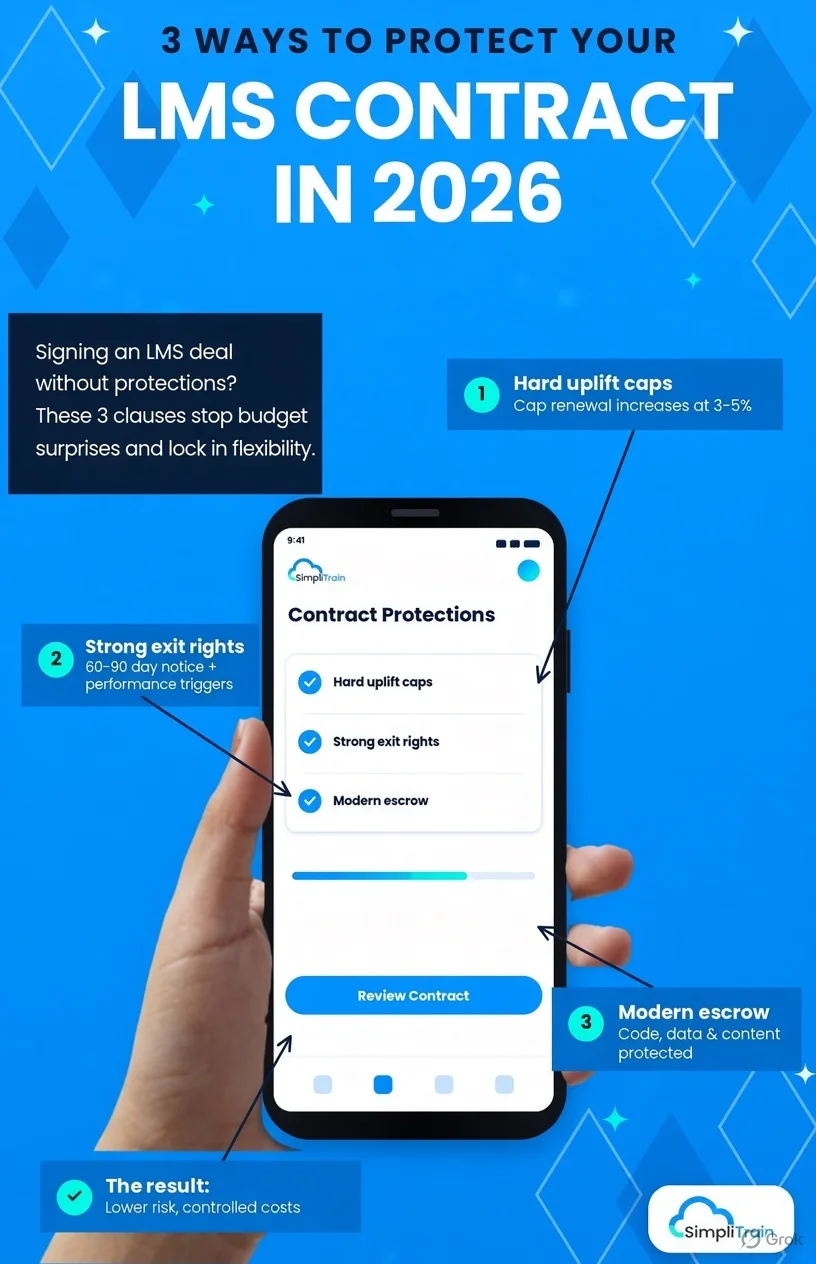
Signing an LMS contract without locking down price protection, clean exit paths, and data/code safeguards is one of the most expensive mistakes learning leaders still make. In 2026 the average uncapped renewal increase sits between 8–15 %. Multi-year deals without performance-based termination rights leave organizations trapped. Escrow that only covers source code but ignores learner data and content libraries creates real operational risk.
This guide gives you the exact levers that move the needle, written for procurement, L&D, and legal teams who need results, not theory.
Why Most LMS Negotiations Fail Before They Start
Vendors write the first draft. That draft protects their revenue, not your budget or continuity. Common traps include:
- Automatic renewal with 60-day notice windows that clash with internal budget cycles
- “Market-rate” or CPI-plus language that has no hard ceiling
- Exit clauses that require six-to-twelve months’ notice and full payment through the term
- Escrow limited to source code while learner records, custom content, and integration configurations stay locked
The fix is simple in concept and rigorous in execution: treat the contract as a living risk document, not a formality.
Uplift Caps: The Single Highest-ROI Clause
An uplift cap is a contractual ceiling on how much the vendor can raise prices at renewal. Without it, the vendor decides. With it, you control the trajectory.
Target language: “Renewal per-unit pricing for identical SKUs and entitlements shall not increase by more than three percent (3 %) over the immediately preceding term’s net unit price.”
A fixed 3–5 % hard cap outperforms CPI-linked language in most environments. CPI can spike; a fixed percentage does not. Apply the cap to net price after discount, not list price, and make it bind every renewal term, not just the first.
Quantify the savings before the meeting. A $200,000 annual contract with an uncapped 10 % average increase costs roughly $122,000 more over five years than the same contract with a 4 % cap. That number usually ends the debate.
Exit Rights That Actually Work
Termination for convenience with 60–90 days’ notice is the gold standard, but many vendors resist it on multi-year deals. Acceptable fallbacks include:
- Performance-based exit: if the vendor misses defined SLA targets for two consecutive months, you may terminate without penalty
- Module-level opt-out: ability to drop under-used modules at anniversary without affecting the rest of the agreement
- Change-of-control termination right: if the vendor is acquired, you can exit within 30–60 days
Pair every exit right with a concrete data-handover obligation: full export of learner records, completion data, custom content, and configurations in open formats within 15 business days, plus 30 days of read-only access.
Escrow: Beyond Source Code
Traditional source-code escrow is necessary but insufficient. Modern LMS contracts should escrow:
- Source code and deployment scripts
- Custom content and learning objects
- Database schemas and learner data export scripts
- Integration configurations
Require annual verification that the escrow deposit is current and can be tested. Name a reputable third-party escrow agent and define trigger events clearly (bankruptcy, material breach, failure to support for 30 days). When evaluating vendor security and quality practices, reference recognized International Organization for Standardization (ISO) frameworks to strengthen requirements for information security and management systems.
Negotiation Sequence That Wins
- Share your non-negotiables early (uplift cap, exit notice, data portability).
- Trade term length for better commercial terms: three years can buy a stronger cap and exit window.
- Demand a written three-year total-cost projection that includes every add-on, storage overage, and support tier.
- Redline the MSA and order form together; never accept “we’ll handle that later.”
Useful public resources for preparation include the free LMS RFP template and questionnaire available at lmspedia.org/free-lms-rfp-template and the managed-training contract negotiation checklist at lmspedia.org/managed-training-contract. For broader guidance on fair business practices and data-related obligations, consult the Federal Trade Commission (FTC).
“In the middle of difficulty lies opportunity.” — Albert Einstein
An unbalanced LMS contract is a real problem. The opportunity is the chance to rewrite it before signing.
Practical Checklist Before You Sign
- Hard uplift cap of 5 % or less on net unit price
- 60–90 day termination for convenience or strong performance trigger
- Full data and content export in open formats + 30-day retrieval window
- Escrow covering code, content, data schemas, and configs
- Clear SLA credits that are automatic, not “upon request”
- No auto-renewal without affirmative confirmation of quantities
Frequently Asked Questions
Q1. What is a realistic uplift cap in 2026?
Most competitive deals land between 3 % and 5 % fixed. Anything above 7 % without a strong offsetting discount is usually negotiable.
Q2. Can I terminate a three-year LMS deal for convenience?
Yes, especially if you offer a modest early-termination fee or accept a longer initial term. Performance-based exit is the next-best alternative.
Q3. Does source-code escrow protect my learner data?
No. You must explicitly require data and content escrow or contractual export rights.
Q4. How early should legal join the conversation?
Before the first commercial proposal is accepted. Once verbal commitment exists, leverage drops sharply.
Q5. Are RFP responses legally binding?
They are not contracts, but written commitments made in an RFP become powerful negotiation anchors and can be incorporated by reference into the final agreement.
Organizations that treat LMS contracting as a strategic risk exercise rather than a procurement checkbox consistently spend less, retain more flexibility, and avoid the painful mid-term renegotiations that plague their peers. Start with the three levers uplift, exit, and escrow and the rest of the contract becomes far easier to shape.