Sign up with Google
 Sign in with Zoho
.webp)
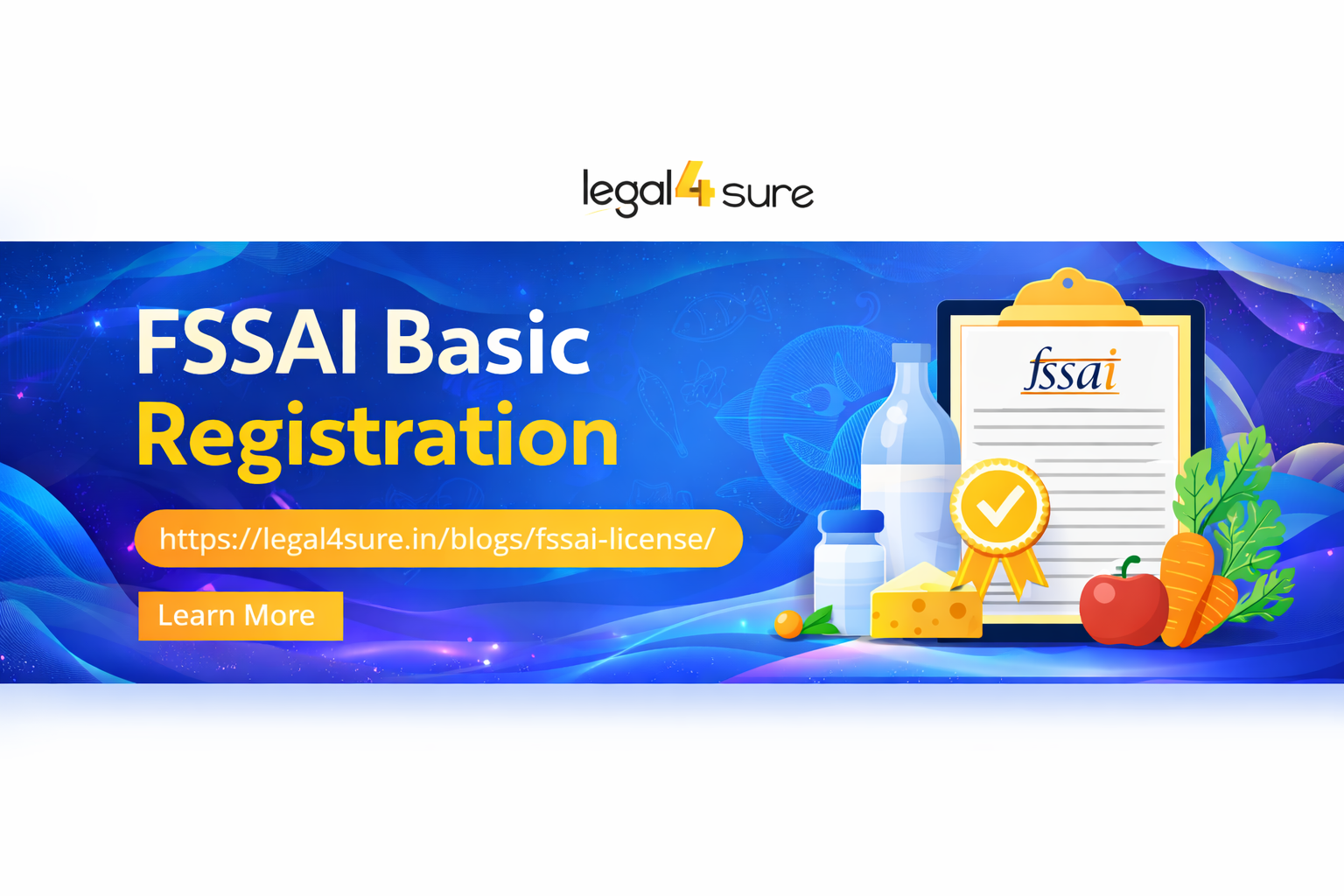
In India, running any food business without FSSAI (Food Safety and Standards Authority of India) registration is illegal. Yet, thousands of small food entrepreneurs delay this step because they assume it's complicated, expensive, or only meant for large businesses. The reality is quite the opposite. FSSAI Basic Registration is simple, affordable, and one of the smartest investments you can make for your food business.
In this comprehensive guide, we will walk you through everything you need to know — what FSSAI Basic Registration is, who needs it, what documents are required, how to apply step by step, and what benefits it brings to your business.
What is FSSAI and Why Does It Matter?
FSSAI stands for Food Safety and Standards Authority of India. It is a statutory body established under the Ministry of Health and Family Welfare, Government of India. Its primary role is to regulate and supervise food safety across the country — ensuring that every FSSAI Basic Registration. food product manufactured, stored, distributed, or sold in India is safe for consumption.
Whether you run a roadside stall or a packaged food company, FSSAI ensures that consumers are protected from substandard or harmful food products. Every food business operator (FBO) in India is legally required to obtain FSSAI registration or license before commencing operations.
Operating without FSSAI registration can lead to:
- A fine of up to ₹5 lakh
- Forced closure of your business
- Legal prosecution under the Food Safety and Standards Act, 2006
This is why — no matter how small your food business is — FSSAI registration is non-negotiable.
Three Types of FSSAI Registration
FSSAI categorizes food businesses into three tiers based on annual turnover and scale of operations:
If your food business has an annual turnover of ₹12 lakh or less, you only need FSSAI Basic Registration — the simplest and most affordable category.
Who Needs FSSAI Basic Registration?
The following types of food businesses are eligible for — and required to obtain — FSSAI Basic Registration:
- Home-based food businesses — home bakers, tiffin services, pickle and chutney makers
- Small retail shops — grocery stores, sweet shops, paan stalls, tea stalls
- Street food vendors and hawkers — anyone selling food on roads or in public spaces
- Small restaurants and dhabas — with limited seating and low annual revenue
- Small-scale caterers — providing food for small gatherings and events
- Cottage and micro food producers — making namkeen, papad, masalas, and similar products
- Temporary stall holders — those setting up food stalls at fairs, exhibitions, or festivals
Important Note: If your business operates across multiple states or your turnover exceeds ₹12 lakh, you will need a State or Central License instead of Basic Registration.
Documents Required for FSSAI Basic Registration
Before you begin the application process, gather the following documents:
For Individual Applicants:
- Photo identity proof (Aadhaar Card, Voter ID, Passport, or Driving License)
- Address proof (electricity bill, ration card, or rent agreement)
- Recent passport-size photograph
- Business address proof (if different from residential address)
- Completed Form A (FSSAI Basic Registration application form)
For Partnership Firms:
- All of the above for each partner
- Partnership Deed
For Registered Companies:
- Certificate of Incorporation
- Memorandum of Association (MoA) and Articles of Association (AoA)
- List of Directors with ID proof
Make sure all documents are clear, legible, and in PDF or JPG format before uploading.
FSSAI Basic Registration: Step-by-Step Application Process
Applying for FSSAI Basic Registration is entirely online. Here is how to do it:
Step 1: Visit the FoSCos Portal
Go to the official FSSAI licensing portal: https://foscos.fssai.gov.in
This is the unified portal for all FSSAI applications across India. Click on "Apply for License/Registration."
Step 2: Create a New Account
Register on the portal using your mobile number and email address. Verify your mobile number via OTP, then set a password to create your account.
Step 3: Fill Out Form A
After logging in, select "New Registration" and choose Form A for Basic Registration. Fill in the required details:
- Full name and address of the applicant
- Name and nature of the food business
- Type of food products you deal in
- Estimated production or sales volume
- Business premises details
Be thorough and accurate here — incorrect information can lead to application rejection.
Step 4: Upload Supporting Documents
Scan and upload all required documents in the accepted formats (PDF/JPG). Ensure file sizes are within the prescribed limits and documents are clearly visible.
Step 5: Pay the Registration Fee
The fee for FSSAI Basic Registration is:
- ₹100 per year
- For a 5-year registration: ₹500
Payment can be made via Net Banking, Debit/Credit Card, or UPI — all through the secure payment gateway on the portal.
Step 6: Submit Your Application
Review all details carefully before submitting. Once submitted, you will receive an Acknowledgement Number. Save this — you will need it to track your application status.
Step 7: Inspection and Approval
- A designated Food Safety Officer (FSO) may visit your business premises for inspection.
- If everything is in order, your registration certificate is typically issued within 7 to 30 working days.
- You can download your FSSAI Registration Certificate directly from the portal once approved.
How to Use Your FSSAI Registration Number
Upon successful registration, you receive a 14-digit FSSAI Registration Number. Here is how and where you must use it:
- On product packaging — Printing your FSSAI number on every food package is mandatory under Indian law
- On your shop signboard — Display it prominently at your business premises
- On invoices and bills — Include it in all commercial documents
- Online marketplaces — Required for listing on Swiggy, Zomato, Amazon, Flipkart, and BigBasket
- Social media and websites — Adds credibility when marketing your food products online
Key Benefits of FSSAI Basic Registration
1. Legal Protection
With FSSAI registration, you are operating within the law. You eliminate the risk of fines, closure notices, or legal action from food safety authorities.
2. Consumer Trust and Credibility
When customers see the FSSAI number on your product or at your stall, it signals that your food meets safety standards. This builds trust — especially important for new businesses trying to grow their customer base.
3. Access to Online Food Platforms
All major food delivery and e-commerce platforms — including Swiggy, Zomato, Amazon, and BigBasket — require FSSAI registration before onboarding a food seller. Without it, you simply cannot list your products online.
4. Eligibility for Government Schemes and Bank Loans
Several government schemes, including PM Mudra Yojana and other MSME support programs, require FSSAI registration as a prerequisite. It also strengthens your profile when applying for a business loan from banks.
5. Foundation for Future Growth
As your business grows and your turnover crosses ₹12 lakh, upgrading from Basic Registration to a State License becomes much easier. Your existing compliance track record works in your favour.
6. Competitive Advantage
In a crowded food market, having FSSAI registration sets you apart from unregistered competitors — especially when pitching to corporate clients, hotels, or institutional buyers who require verified vendors.
Common Mistakes to Avoid When Applying
- Choosing the wrong category — Always check your annual turnover before deciding between Basic Registration, State License, or Central License.
- Uploading blurry or incomplete documents — All documents must be clear and fully visible. Unreadable uploads lead to rejection.
- Incorrect business address — The address on your application must exactly match your supporting documents.
- Not listing all food products — Mention every food product or category you deal in. Missing items can create compliance issues later.
- Ignoring renewal deadlines — Do not wait for your registration to expire. Apply for renewal at least 30 days before the expiry date.
How to Renew FSSAI Basic Registration
FSSAI Basic Registration is valid for 1 to 5 years, depending on what you chose at the time of application.
Renewal Process:
- Log in to the FoSCos portal at least 30 days before your registration expires
- Select the "Renewal" option from your dashboard
- Update any changed information and re-upload documents if required
- Pay the renewal fee (₹100 per year)
- Submit and track your application
Late Renewal Penalty: If you fail to renew on time, a penalty of ₹100 per day is charged for the lapse period. It is always better to renew early and avoid this unnecessary expense.
FSSAI Basic Registration vs State License: Which One Do You Need?
This is a common point of confusion. Here is a quick comparison to help you decide:
If you are just starting out or running a micro food business, Basic Registration is the right choice. As your business scales, you can upgrade to a State License.
Conclusion
FSSAI Basic Registration is not just a legal formality — it is the foundation on which a trustworthy, scalable food business is built. For just ₹100 a year, you gain legal protection, consumer confidence, access to online platforms, and eligibility for government schemes.
Whether you are a home baker selling cakes from your kitchen, a street vendor serving your neighbourhood, or a first-time food entrepreneur ready to take on the market — registering with FSSAI is the single most important step you can take today.
Do not let the fear of paperwork hold your food business back. The process is online, straightforward, and takes just a few hours to complete. Apply for your FSSAI Basic Registration today and give your food business the legal identity it deserves.