 Sign up with Google
 Sign in with Zoho

Same brief. Nearly a 7x difference in price. What on earth is going on?
If you've been through this, you're not alone. It's one of the most frustrating parts of commissioning a website in Dubai, especially if you're doing it for the first time. The problem isn't that agencies are randomly picking numbers. It's that most briefs leave enormous room for interpretation, and each agency fills that gap differently.
Once you understand what actually drives the price, the fog clears fast. So let's get into it.
Websites Are Not a Commodity
Before we dig into the factors, it helps to understand why web pricing works the way it does.
When you buy a piece of furniture, you're buying a physical object. The cost is tied to materials, manufacturing, and retail markup. It's relatively easy to compare.
A website isn't like that. Two websites that look nearly identical on the surface can be built completely differently underneath, one thrown together with a template in three weeks, the other painstakingly coded over four months with a full design team. The end user might not notice the difference on day one. But the business owner absolutely will, six months later, when one website ranks on Google and converts visitors, and the other doesn't.
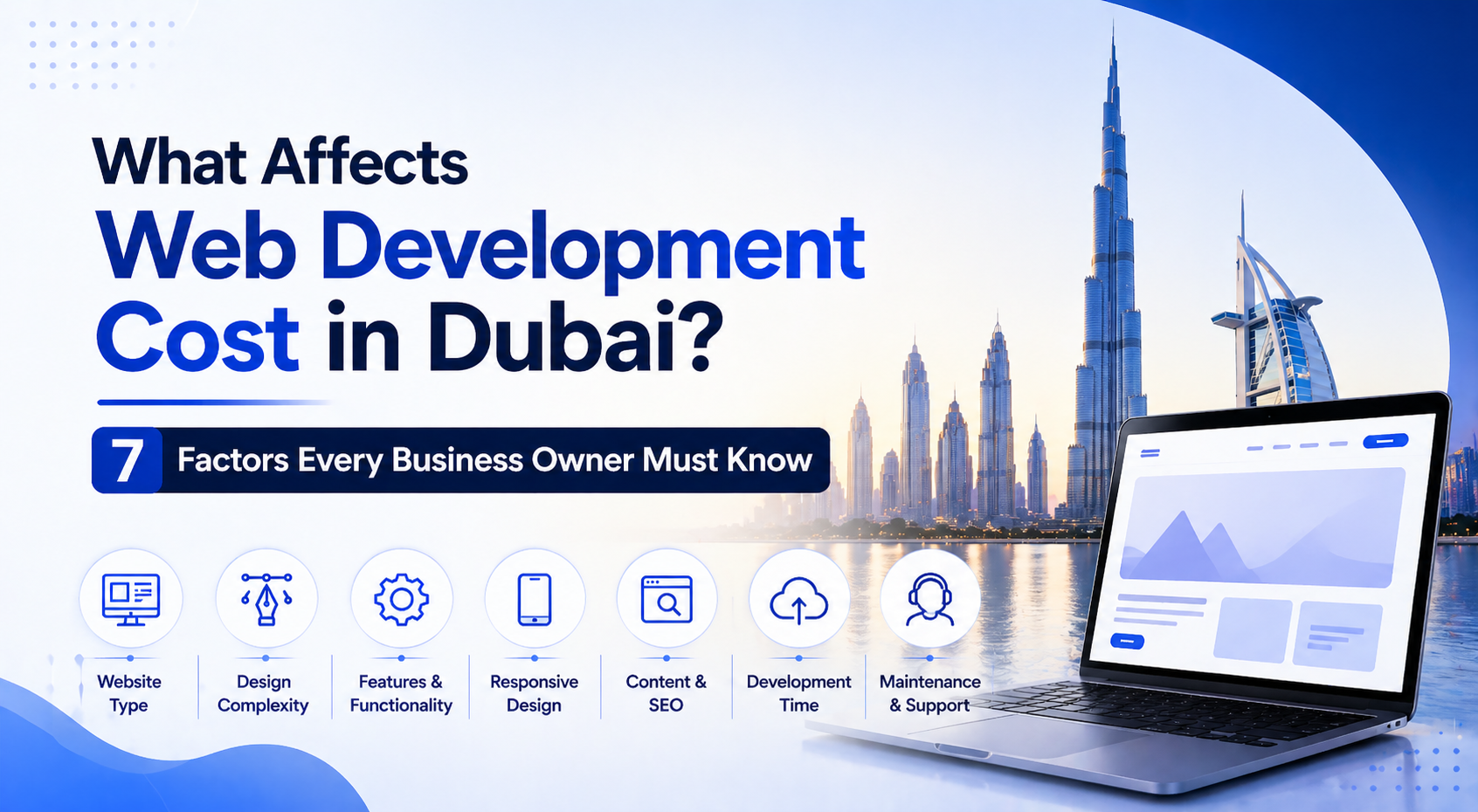
The 7 Things That Actually Drive Web Development Cost in Dubai
1. Size and Complexity
This is the big one. More than anything else, what your website needs to do determines what it will cost.
A five-page brochure site for a consultancy is a fundamentally different project to a 200-product ecommerce store. One might take three weeks. The other might take four months, involve multiple developers, and require integration with a payment gateway, an inventory system, and a CRM.
Here's a rough picture of where different types of sites tend to land:
The clearer your brief, the more accurate your quotes will be. Vague briefs produce wildly different interpretations, which is exactly why you end up with those three very different numbers.
2. Custom Design vs. Template Design
This single decision can shift your quote by AED 8,000 to 20,000. And yet most business owners don't know to ask about it upfront.
Template design starts with a pre-built layout. A developer customises the colours, fonts, logo, and content to fit your brand. Done well, a template site looks completely professional; most visitors will never know the difference. For a lot of Dubai SMEs, it's the right call.
Custom design starts with a blank canvas. A designer builds original wireframes, creates a unique visual language, and crafts every screen specifically for your brand and users. It takes more time, requires a more skilled team, and costs more. But for businesses where brand differentiation genuinely matters, such as luxury, hospitality, and high-end retail, it can absolutely be worth it.
The honest question to ask yourself: does your business actually need a fully custom design, or does it need a well-executed template? Many businesses pay for custom design when a great template would serve them just as well.
3. Platform Choice
The platform your site is built on affects both what you pay now and what you'll pay for the next five years.
WordPress is the most common choice for business websites in Dubai. It's flexible, plays nicely with SEO, and there's a deep pool of local developers who know it well. It's usually a safe, sensible default for most SMEs.
Shopify is the dominant choice for ecommerce. It's easier to manage day-to-day, but it comes with monthly subscription costs (roughly AED 110–440/month) and transaction fees if you're using third-party payment gateways, which most UAE businesses are.
Custom-coded platforms built on React, Node.js, Laravel, or similar technologies offer maximum control and flexibility. They're also the most expensive to build and the most expensive to maintain. Unless you have genuinely complex, unique requirements, the extra cost is rarely justified.
Wix and Squarespace are cheap entry points, but they hit real ceilings when it comes to SEO and scalability. Fine for a pre-revenue startup. Not fine for a growing business that wants to be found on Google.nd Squarespac
4. Integrations and Add-On Features
Every integration, every connection your website makes to another system, takes development time to build and test. Those hours add up.
Here are the most common add-ons Dubai businesses ask for, and what they typically cost:
A practical tip: separate what you genuinely need at launch from what you think you might want. Features deferred to phase two save you money upfront, and more often than not, you'll have real user feedback by then to tell you whether you actually need them.
5. Content Creation
This is where a lot of businesses get caught off-guard.
When an agency quotes you for a website, they are quoting for design and development. The words, images, and videos that fill the site? That's usually on you.
If you don't have professional content ready to go, you'll need to budget separately:
- Copywriting: AED 300–800 per page. For a 10-page site, that's AED 3,000–8,000.
- Photography: AED 1,500–6,000 for a professional shoot covering headshots, office, and product imagery.
- Video: AED 5,000–20,000+ for a brand video, depending on production complexity.
- Arabic translation: AED 0.15–0.30 per word for professional translation — roughly AED 1,500–4,000 for a 10-page site.
Don't skip this. A beautifully designed website carrying blurry stock photos and generic placeholder text will not convert. The content is at least half the job.
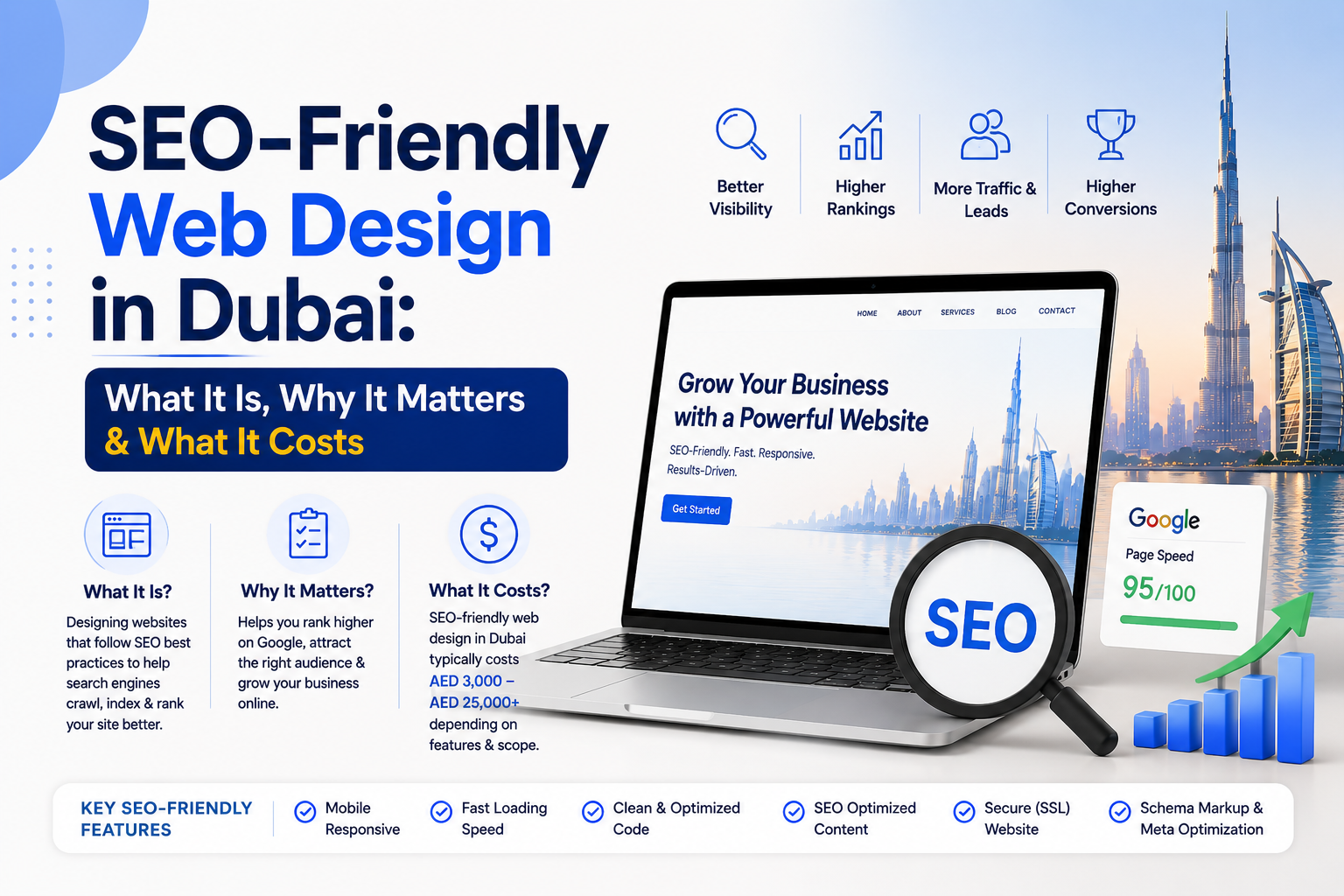
6. SEO Setup
A website no one can find is a very expensive brochure.
Good on-page SEO, properly optimised page titles, clean URL structure, meta descriptions, internal linking, and page speed should be baked into every professional web project. Many budget agencies leave it out entirely, which means you end up paying twice: once for the build, and again to fix the SEO later.
Rough cost benchmarks:
- Basic on-page SEO setup: AED 2,000–5,000 (one-time)
- Technical SEO audit and fixes: AED 3,000–8,000 (one-time)
- Ongoing SEO retainer: AED 2,000–8,000/month
Ask every agency the same direct question: what SEO work is included in this quote? A vague answer tells you a lot.
7. Who's Building It
The same brief sent to a freelancer, a boutique agency, and a large agency will come back with three very different numbers, even if the quality of the output is comparable.
Freelancers have low overhead, which means lower prices (typically AED 2,000–15,000). The trade-off is capacity and accountability. A solo developer juggling several projects at once may not give yours the attention it needs, and if something goes wrong post-launch, there's one person responsible for fixing it.
Small agencies (5–20 people) tend to be the sweet spot for most Dubai SMEs. You get a proper team, designer, developer, and project manager, without the inflated overhead of a large agency. Typical range: AED 8,000–40,000.
Large agencies bring senior talent and proven processes, but their pricing reflects their overheads, the office on Sheikh Zayed Road, the large account teams, and the brand reputation. Expect AED 30,000–200,000+ for large agency projects.
None of these is universally better. The right choice depends on your budget, the complexity of your project, and how much you value ongoing post-launch support.
How to Actually Evaluate the Quotes You Receive
When three quotes land in your inbox, don't compare the totals. Compare the scope. Use these seven questions as your framework:
- How many pages and features are included, and is the scope clearly written out?
- Is this a template or a custom design, and does that distinction match what my business actually needs?
- What platform is being used, and what are the ongoing costs (hosting, licences, maintenance)?
- Which integrations are included, and which are quoted as extras?
- Is content creation included, or am I expected to provide everything?
- What SEO work is specifically included in this quote?
- Who will actually build this, and what does post-launch support cover?
A quote that answers all seven clearly is one you can evaluate fairly. A quote that's vague on any of them is likely to produce surprises, almost always expensive ones, once the project starts.
Common Questions Worth Answering Directly
Why are the quotes so different if I sent the same brief?
Because agencies interpret vague briefs differently, use different platforms, and include different amounts of post-launch support. Always push for a detailed scope of work, not just a number.
Does a higher price mean better quality?
Not necessarily. Price reflects overhead as much as skill. A small agency with low costs can genuinely outperform a large agency charging three times as much. Judge quality through portfolio work and client references, not the invoice.
How do I bring the cost down without cutting corners?
Start with fewer pages. Use a template rather than a custom design. Provide your own content. Defer features you don't need on day one. Come to the brief with clarity; every hour you save an agency from clarifying requirements is an hour they don't bill you for.
Is hosting usually included in the quote?
Rarely. Budget AED 500–3,000/year separately, depending on traffic and server requirements. Always ask about this upfront.
What are the most common hidden costs?
Content and post-launch changes. Most quotes assume you'll provide ready-to-use content, and most clients don't realise this until the project is already underway. Additional revision rounds beyond what's agreed are also typically billed separately.
The Bottom Line
Web development pricing in Dubai isn't arbitrary. Every number in a quote reflects real decisions about design approach, platform, features, content, SEO, and the team doing the work.
The most expensive website isn't always the best one. The cheapest is rarely the best value. The right website is the one built around what your business genuinely needs, and understanding how pricing works is the first step to making that call with confidence.