 Sign up with Google
 Sign in with Zoho

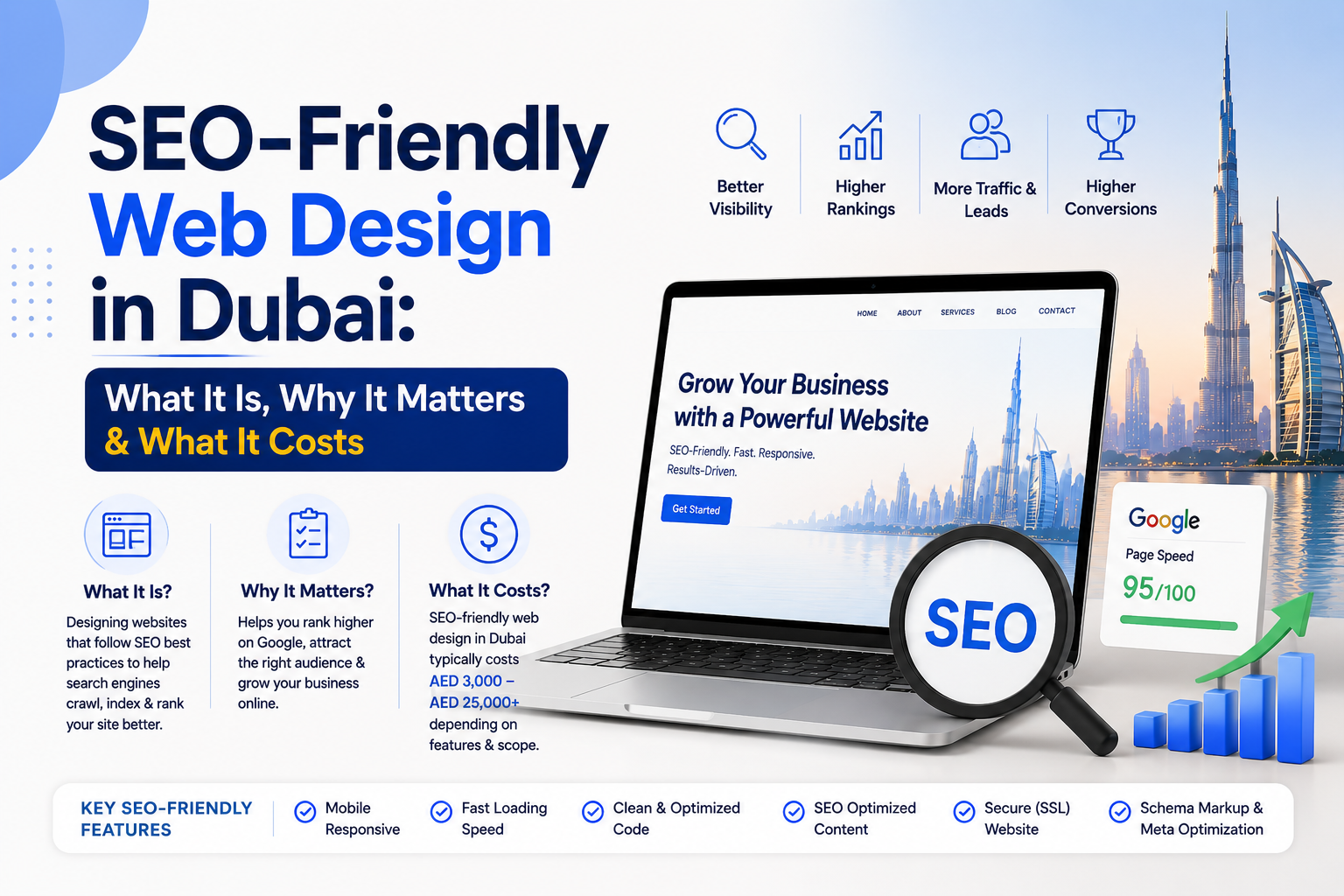
Most Dubai businesses think about SEO and web design as two separate things. The website gets built first. Then, a few months later, someone suggests adding SEO. A plugin gets installed. A few page titles get updated. And the business wonders why it is still not ranking on Google.
This is the wrong approach — and it is expensive to fix after the fact.
SEO-friendly web design means building a website where search engine optimisation is not an afterthought bolted on at the end. It is an architectural decision made from the very first line of code. The structure, the speed, the content framework, the technical setup — all of it designed with Google in mind from day one.
This guide explains what SEO-friendly web design actually involves in the Dubai market, how it affects your web design cost in Dubai, and why getting it right from the start saves you significantly more than it costs.
Why SEO and Web Design Cannot Be Separated
Google does not rank websites based on how they look. It ranks them based on how they perform — technically, structurally, and in terms of content relevance. Many of the factors that determine your Google rankings are decided during the web design and development process, not after it.
Here is what Google evaluates that is directly determined by how your website is built:
- Page speed — a slow website ranks lower, regardless of content quality
- Mobile performance — Google uses mobile-first indexing for all websites
- URL structure — clean, logical URLs that reflect your site hierarchy
- Heading structure — proper use of H1, H2, and H3 tags
- Internal linking — how pages within your website connect to each other
- Schema markup — structured data that helps Google understand your content
- Core Web Vitals — Google's specific performance metrics that directly affect rankings
- Crawlability — whether Google can access and index all your important pages
- HTTPS security — an unsecured website is penalised in rankings
Every one of these factors is set during development. Retrofitting them onto a poorly built website after launch is technically possible — but it costs significantly more than building them in from the start.
What SEO-Friendly Web Design Includes in Practice
1. Site Architecture and URL Structure
A well-structured website is easy for both users and Google to navigate. Pages are organised logically — service pages under a services section, blog posts under a blog, location pages properly nested. URLs are clean and descriptive: /web-design-dubai/ not /page?id=247.
For Dubai businesses targeting multiple areas or services, a clear site architecture that gives each service and location its own properly optimised page is foundational to local SEO success.
2. Core Web Vitals Optimisation
Google's Core Web Vitals are three specific performance metrics that directly affect search rankings:
- LCP (Largest Contentful Paint) — how fast the main content of a page loads. Target: under 2.5 seconds
- FID (First Input Delay) — how quickly the page responds to a user's first interaction. Target: under 100ms
- CLS (Cumulative Layout Shift) — how stable the page layout is as it loads. Target: under 0.1
A website built without performance as a priority will almost certainly fail one or more of these metrics — and rank accordingly. Optimising for Core Web Vitals is a development-level task, not something a plugin can fully solve.
3. Schema Markup Implementation
Schema markup is structured data added to a website's code that helps Google understand what the content means — not just what it says. For a Dubai business, schema markup can tell Google that a page is about a local business (with address, phone, opening hours), a specific service, a product, an FAQ, or a review.
Properly implemented schema markup increases the likelihood of your website appearing in rich results — the enhanced Google listings that show star ratings, FAQs, prices, and other information directly in search results. This significantly improves click-through rates without changing your actual ranking position.
4. Technical SEO Foundation
An SEO-friendly website is built with a clean technical foundation:
- XML sitemap generated and submitted to Google Search Console
- Robots.txt file configured correctly so Google crawls the right pages
- Canonical tags implemented to prevent duplicate content issues
- 301 redirects set up for any changed or removed URLs
- Image alt text built into the CMS workflow
- Open Graph tags for social media sharing
- Page titles and meta descriptions templated correctly across all page types
5. Mobile-First and Speed Optimisation
Since Google ranks the mobile version of your website, mobile performance is an SEO factor — not just a user experience consideration. Image compression, lazy loading, minified CSS and JavaScript, browser caching, and CDN implementation all contribute to the mobile speed scores that affect your rankings.
6. Content Structure and Keyword Architecture
An SEO-friendly website is built around a keyword strategy — not random page titles. Before a single page is designed, keyword research identifies what Dubai users are actually searching for, and the website's page structure is built to target those terms systematically.
For a web design agency in Dubai, this means having dedicated pages for "web design Dubai," "ecommerce website development Dubai," "WordPress development Dubai" — each optimised for its specific keyword — rather than one generic "services" page that tries to rank for everything and succeeds at nothing.
How SEO-Friendly Design Affects Web Design Cost in Dubai
Building SEO properly into a website adds cost — but it is far less than most businesses expect, and significantly less than retrofitting it later.
Building SEO into your website from the start costs roughly half what fixing a poorly built website costs later — and the results come faster because you are not recovering from a damaged foundation.
For a full understanding of how SEO setup fits within overall Website Development cost in Dubai, this guide on Web Design cost in Dubai gives you a complete pricing breakdown across every website type.
Common SEO Web Design Mistakes Dubai Agencies Make
Building on slow hosting. No amount of on-page SEO overcomes a website hosted on a slow shared server. Many budget web design packages in Dubai include cheap hosting that fails Core Web Vitals benchmarks from day one.
JavaScript-heavy builds that Google cannot crawl. Some modern web frameworks render content using JavaScript in a way that Google struggles to index. A visually impressive website built this way can be effectively invisible to search engines.
No internal linking strategy. Internal links distribute authority across a website and help Google understand which pages are most important. Many Dubai websites have pages that are effectively orphaned — no links pointing to them from other pages, which means Google rarely finds or ranks them.
Generic page titles and meta descriptions. "Home | Company Name" is not an SEO page title. Every page on a website should have a unique, keyword-informed title that tells both Google and the user exactly what the page is about.
Images without alt text. Image alt text is an SEO signal and an accessibility requirement. A website with hundreds of images and no alt text is missing a significant optimisation opportunity — and failing basic accessibility standards.
Duplicate content across pages. Many Dubai business websites have nearly identical service pages for different locations — same content, different city name swapped in. Google identifies this as thin or duplicate content and typically ranks all versions poorly as a result.
SEO-Friendly Web Design vs Ongoing SEO: Understanding the Difference
SEO-friendly web design sets the foundation. Ongoing SEO builds on it.
SEO-friendly web design (one-time, during development):
- Technical setup, site architecture, schema markup, Core Web Vitals
- Keyword-informed page structure and URL planning
- Initial content optimisation for key pages
Ongoing SEO (monthly, after launch):
- New content creation targeting additional keywords
- Link building to increase domain authority
- Technical monitoring and fixes as issues arise
- Ranking tracking and strategy adjustment
- Local SEO management (Google Business Profile, citations)
A website built with proper SEO foundations reaches its ranking potential faster when ongoing SEO work begins. A poorly built website requires the ongoing SEO budget to fix technical problems before it can even start building rankings — wasting months of investment.
What to Ask Your Dubai Web Design Agency About SEO
Before signing with any agency, ask these specific questions:
- Do you conduct keyword research before building the site structure?
- How do you optimise for Core Web Vitals — specifically LCP, FID, and CLS?
- Do you implement schema markup, and which types?
- How do you handle the XML sitemap and robots.txt configuration?
- What hosting do you recommend, and where are the servers located?
- How do you structure URLs for a business targeting multiple Dubai locations?
- Do you set up Google Search Console and Analytics before launch?
An agency that answers these questions fluently and specifically has built SEO into its process. One that gives vague answers or suggests "we add SEO at the end" is treating it as an afterthought — which it cannot be.
FAQs
Q1. What is the difference between SEO-friendly web design and regular web design? Regular web design focuses on how a website looks and functions for users. SEO-friendly web design adds a layer of technical and structural decisions — URL architecture, schema markup, Core Web Vitals optimisation, keyword-informed content structure — that make the website perform well in Google search results, not just for human visitors.
Q2. How much does SEO-friendly web design add to the cost in Dubai? Expect to pay AED 8,500–20,000 more for a website built with proper SEO foundations compared to a standard build. This is significantly less than retrofitting SEO onto a poorly built website later, which typically costs AED 18,000–49,000 and takes longer to produce results.
Q3. Can I add SEO to my existing website instead of rebuilding it? Yes, if the existing website has a solid technical foundation. A professional SEO audit (AED 2,000–6,000) will tell you what can be improved on your current site and what would require a rebuild. Some websites can be significantly improved without a full rebuild. Others have fundamental structural issues that make a rebuild the more cost-effective path.
Q4. How long does it take to see SEO results from a new website in Dubai? Typically 3–6 months for initial traction, 6–12 months for meaningful rankings on competitive keywords. A website built with proper SEO foundations reaches these milestones faster than one built without them, because it is not spending the first few months overcoming technical deficiencies.
Q5. Does every Dubai business need SEO-friendly web design? Yes — even if you do not currently plan to invest in ongoing SEO. A website built with proper foundations costs no more to maintain, ranks better by default, and is ready to leverage SEO investment whenever you choose to make it. There is no good reason to build a website that is not SEO-friendly.
Q6. What is the single most important SEO factor in web design? Page speed — specifically mobile page speed. Google uses mobile-first indexing and Core Web Vitals as direct ranking factors. A fast, mobile-optimised website has an immediate and significant advantage over a slow one, regardless of content quality or backlink profile.
Final Word
SEO-friendly web design in Dubai is not a premium option or a technical luxury. It is the correct way to build a website that does its job — being found by the people who are searching for what your business offers.
The Web Design Price in Dubai for an SEO-built website is higher upfront. But it is the only investment in web design that pays back through organic traffic, consistent leads, and long-term Google visibility — without ongoing ad spend to compensate for poor discoverability.
Build it right from the start. The foundation determines everything that follows.