 Sign up with Google
 Sign in with Zoho

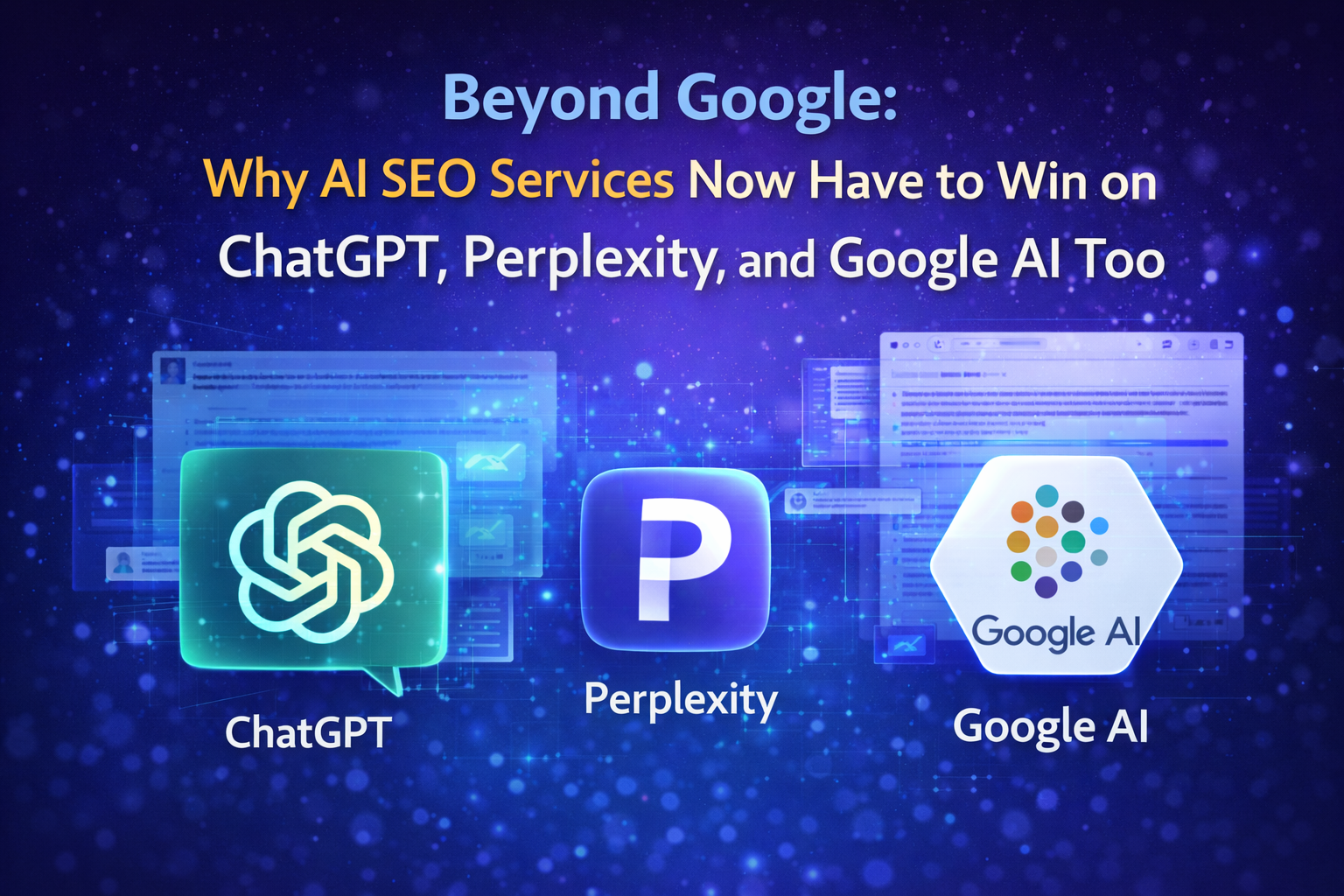
For the better part of two decades, SEO had one address: Google. Rank on page one, capture the clicks, and grow the traffic. The entire discipline, the keyword research, the link building, and the technical audits, was built around a single platform's algorithm. That clarity made life simple, if not always easy.
In 2026, that clarity is gone. And businesses that haven't noticed yet are quietly losing ground to competitors who have.
Search is no longer a single destination. It's a fragmented landscape of AI-powered platforms, each with its own logic, its own source preferences, and its own version of what makes a brand worth mentioning. Winning visibility today means showing up not just in Google's results but also inside the answers generated by ChatGPT, Perplexity, and Google's own AI features, three platforms that collectively shape how hundreds of millions of people research, compare, and make decisions every single week.
This is the new frontier for AI SEO services. And the businesses that understand it early will have an edge that compounds for years.
The Split That Changes Everything
Here is the stat that should reframe how you think about search in 2026: according to a research conducted by Eight Oh Two, 37% of users now begin their search journeys on an AI tool, ChatGPT, Perplexity, or Gemini, instead of Google. That is more than one in three searches starting outside the platform your entire SEO strategy was likely built around.
Google isn't disappearing. It still commands roughly 90% of global search volume and sends 345 times more traffic than ChatGPT, Perplexity, and Gemini combined. But the nature of search is changing fast. People are asking AI systems for recommendations, comparisons, and definitive answers, and those systems are synthesising responses from a curated set of sources. If your brand isn't in those sources, you simply don't exist in that moment of discovery.
That's the new visibility problem. And it requires a fundamentally different approach to solve.
Three Platforms, Three Completely Different Rules
The most important insight in modern AI SEO is also the most underappreciated one: ChatGPT, Perplexity, and Google AI do not work the same way. Treating them as a single channel is like running the same ad on LinkedIn and TikTok and expecting identical results.
Analysis of 680 million citations across these three platforms reveals that only 11% of domains are cited by both ChatGPT and Perplexity. These are, for most practical purposes, different ecosystems, and they reward different things.
1. ChatGPT SEO is fundamentally about brand authority in the broader information environment, not your website. ChatGPT's base model draws from training data rather than live web crawls for many queries. The sources it cites most frequently are encyclopedic, consensus-driven content; Wikipedia accounts for nearly 48% of its top citations. What that means practically is that getting your brand mentioned credibly across third-party publications, review platforms, industry directories, and authoritative sources carries far more weight than updating your own website. ChatGPT is reading the web's opinion of you, not just your self-description. Structured content, FAQ sections, and clear factual claims help when ChatGPT does browse the live web, but the deeper lever is building a brand that the broader information ecosystem recognizes as legitimate.
2. Perplexity AI SEO operates on an entirely different logic. Perplexity searches the live web in real time for every single query and cites its sources explicitly in 97% of responses, according to analysis by Otterly. This makes it the AI platform most similar to traditional search in terms of how it can drive referral traffic. The catch is what it surfaces: 46.7% of Perplexity's top citations come from Reddit. Not brand websites. Not industry blogs. Reddit, the platform where real people have real conversations about real problems. Perplexity is built to surface authentic, community-generated content over polished marketing copy. For brands, that means fostering genuine presence in online communities, encouraging real customer discussions, and creating content that earns mentions in the places where users actually exchange opinions. Fresh, regularly updated content also matters disproportionately here, Perplexity's live retrieval means stale pages lose ground quickly.
3. Google AI SEO services sit closest to traditional SEO because Google's AI overviews draw from the same index it has spent decades building. Pages that already rank well organically have a 76.1% overlap with AI Overview citations. But there's an additional layer; structured data has become non-negotiable. FAQ schema, article schema, HowTo schema, organization schema: these aren't optional enhancements anymore. They're the machine-readable signals that tell Google's AI what your content is, who wrote it, and why it's trustworthy enough to surface in a synthesised answer. Ignore them, and Google's AI will deprioritize your content regardless of how well it ranks. YouTube and multimodal content also carry increasing weight in Google AI Overviews, reflecting where the platform is headed: text, video, and structured data are treated as a unified authority signal.
What This Means for How You Approach AI SEO
The temptation when facing this complexity is to pick one platform and focus there. Resist it. The businesses building durable visibility in 2026 are approaching AI SEO services with a unified but differentiated strategy, one set of strong fundamentals that serves all three platforms, layered with platform-specific optimization where it matters most.
The shared fundamentals look like this: content that answers specific questions directly and completely, clear authorship with genuine credentials, structured data implemented properly across the site, regular content updates that signal relevance and recency, and a technical foundation clean enough for AI crawlers to access and parse. These are not new concepts. They are the SEO basics that have always mattered, now elevated to table stakes in a world where AI systems are the gatekeepers.
On top of that foundation, the differentiation begins. For ChatGPT SEO visibility, the priority is expanding your brand's presence beyond your own domain, earning mentions in trusted publications, building up review profiles, and generating discussion in places AI systems treat as consensus signals. For Perplexity AI SEO, the focus shifts to community presence, content freshness, and creating the kind of specific, verifiable content that a research-oriented user would find worth citing. For Google AI SEO services, the work looks most like traditional SEO, but with a structured data layer and an eye toward being the most clearly organized, directly answering the source in your category.
The Measurement Problem Nobody's Talking About
Here's a blind spot that most businesses haven't addressed: traditional SEO tools don't measure any of this. Semrush, Ahrefs, and Google Search Console were built to track rankings and organic clicks. They have no visibility into whether your brand appears in ChatGPT's responses, how often Perplexity cites your content, or what Google's AI summaries say about you.
This matters because visibility and traffic are no longer the same metric. A brand cited in a ChatGPT response that influences a purchasing decision may never generate a tracked click, but it still shaped the outcome. The businesses winning in AI search are tracking citation frequency across platforms, monitoring brand sentiment in AI-generated answers, and building attribution frameworks that account for the full discovery journey, not just the final click.
If your reporting hasn't evolved to capture these signals, your investment in AI search is flying blind.
The Window Is Still Open, But Not for Long
The honest truth about AI search optimization in 2026 is that most businesses haven't seriously started. The strategies are still being written, the tools are still maturing, and the competitive landscape is still open enough that early movers can establish real advantages.
That window will close. AI citation patterns are already showing signs of consolidation; platforms tend to re-cite sources they've previously cited, creating a self-reinforcing advantage for the brands that get there first. The businesses investing in serious AI SEO services now aren't just chasing a trend. They're building a position that gets harder to dislodge with every passing month.
The search landscape beyond Google isn't coming. It's already here. The question is simply whether your brand shows up in it.
A practical starting point: run your ten most important business queries through ChatGPT, Perplexity, and Google AI this week in incognito mode, fresh sessions. Note what comes back. Does your brand appear? What do competitors look like? What sources are being cited that you're not in? That manual audit costs nothing and will tell you more about your AI visibility gaps than any report. From there, the work is building toward citation-worthiness on each platform, not gaming algorithms, but genuinely becoming the kind of source that intelligent systems reach for when they need a trustworthy answer.
That is what modern AI SEO are really about. Not rankings. Not clicks. Authority built deliberately, across every platform where your customers are now searching.



.jpg)