Sign up with Google
 Sign in with Zoho

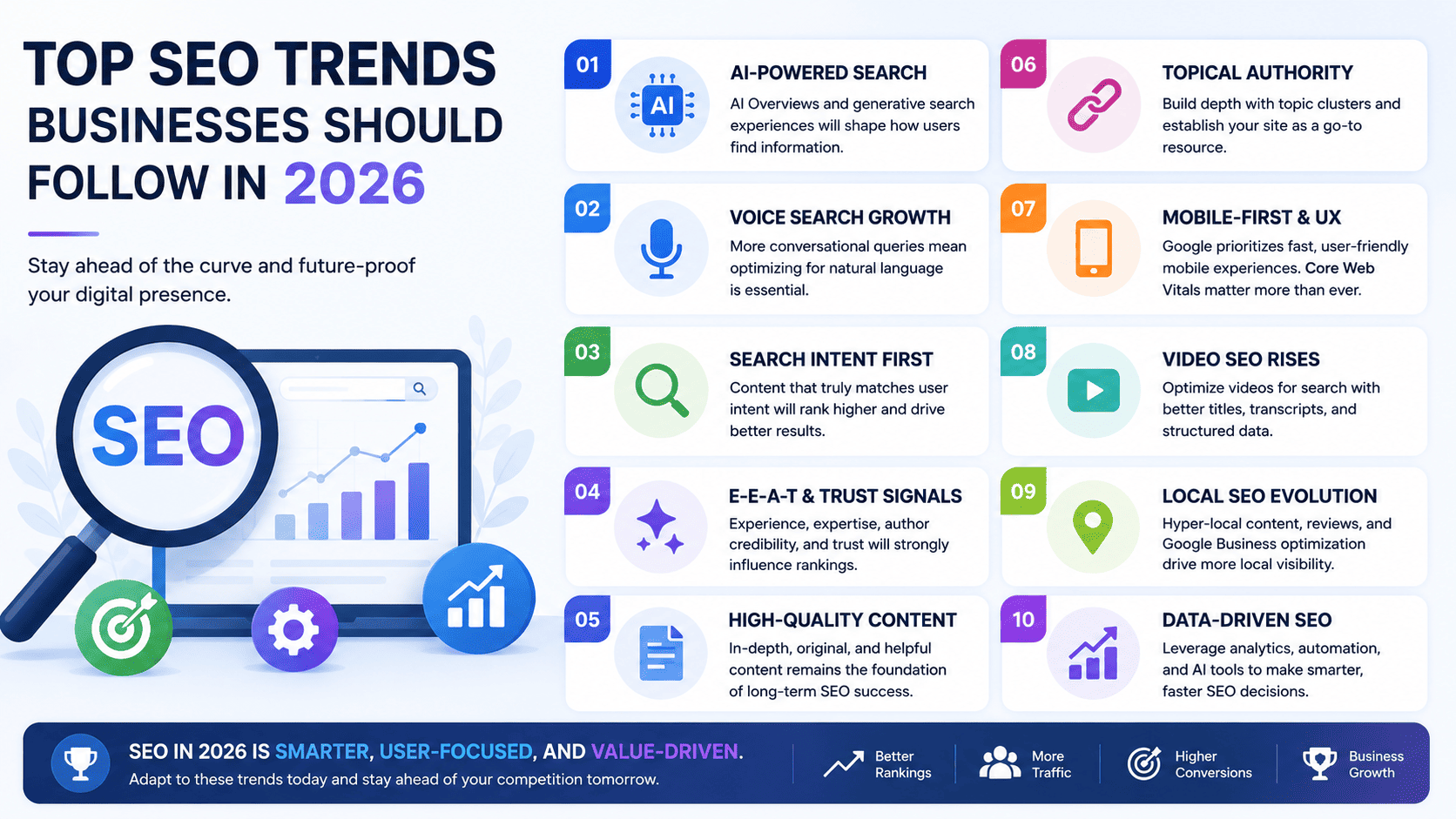
Top SEO Trends Businesses Should Follow in 2026
Let’s be honest—SEO is changing faster than most of us can keep up with. What worked two or three years ago? Yeah, that’s probably not enough anymore. Google keeps getting smarter, people are becoming pickier about what they click on, and competition? It’s fierce in almost every industry you can think of.
So here’s the reality for 2026: if you want to rank consistently, you need to stop looking for shortcuts. Instead, focus on building something actually useful—a website people trust and enjoy using. SEO today isn’t just about stuffing keywords into a blog post. It’s about understanding why someone searched in the first place, giving them a great experience, publishing real content, and staying on top of how search engines keep changing.
The businesses that adapt early? They’re the ones who’ll see steady organic traffic and long-term visibility.
Let’s walk through the most important SEO trends you should be paying attention to right now.
AI Has Changed How Search Engines Rank Content
Artificial Intelligence isn’t coming—it’s already here, and it’s deep inside Google and other search engines. These systems try to figure out what users actually mean when they type something.
Instead of just matching keywords, search engines now look at:
- What the user really wants (search intent)
- How useful the content actually is
- Whether people engage with it
- The context around the search
- How trustworthy the website seems
That means those low-effort pages built just to rank for a specific phrase? They’re losing their edge. On the flip side, businesses that create original, genuinely helpful content are seeing better results—because search engines now reward value, not trickery.
Oh, and AI is also getting scarily good at spotting spam, copied content, and lazy articles. Fast.
Search Intent Beats Keyword Density Every Time
I still see websites making the same old mistake: cramming keywords into every paragraph. In 2026, that can actually hurt your rankings.
Search engines want to know why someone is searching.
For example:
- Someone types “how to improve local SEO” – they want to learn. Give them a guide.
- Someone types “SEO agency near me” – they’re probably ready to hire. Give them a way to contact you.
See the difference? When you understand the purpose behind a search, you can create content that actually satisfies people. Stop forcing keywords. Start answering questions clearly.
Helpful Content Just Works Better
Here’s a trend worth paying attention to: helpful content is winning.
Search engines reward pages that:
- Solve a real problem
- Answer questions in plain language
- Offer unique insights
- Keep people reading
Those shallow, generic articles written just to rank? They’re slowly dying.
Instead, focus on content that shows real experience. Things like:
- Step-by-step tutorials
- Honest case studies
- Industry insights you won’t find elsewhere
- Expert opinions
When someone stays on your page longer because they’re actually learning something, search engines notice. And they reward that.
Local SEO Is Getting Fierce
People are constantly searching for things nearby. “Best coffee shop near me.” “SEO company in Kolkata.” “Gym open now.” It’s just how we shop and live now.
As a result, local SEO has become super competitive.
Here’s what actually works in 2026:
- Keep your Google Business Profile updated
- Ask happy customers for reviews (and respond to them)
- Create location-specific content
- Get backlinks from local businesses or news sites
- Make sure your site works perfectly on mobile
A lot of smart business owners work with a professional digital marketing company in Kolkata to help them show up in local searches. It’s one of those investments that pays off again and again.
Mobile Optimization Isn’t Optional Anymore
Most people browse on their phones. That’s just how it is. And search engines know it.
If your website is a pain to use on mobile, you’re going to struggle with:
- Rankings
- User experience
- Bounce rate (people leaving fast)
- Sales or signups
Make sure your site loads fast, text is readable without zooming, buttons are easy to tap, and navigation makes sense. Google mainly looks at the mobile version of your site now—so if that’s broken, you have a problem.
Speed Still Matters—a Lot
Nobody waits for a slow website. If your page takes more than a couple of seconds, most visitors are gone.
And that sends a bad signal to search engines.
Slow websites usually have:
- Higher bounce rates
- Lower engagement
- Fewer conversions
You can speed things up by:
- Compressing images (huge difference)
- Switching to better hosting
- Cutting unnecessary scripts
- Using caching
Fast sites feel better to use. And search engines prefer them.
Voice Search Is Growing Quietly
More people are talking to their phones. “Hey Google, where’s the best pizza near me?” “What’s the best way to improve my website ranking?”
Voice searches are longer and more conversational than typed searches. So your content should sound more natural too.
Try adding an FAQ section with real questions people ask out loud. That helps a lot with voice search visibility.
User Experience Is Now a Ranking Signal
Here’s something that’s changed: SEO isn’t just about content and backlinks anymore. How people feel when using your site matters.
Search engines look at signals like:
- How long someone stays on your page
- Whether they leave right away (bounce rate)
- If they can navigate easily
- Accessibility
- Mobile usability
If your site is confusing or frustrating, people leave fast. That hurts your rankings. Keep things clean, simple, and easy to use.
Video Helps You Rank Better
Love it or hate it, video is everywhere. A lot of people would rather watch a two-minute video than read a long article.
Businesses are having success with:
- Quick tutorials
- Product demos
- Short educational clips
- Webinars
Adding a relevant video to a blog post can keep people on the page longer. And when engagement goes up, search engines take notice.
E-E-A-T Still Matters (Trust Is Everything)
Google talks about Experience, Expertise, Authoritativeness, and Trustworthiness. That’s not just buzzwords—it’s how they judge quality.
Websites that feel credible tend to rank better, especially for competitive topics.
How do you build trust?
- Publish accurate, well-researched content
- Show real experience (not just theory)
- Display customer reviews
- Earn backlinks from trusted sites
- Make your contact and about pages clear
Trust takes time to build, but it’s one of the strongest long-term SEO advantages.
Keep Your Content Fresh
Old articles with outdated info slowly lose rankings. That’s just how it works.
Make it a habit to go back and:
- Update blog posts with new stats
- Refresh old examples
- Improve structure and readability
Fresh content signals to Google that you’re still relevant. This is especially important in fast-moving fields like digital marketing and tech.
Backlinks: Quality Over Quantity
Backlinks are still a big deal. But having a hundred junk links won’t help you—it might even hurt.
A few strong links from trusted websites are worth more than hundreds of low-quality ones.
Focus on earning links from:
- Industry blogs that people actually read
- News websites
- Reputable publications
Those spammy link schemes? Google is better at catching them than ever. Don’t risk it.
AI Content Needs a Human Touch
AI writing tools are everywhere now. But if you just publish raw AI output, it usually feels... off. Repetitive. Generic. Sometimes just wrong.
Search engines can spot low-quality AI content.
Use AI as a helper—not a replacement. A human editor makes all the difference for:
- Readability
- Originality
- Tone
- Accuracy
The best content combines AI efficiency with real human experience.
Semantic SEO Helps You Cover Topics Better
Search engines understand relationships between words now. So instead of repeating one keyword, you’re better off naturally covering related ideas.
For example, if you’re writing about “local SEO,” you might also talk about Google Business Profile, customer reviews, and nearby searches.
That’s semantic SEO. It helps search engines understand your whole topic—and it usually leads to better rankings.
Featured Snippets = More Visibility
You know those answer boxes at the very top of Google? Those are featured snippets. They can send a lot of traffic your way.
To increase your chances of getting one:
- Use clear headings
- Answer specific questions directly
- Keep explanations short and useful
- Use bullet points or numbered steps
It’s worth the effort.
Social Media Helps SEO Indirectly
Social signals aren’t a direct ranking factor. But don’t ignore social media entirely.
When your content gets shared on social platforms, you get:
- More visibility
- More traffic
- More chances for people to link to you
Plus, content that performs well socially often gains more exposure overall. And that leads to backlinks.
Common SEO Mistakes to Avoid
I still see these mistakes everywhere:
- Keyword stuffing (just stop)
- Duplicate content
- Slow hosting
- Non-mobile-friendly design
- Thin, low-value content
- Ignoring user experience
- Buying spammy backlinks
Avoid these, and you’ll save yourself a lot of ranking headaches.
Preparing for the Future of SEO
SEO will keep evolving. AI will get smarter. User behavior will shift. That’s just how it goes.
But the businesses that do well over time focus on:
- Creating genuinely helpful content
- Improving website performance
- Understanding what customers actually want
- Building real trust
- Adapting without chasing every trend
The ones who stay consistent and prioritize people over shortcuts? They’re the ones who win.
Final Thoughts
SEO in 2026 comes down to three things: quality, trust, and user experience.
If you create content that actually helps people, make your site fast and mobile-friendly, and think about search intent instead of keywords—you’ll have a real shot at ranking well.
The future of SEO isn’t about tricking algorithms. It’s about building a website that genuinely helps people solve problems.
Brands that get that early will keep growing their organic traffic for years to come.